In This Blog:
- Defining negative symptoms versus positive symptoms
- Identifying common signs like apathy and social withdrawal
- The impact of these symptoms on daily life
- Challenges in diagnosing and treating emotional flattening
- The importance of a monitored treatment environment
Schizophrenia is a complicated mental disorder that is misunderstood by people. Although most people often know the so-called positive symptoms (hallucinations or delusions), the so-called negative Symptoms Of Schizophrenia are often ignored. These are symptoms that signify an impairment or reduction in the usual functions including the capacity to experience pleasure or sustain social relationships. These experiences are hard to observe because they are built over time so they may seem to be cases of depression or extreme exhaustion.
Knowing such signs is the initial step in locating a supervised environment in which people may get the specialized care that they require to become stable. Negative symptoms may have severe consequences on the quality of life of the individual and his or her performance in the professional or social role.
Expert Advice: A professional support environment is a necessary tool to deal with complex mental health situations.
What are Negative Symptoms?
Negative in reference to Schizophrenia is not bad but is something removed from the normal experience of the person. Such symptoms include decrease in emotional expression, speech and motivation.
These symptoms are a loss of functioning as opposed to hallucinations that are an additional experience. They tend to be the most tenacious aspect of the condition and they may persist even following the treatment of positive symptoms.
Common Types of Negative Symptoms
Negative symptoms are presented in various forms which influence the way a person socializes with his or her world. The signs include one, which is the so-called flat affect where the face of the person is expressionless and also the voice of his or her voice is monotonous.
The other important symptom is alogia where there is a loss of the quantity of the speech or the level of detail given in the conversation. These patterns can be better assessed in a monitored support system to make sure that they are not due to other health issues.
Symptom Category | Scientific Name | Characteristics |
Emotional | Affective Flattening | Reduced facial expression and monotonous voice |
Motivational | Avolition | Lack of initiative to start or finish tasks |
Social | Asociality | Withdrawal from social interactions and relationships |
Verbal | Alogia | Poverty of speech or limited conversational content |
Transitioning to Supervised Support
Within a monitored environment, one can get an evaluation that examines the entire spectrum of his experiences. It is this environment that offers the protection required to handle these internal deficits under the unremitting professional monitors.
FACT: The symptoms of the negative type tend to manifest themselves prior to the emergence of the first psychotic episode.
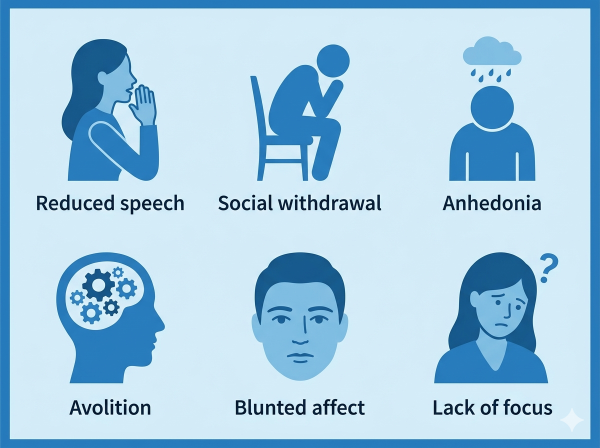
The Impact of Apathy and Avolition
Avolition is an excessive deficiency of motivation that causes people to find it hard to perform some of the simple daily tasks. This may involve the abandonment of personal hygiene or resultant non-completion of work or school assignments.
Apathy may cause a feeling of complete malice to the future or own goals. Professional recovery services are aimed at assisting one to seek small and manageable methods of re-entering the daily activity.
Social Withdrawal and Anhedonia
Anhedonia is a condition of being unable to derive pleasure as a result of activities previously enjoyed. This may result in extreme social isolation, since the individual will not see any reason to be with his or her friends and family.
These Schizophrenia symptoms are usually very stressful in personal relationships, since the person may be perceived by their loved ones as pushing him/her away. A treatment setting provides an environment in which these social skills can be exercised without being judged.
Contact DeLand Treatment Solutions (386) 866-8689 to receive compassionate help today.
Start your recovery journey today with compassionate care at DeLand Treatment Solutions.
Challenges in Diagnosis
Negative symptoms are infamously hard to diagnose, as they can be confused with other disorders such as clinical depression. In other cases, emotional flatness may be presented as side effects of some medications.
There must be professional monitoring to make a distinction between the primary symptoms of the disorder and secondary effects, which are caused by the environment or treatment. This allows the person to be provided with the best and correct care plan.
Treatment Approaches for Negative Symptoms
Negative symptoms often need a mixture of both specialized interventions and assistance to be treated. Social skills training is used to train people on how to cope with interpersonal interaction in a better way.
Therapy Type | Focus Area | Goal |
Negative thought patterns | Improving motivation and self-esteem | |
Social Skills Training | Interpersonal communication | Reducing social isolation and withdrawal |
Vocational Rehab | Employment skills | Reintegrating into the workforce |
The Role of a Treatment Environment
The environment to be used would be monitored and this would give the structure to carry out these therapies systematically. This cooperative strategy assists people in developing emotional and social mechanisms that they need to lead a more satisfying life.

The Importance of Professional Oversight
Due to the persistence of negative symptoms, long-term professional supervision is the only key to health maintenance. Periodic visits with a team of caregivers are used to evaluate the progress and modify the wellness plan accordingly.
The combination of recovery services provides a guarantee that the psychological level is taken care of alongside the social level. By the help of the appropriate support, people will be able to become more stable and enhance their overall functioning.
Get serious assistance from DeLand Treatment Solutions at (386) 866-8689 to begin your trip.
Moving Toward Emotional Wellness
One of the crucial steps of the recovery process is dealing with the negative symptoms of Schizophrenia. The support that they get in a treatment setting is what many find to be able to help them gradually reconnect to their feelings as well as their community.
It is all about long-term stability by evidence-based care and patient support. The direction towards a more active and steady life is possible through professional control and a set strategy.
Medical Disclaimer: This article is for informational purposes only and is not a substitute for professional medical advice.
Take control of your life now choose DeLand Treatment Solutions for trusted addiction recovery support today.
Key Takeaways
- Negative symptoms involve a loss of normal functions like emotional expression or motivation.
- These signs are often more persistent than positive symptoms like hallucinations.
- Social withdrawal and anhedonia can significantly impact a person’s relationships.
- Professional oversight is necessary to distinguish these symptoms from depression.
- Structured recovery services offer the social skills training needed for improved functioning.
FAQs
Why are these called “negative” symptoms?
In clinical terms, “negative” refers to a deficit or the absence of a normal behavior. For example, a “flat affect” means a person has lost the ability to show a wide range of facial expressions. This is different from “positive” symptoms, which are experiences added to a person’s reality.
Can these symptoms be treated with medication?
While antipsychotic medications are highly effective for positive symptoms, they are often less effective for negative ones. Treatment usually involves a combination of therapy, social support, and lifestyle changes within a treatment environment. Professional oversight is key to finding the right balance for each person.
How do I support a loved one with apathy?
It is important to remember that apathy is a symptom of the condition, not a sign of laziness. Encouraging small, low-pressure activities can help them stay engaged without feeling overwhelmed. Suggesting a monitored setting for an assessment can also provide them with professional resources for motivation.
Does everyone with schizophrenia have negative symptoms?
Most people with the condition experience some degree of negative symptoms, though the severity varies widely. Some may only experience them during certain phases of the illness, while for others, they are constant. Recovery services help tailor support to the specific intensity of these symptoms.
Is social withdrawal permanent?
Social withdrawal can be managed with professional help and consistent social skills training. While it may take time, individuals can learn new ways to connect with others in a safe environment. Long-term stability involves finding a social balance that feels comfortable and sustainable for the individual.