In This Blog
- Defining Social Anxiety: More Than Just Shyness
- Common Emotional and Behavioral Symptoms
- The Physical Toll: How the Body Reacts to Social Fear
- Avoidance Behaviors and Their Impact on Daily Life
- The Science of the “Anxiety Loop”
- Why Professional Oversight is Essential for Diagnosis
- Treatment Modalities within a Structured Environment
- Steps Toward Social Confidence and Healing
It is normal to get slightly nervous when presenting in front of a huge audience or on a first date. Nevertheless, it is not a fleeting bypass experience as it happens to people with Social Anxiety Disorder (SAD), this nervousness is a persistent and intense axon of experiencing being judged, rejected, or scrutinized by others. The question of what you need to know starts with the fact that social anxiety is a medical condition that is not a personality or a choice but a legitimate medical issue.
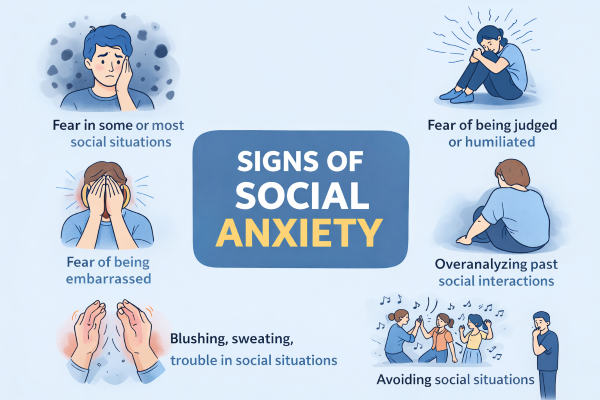
Social anxiety is more than quietness or introversion. It consists of excessive preoccupation with social performance, which may render even the most prosaic tasks such as eating in shops, maintaining eye contact, or visiting a shared restroom, as impassable. This disorder may result in severe isolation, depression, and a marked reduction of quality of life when it is not treated. The initial step in regaining your liberty is to know the signs.
Since social anxiety has a brain chemistry basis, as well as a thought pattern basis, it may need more than self-help to overcome.
Expert Advice: Gradually tapering doses reduces withdrawal severity and prevents sudden depressive episodes.
Defining Social Anxiety: More Than Just Shyness
While shyness is a personality trait that often fades as a person becomes comfortable, social anxiety is a persistent fear that often worsens without intervention. According to the National Institute of Mental Health (NIMH), people with social anxiety experience an intense, persistent fear of being watched and judged by others.
This fear is often irrational; the individual may know that their anxiety is excessive but feel powerless to stop it. This creates a “secondary anxiety” where the person becomes anxious about appearing anxious, leading to a cycle of self-consciousness that can paralyze social interaction. Without supervised support, this cycle often results in the individual narrowing their world to avoid any possibility of social discomfort.
100% Confidential Support is Available 24/7
No matter what you’re going through, you’re not alone. Our dedicated team is here to provide a safe, judgment-free space where you can talk openly and honestly. Whether you need emotional support, resources, or just someone to listen.
We’re here for you—completely confidential and always respectful of your privacy. Call us today!
The Physical Toll: How the Body Reacts
Social anxiety is not just “in your head.” The brain’s amygdala, the center for the “fight or flight” response, becomes hyper-reactive in social situations. This triggers a cascade of physical symptoms that can be as distressing as the fear itself.
Common Physical Symptoms include:
- Blushing, sweating, or trembling: Often accompanied by a fear that others will notice these signs.
- Rapid heart rate: Feeling like the heart is racing or skipping beats.
- Nausea or stomach upset: A “pit” in the stomach before or during social events.
- Rigid body posture: Difficulty moving naturally or maintaining a relaxed stance.
- Soft voice: Difficulty speaking up or being heard in a group.
FACT: Misuse of amphetamines may cause sudden death and serious cardiovascular reactions
Contact DeLand Treatment Solutions for professional oversight to address these physical responses
Deland Treatment Solutions
Battling with Drug and Alcohol Addition? Remember, you are not alone and we are here to help you!
Comparison of Social Anxiety Contexts
Social anxiety can manifest in specific situations (performance-only) or across all social interactions. This table helps distinguish where the fear primarily resides.
Situation Category | Examples of Triggers | Internal Experience |
Public speaking, playing an instrument, or sports. | Fear of failing or looking “stupid” in front of a crowd. | |
Small talk, meeting new people, or dating. | Fear of having nothing to say or being boring. | |
Eating in public, walking into a room, using public toilets. | Fear of being “watched” or scrutinized in mundane tasks. | |
Returning an item to a store, disagreeing with a peer. | Fear of conflict or being “unlikeable.” |
The “Anxiety Loop” and Avoidance Behaviors
One of the most destructive aspects of social anxiety is the development of avoidance behaviors. To find relief from the intense fear, individuals begin to avoid social gatherings, work meetings, or even grocery stores. While this provides temporary relief, it actually reinforces the anxiety in the long term.
The Loop of Avoidance:
- Trigger: An invitation to a party.
- Anxiety: Immediate fear of judgment and physical symptoms.
- Avoidance: Canceling the plans.
- Temporary Relief: The anxiety vanishes.
- Reinforcement: The brain learns that “avoiding = safety,” making the next trigger even more terrifying.
Breaking this loop requires a structured treatment environment where “exposure therapy” can be practiced under professional oversight. In this monitored setting, individuals gradually face their fears in a safe, controlled way, teaching the brain that social situations are not actual threats.
Treatment Modalities within a Structured Environment
For those with severe social anxiety, a structured treatment environment offers the intensity needed for a breakthrough. Rather than one hour of therapy a week, a comprehensive program provides a daily immersion in healing.
Recovery Services for Social Anxiety
Modality | Description | Clinical Benefit |
Identifying and challenging “hot thoughts” or cognitive distortions. | Changes the internal narrative of being judged. | |
Gradually facing social fears in a safe, monitored setting. | Desensitizes the amygdala’s “fight or flight” response. | |
Practicing eye contact, conversation starters, and body language. | Builds the actual tools needed for social success. | |
Sharing experiences with others who have the same condition. | Provides a safe “testing ground” for social interaction. |
DeLand Treatment Solutions utilizes these integrated recovery services to help residents build a sustainable foundation for social health.
The Role of Professional Oversight in Recovery
Self-diagnosis of social anxiety can be difficult because it often overlaps with other conditions like Generalized Anxiety Disorder (GAD) or Avoidant Personality Disorder. Professional oversight is critical for an accurate diagnosis and the creation of a tailored treatment plan.
In a monitored setting, clinicians can observe an individual’s social interactions and physical symptoms in real time. This allows for immediate supervised support during high-anxiety moments, helping the resident process the fear as it happens. Additionally, psychiatrists can manage any necessary medications, such as SSRIs or beta-blockers to help “lower the volume” of the physical symptoms while the individual works on the psychological aspects of the disorder.

Social anxiety can make the world feel like a hostile and judgmental place, but it does not have to be your permanent reality. By recognizing the physical and emotional signs of the disorder, you are already taking the first step toward healing. Whether your anxiety is limited to specific performances or affects every area of your life, high-quality recovery services and professional oversight can help you bridge the gap between fear and connection.
At DeLand Treatment Solutions, we provide a structured treatment environment designed to foster safety and social growth. Our approach combines evidence-based therapies with compassionate, supervised support, ensuring that you have the guidance you need to face your fears. By offering a monitored setting where you can practice new skills without judgment, we empower you to reclaim your voice and your place in the community. You are more than your anxiety, and a world of connection is waiting for you.
Medical Disclaimer: This blog is for informational purposes only and is not a substitute for professional medical advice.
FAQs
Is social anxiety just a form of “being an introvert”?
No. Introversion is a personality trait where a person gains energy from being alone; they are often perfectly comfortable in social settings but prefer solitude. Social anxiety is a fear-based disorder where the person may desperately want to connect with others but is held back by an overwhelming fear of judgment. Professional oversight can help distinguish between the two.
Can social anxiety be cured?
While “cure” is a strong word, social anxiety is highly treatable. Most people who engage in structured care and CBT see a significant reduction in symptoms. Many learn to manage their anxiety so effectively that it no longer interferes with their daily lives or goals.
How do I know if I need a residential program for anxiety?
If your social anxiety has led to total isolation, an inability to work, or co-occurring issues like substance use (self-medicating), a structured treatment environment may be necessary. A monitored setting provides the intensive support needed to break deep-seated patterns of avoidance.
What is “Selective Mutism” in relation to social anxiety?
Selective mutism is a severe form of social anxiety where an individual is physically unable to speak in specific social situations (like school or work) despite being able to speak comfortably in others (like at home). This requires specialized recovery services and early professional oversight.
Do medications for social anxiety have to be taken forever?
Not necessarily. Many people use medication as a “scaffolding” to manage physical symptoms while they learn psychological coping skills in therapy. Under professional oversight, you can eventually discuss tapering off medication once your behavioral tools are strong enough to maintain your progress.
Reference Links
- NIMH – Social Anxiety Disorder
- Social Anxiety Association
- Mayo Clinic – Social Anxiety Disorder
- SAMHSA – Anxiety Disorders