Key Takeaways
- Panic attacks are strong, intense and abrupt and occur in most cases unexpectedly.
- Anxiety attacks are normally developed gradually as a response to stress or anxiety.
- Neither can be considered easy but can be treated successfully with support.
- The distinction between Panic Attack vs. Anxiety Attack can be used to know how to treat a person.
- Frequency and severity are much less capable of being reduced by professional care.
When you have found yourself in a situation where your heart pumps faster, your chest feels tight, or when suddenly you feel the fear is covering your whole body, you might have thought that you either had a panic attack or an anxiety attack. The question of what the difference between a panic attack and an anxiety attack is one which the clinicians have to distinguish daily and with some justification. Although the two experiences are similar, they are not identical. Understanding how they feel different may reduce the fear and confusion, as well as lead you to the correct type of support.
At DeLand Treatment Solutions, we deal with people who are frequently overcome by sudden fear and constant worrying or both. This guide will deconstruct Panic Attack vs. Anxiety Attack in simple human language so that you can get a clearer picture of what exactly is happening in your body and in your mind, and further, what should be done.
Understanding Panic Attacks
A panic attack is a sudden burst of intense fear or discomfort that peaks very fast. It is said by many that it like something horrible is going to occur even though there is no threat.
Panic attacks may take place without any warning and could occur even when one is asleep or at a time of rest. Since the symptoms may easily resemble severe medical disorders, a considerable portion of people appear at the emergency department and are convinced that they are experiencing a heart attack or another emergency that endangers their lives.
Symptoms of Panic Attacks
There is typically a strong physical reaction that is called a panic attack, which may involve:
- One feels the rapid beating of the heart or the thumping of the chest.
- Smoking, suffocation and dyspnea.
- Chest pain or tightness
- Light-mindedness or vertigo.
- Sweating or chills
- Nausea or stomach distress
- The lack of control, paranoia and death.
The symptoms usually crescendo in 10 minutes and only gradually alert, though the emotional residual, like the lingering fear or avoidance, can be extraordinarily prolonged.
What Causes Panic Attacks?
Panic attacks are a disorder usually regarded as correlated to panic disorder, though it can be combined with other mental illnesses. The usual causes are:
- Genetic predisposition
- Chronic stress or trauma
- Major life transitions
- Substance use or withdrawal
- Certain medical conditions
There is also the presence of panic attacks unexpectedly and in a way, it increases the fear and reinforces the fear that a recurrence of the same is in the future.
Understanding Anxiety Attacks
Anxiety attacks are not a diagnosis of panic, unlike panic attacks. This term is normally applied to refer to bouts of anxiety heightening that gradually occur with time.
Anxiety attacks are normally associated with persistent stress, overworrying, expecting some dreaded incident, work-related stress, a quarrel in relationships or illness. In the comparison of Panic Attack vs. Anxiety Attack, anxiety tends to be more lasting and it is also related to certain stressors.
What Does an Anxiety Attack Feel Like?
The emotional falseness of losing its temper will be a red flag that is likely to indicate a nervous breakdown. People may experience:
- Being anxious or disturbed.
- Muscle tension
- Fatigue
- Difficulty concentrating
- Racing or intrusive imaginations.
- Irritability
The physical symptoms may be felt though not in a severe proportion compared to the experiences that are associated with the occurrence of panic attacks but may even be variable with the degrees of stress.
What Causes Anxiety Attacks?
Constant fear or stress usually causes anxiety attacks. Among the factors include:
- Generalized anxiety disorder (GAD).
- Exceptional phobia or social fear.
- Transit pressure: work, economic or academic.
- Relationship challenges
- Health-related worries
The major difference between a Panic Attack and an Anxiety Attack is that, an anxiety attack generally has a definite cause or buildup of stress.
100% Confidential Support is Available 24/7
No matter what you’re going through, you’re not alone. Our dedicated team is here to provide a safe, judgment-free space where you can talk openly and honestly. Whether you need emotional support, resources, or just someone to listen.
We’re here for you—completely confidential and always respectful of your privacy. Call us today!
Key Differences Between Panic and Anxiety Attacks
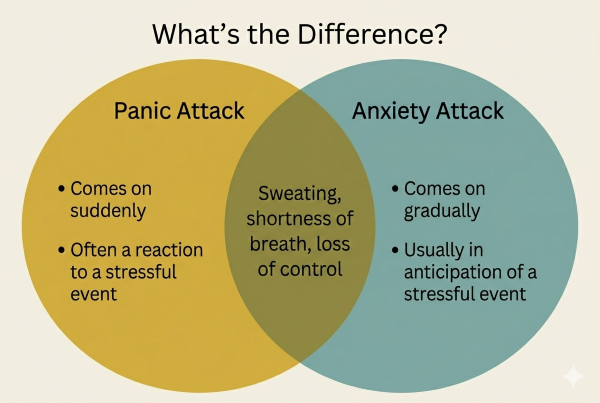
A comparison of a Panic Attack and Anxiety Attack will help to have a more effective concept, the comparison of the two may bring certain calming:
- Symptoms: Panic attacks are impulsive, anxious and gradual.
- Extremeness: Panic attacks are more satisfying.
- Duration: Panic effects are short, and anxiety and anxiety measurements are long.
- Onset: Panic and anxiety attacks are sources of stress, and they may occur at any time (unpredictably).
- Focus: Dying or losing control is a differentiation between panic attacks and anxiety attacks as the anxiety attacks always give worries about them.
Risk Factors for Panic Attack vs. Anxiety Attack
Some similarities of risk factors in the two experiences can be identified, although there are major differences too:
Panic Attack Risk Factors
- History of panic disorder among the family members.
- Negative experiences or past traumatic experiences.
- Sensations of the body are extremely delicate.
Anxiety Attack Risk Factors
- Enduring or unremitting stress.
- The characteristics of personality are perfectionism or high self-criticism.
- Present health, relationship or life problems.
Such risk factor awareness may lead to the appropriate intervention and effective organization of the treatment.
How to Help Panic and Anxiety Attacks
The support plans would vary slightly in order to deal with panic or anxiety, being a symptom but some of the practical approaches would include:
- Taking long and deep breaths.
- it is the anchoring of oneself to senses.
- The reminder that the symptoms are going to be temporary.
- Restricting stimulants and caffeine.
- Applying relaxation of progressive muscle relaxation.
In both panic and anxiety, regular therapy and acquired coping strategies may help to reduce symptoms or frequency of symptoms significantly.

How Long Do Anxiety Attacks Last?
Depending on the coping mechanisms and the nature of the stressor, anxiety attacks may take several minutes or several hours. Unlike panic attacks, which have short-term peaks, anxiety attacks tend to taper off as the levels of stress subside.
This temporal variation can be used as a convenient indicator when determining the difference between a Panic Attack and an Anxiety Attack.
Seeking Professional Help
When panic or anxiety attacks are getting in the way of your normal life, then it is not only a good idea to seek professional help but also a strong move. With the help of the therapy, triggers can be described and coping strategies can be provided, and time can reduce symptoms. In other cases, drug prescription may be employed as part of an interventional way to treatment.
DeLand Treatment Solutions does provide evidence-based, person-centered care in a hospitable way. You do not have to go through it by yourself, be it panic or anxiety calls or both.
Take the Next Step Toward Relief
Constant fear or worrying is stressful but there is a way out. When you have or your loved one is experiencing the symptoms of panic or anxiety, contact DeLand Treatment Solutions today. The next step of having more calm, clarity, and control can be the first step of a secret discussion.
Disclaimer
This content is for informational purposes only and is not intended to replace professional medical, psychological, or mental health advice. Always consult a qualified healthcare provider for diagnosis and treatment of panic- or anxiety-related conditions.
Frequently Asked Questions
How do I tell if I had an anxiety attack or a panic attack?
Panic attacks are sudden and intense, often without a clear trigger. Anxiety attacks usually build gradually and are linked to stress or worry. Timing, intensity, and triggers help distinguish between the two.
What medication is used for panic attacks and anxiety?
Doctors may prescribe antidepressants like SSRIs for long-term management. In some cases, short-term medications such as benzodiazepines are used carefully under medical supervision to manage acute symptoms.
What does someone having a panic attack look like?
They may appear frightened, breathe rapidly, clutch their chest, sweat, or feel dizzy. Many fear they’re having a heart attack and may urgently seek medical help.
What not to do when someone is having an anxiety attack?
Avoid dismissing their feelings or telling them to “calm down.” Don’t overwhelm them with advice. Instead, offer reassurance, stay calm, and encourage slow breathing.
Which lasts longer, a panic attack or an anxiety attack?
Anxiety attacks generally last longer because they’re tied to ongoing stress. Panic attacks peak quickly often within 10 minutes and then gradually subside.
What is the 3-3-3 rule for anxiety attacks?
The 3-3-3 rule involves naming three things you see, three sounds you hear, and moving three body parts. It helps ground your mind and reduce anxious thoughts.