You may have spent a significant amount of time pondering this question if you have known someone who has been experiencing mood swings, the need for constant attention and reassurance and the inability to form healthy relationships.
Or maybe you are the one who finds yourself in these patterns and you already know that there is more going on than simply being ’emotional’ or ‘loving the spotlight.’
Histrionic Personality Disorder (HPD) is a legitimate and diagnosable disorder. And it’s one that can be cured. However, to find the right help, it helps to first be familiar with what is going on and which types of therapy have proven effective in getting things moving.
One of the most proven and popular treatments for HPD is called Cognitive Behavioral Therapy (“CBT”). This guide outlines precisely what HPD consists of, how it is motivated, and how CBT and other evidence-based approaches can be used to change the patterns that keep a person locked in.
Understanding Histrionic Personality Disorder
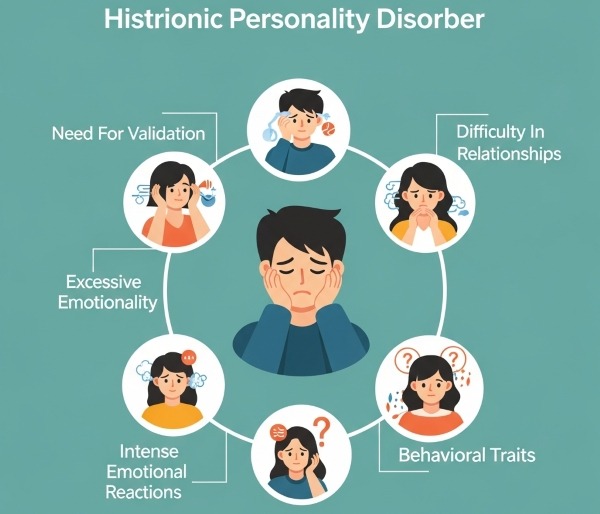
Histrionic Personality Disorder (HPD) is a personality disorder under the Cluster B category that features a pattern of excessive emotionality, attention-seeking, and a desire for approval and validation.
The DSM-5 criteria include the following patterns that must be present in five or more contexts, onset before early adulthood, and significant impairment or distress, in order to diagnose HPD:
- Discomfort when not the center of attention
- Engaging in socially inappropriate seductive or provocative behavior
- Quickly changing and superficial emotions.
- Consistently using physical appearance to draw attention
- A style of speech that is excessively impressionistic and lacking in detail
- Self-dramatisation, theatrical and excessive emotion
- High suggestibility, easily influenced by others or by current circumstances
- A tendency to consider relationships more intimate than they actually are
The Cleveland Clinic reports that other mental health disorders associated with HPD include co-occurring depression, anxiety disorders, and substance use disorders. HPD frequently co-occurs with other personality disorders, often Borderline Personality Disorder and Narcissistic Personality Disorder, which may make it tricky to diagnose and treat.
A clinically important characteristic of HPD is that it is likely to be ego-syntonic. The majority of those affected do not see their behavior as being a problem. They feel their emotions; they feel the need for attention; it’s just who they happen to be. This creates a useful clinical challenge to pursue, which can only be addressed with specific strategies to overcome.
What Causes Histrionic Personality Disorder?
There is no one single cause for HPD. It is, like most of the personality disorders, a result of genetic, developmental, and environmental interactions.
The most prevalent contributors are:
Genetic and biological factors
Personality disorders have been found to have a heritable aspect, based on research and twin studies. Families demonstrate higher generations of individuals with a history of HPD or other personality disorders. Biological traits such as temperamental characteristics (high emotional reactivity, sociability and sensation-seeking) seem to render individuals susceptible to HPD in the presence of specific developmental events.
Childhood environment and attachment
The childhood context has a strong influence on the development of HPD. Common patterns in case stories are:
- Inconsistent parenting: sometimes giving the child too little attention or affection, sometimes too much, the child has no consistent, internal sense of self
- Conditional attention: love and approval are contingent on the child’s behavior; they are mainly given when the child entertains, performs or appears in a certain manner.
- Childhood trauma, abuse, or neglect, especially emotional and/or sexual abuse that interferes with healthy emotional development and leads to unhealthy coping skills to feel safe through attention and approval.
- Seeing or hearing attention-seeking being used as a key strategy for getting needs met in the family system
Psychoanalytic and developmental perspectives
Psychoanalytic therapists believe that HPD is the result of a failure to move beyond the point in development when the child’s attachment need for consistent and unconditional loving care has not been satisfied.
As the adult with HPD continues to look for this in relationships, they are looking for what they never got: validation, attention and proof that they are worthy and loved.
These developmental roots have important clinical implications as they indicate the level of depth and complexity of the work needed. CBT for HPD is not just about modifying surface behaviors. At its best, however, it covers the underlying beliefs that arose in those early environments concerning the self and relationships.
100% Confidential Support is Available 24/7
No matter what you’re going through, you’re not alone. Our dedicated team is here to provide a safe, judgment-free space where you can talk openly and honestly. Whether you need emotional support, resources, or just someone to listen.
We’re here for you—completely confidential and always respectful of your privacy. Call us today!
How Cognitive Behavioral Therapy Addresses HPD
CBT is one of the most effective psychotherapy treatments to date for Histrionic Personality Disorder and studies have shown it to be effective for decreasing symptoms and enhancing interpersonal functioning.
A landmark study by Matusiewicz, Hopwood, Banducci, and Lejuez, published in Psychiatric Clinics of North America (2010) and available via the National Institutes of Health PMC database, provided a comprehensive review of CBT for personality disorders and concluded that CBT is an effective treatment modality for reducing symptoms and enhancing functional outcomes in people with personality disorders, including HPD. A pilot study referenced in the research showed significant decreases in histrionic symptoms and measurable improvements in interpersonal functioning following a structured CBT program.
CBT is based on the fact that thoughts, feelings, and actions are all closely related. Specific cognitive distortions and behavioral strategies continue to be adaptive for individuals with HPD, but lead to an ongoing dysfunction. The key to the CBT work is the identification and modification of these patterns.
Deland Treatment Solutions
Battling with Drug and Alcohol Addition? Remember, you are not alone and we are here to help you!
CBT Techniques for Histrionic Personality Disorder
Cognitive Restructuring for HPD Core Beliefs
HPD is based on certain fundamental core beliefs and assumptions about self and relations that are held strongly having taken place early in life and influencing all subsequent emotional and behavioral patterns. There are common core beliefs in HPD, such as:
- “I am only worthwhile when others are paying attention to me”
- “I am fundamentally unlovable unless I perform and impress.”
- “If I am not the most interesting person in the room, I am nothing.”
- “Relationships only last as long as I can keep people entertained or attracted.”
- “Being ordinary means being invisible, and being invisible means being abandoned.”
CBT for HPD includes cognitive restructuring which entails:
- Identifying the automatic thoughts that are activated in situations where the person is not receiving the level of attention or approval that they expect.
- Examining the evidence for and against these automatic thoughts in a structured, non-confrontational way
- Tracing automatic thoughts back to the underlying beliefs that produce the thoughts.
- Testing and challenging core beliefs through both cognitive dialogue and behavioral experiments
- Building more balanced, flexible alternative beliefs that allow the person to feel worthwhile independent of external validation
Seeking help from DeLand Treatment Solutions provides essential guidance
Behavioral Experiments and Skills Building
CBT for HPD takes the cognitive approach a step further by designing and conducting experiments and teaching skills.
Behavioral experiments are where core beliefs are subjected to tests to see if they are true. For instance, “Unless I play/attention is called to me in this conversation, I am ignored and rejected.” The experiment consists of entering the situation and witnessing what is happening without engaging in normal attention-seeking habits. As time goes by, successive failures of catastrophic forecasts break down the power of the belief.
Skills training directly provides the interpersonal and emotional skills. HPD development disrupted:
- Active listening: Many persons with HPD have trouble actually listening to others as interactions have historically been a means by which their own needs have been fulfilled. When practiced as a structured skill of paying attention to the other person’s experience, rather than to one’s own, it creates a new relationship skill, and has a positive impact on relationships, often immediately.
- Authentic communication: The Difference between acting emotions and feeling and expressing emotions. Learning how to express needs more directly, instead of by manipulation or dramatic display
- Tolerating not being the center: Developing the ability to be present when interest is no longer on him/her without feeling it as a threat and/or intolerable
- Delayed gratification and impulse control: Training the ability to put up with discomfort without doing anything to feel better about it in the moment (attention-seeking).
Emotion Regulation Training
Being easily provoked to intense emotions and experiencing quick emotional fluctuations are integral to HPD. Those with HPD feel their emotions rapidly and intensely and share it in ways that may be confusing and/or overpowering to others.
This is not an emotional volatility that is made up. The intensity is real but the patterns around it are not appropriate.
For HPD, emotion regulation training is provided with the help of CBT and the following steps are included:
- Identifying and labeling emotions accurately: Distinguishing between sadness, the feeling of being ignored, and being distressed for the purpose of attracting attention
- Understanding the emotion-behaviour chain: Understanding the steps that trigger the emotion, automatic thoughts, emotion, behaviour, and the ability to interrupt each of the steps
- Distress tolerance: Learning to tolerate uncomfortable feelings and not respond by engaging in dramatic behavior or asking for reassurance.
- Grounding techniques: Learning to calm down the autonomic nervous system when emotions “flare up” and to take a break between feeling and reacting.
Schema Therapy for Deep Belief Patterns
Schema therapy (ST) is a specialized type of CBT created by Dr. Jeffrey Young, specific for use with personality disorders. It extends beyond conventional CBT into childhood-based schemas, long-process patterns of thinking, feeling, and relating, linked with unfulfilled core needs of childhood.
The most salient schemas for HPD are likely:
- Emotional deprivation schema: A core belief that one cannot always get his/her needs for love, attention and nurturance fulfilled.
- Approval-seeking schema: A pattern of expecting others to react positively to and approve of one’s actions, doing so in order to build up a sense of self-worth.
- Abandonment schema: An anticipatory set of things to watch out for, that people will leave the relationship and a hypervigilance to the indications that they intend to leave.
- Insufficient self-control schema: Inability to tolerate frustration and organize impulses; behavior is emotionally driven.
To tackle these deep patterns, schema therapy integrates knowledge from cognitive therapy, behavioral experiments, and experiential therapy, such as imagery rescripting and limited reparenting within the therapeutic relationship. It takes longer than regular CBT but results in deeper and more fundamental changes of long-standing personality patterns.
Dialectical Behavior Therapy Skills for HPD
Dialectical Behavior Therapy (DBT) was developed by Dr. Marsha Linehan originally for borderline personality disorder but also has a strong focus on emotional regulation, and many of the traits involved in this overlap substantially with HPD presentations. Many clinicians who work with HPD use DBT skills as an additional component to CBT work.
There are 4 DBT skills modules that are most relevant for HPD:
Mindfulness: Cultivating awareness in the here-and-now and learning to watch thoughts and feelings without having to act on them right away. This creates for HPD the self-reflection ability which is otherwise constrained by ego-syntonic functioning.
Distress tolerance: Staying with an emotional mind and not engaging in dramatic, impulsive or self-destructive behavior. This directly targets the pattern of emotional performance as a means of controlling internal discomfort.
Emotion regulation: Recognizing, comprehending and adjusting strong emotional reactions. Developing the capacity to feel feelings fully without getting caught up in them.
Interpersonal effectiveness: Developing skills to communicate with others in a direct and assertive way, develop healthy relationships and balance considerations for others with self-respect. This explicitly takes on the manipulative and/or dramatic interpersonal styles of the HPD.
Building Authentic Identity and Self-Esteem
One of the basic objectives of CBT for HPD is for the person to become stable and secure in his or her internal self-esteem, not completely reliant on others’ approval and admiration.
Individuals with HPD have often developed a very fragile sense of self and become CO-DEPENDENT, living around the behest of others. They are not just living; they act. They want and don’t just bind. Building true self-esteem consists of:
- Investigating one’s values, interests and strengths which are different from others’ reactions to those values, interests and strengths
- Learning how to know and trust feelings without having to show them a certain way
- Developing tolerance for being alone without it becoming intolerable
- Working on real intimacy, knowing instead of admiring
- Work through the feelings of loss which are frequently part of feeling that much of early development was around conditional approval instead of secure attachment.
This work is some of the deepest and most meaningful work in HPD treatment, and it often needs the safety of and the consistency of a therapeutic relationship that is of a long term nature that will be able to achieve this.
The Therapeutic Relationship in CBT for HPD
The therapeutic relationship is of particular importance in CBT for HPD, and this needs attention in the clinical setting.
These patterns are often directly applied to the therapeutic relationship by individuals with HPD. They might first be idealizing the therapist, overreacting to perceived slights or inattentiveness, have a need to get closer to the therapist than is appropriate, or engaging in drama or appearance in and outside the sessions.
Another important aspect of the therapeutic relationship is boundary setting. The therapist encourages and stays warm while setting boundaries. In time, the client’s experience of love and interest, which is caring and consistently boundaried without withdrawing love or interest, challenges the core belief that having genuine relationships can only be achieved through constant performance.
What to Expect in CBT Treatment for HPD
HPD treatment isn’t something that happens overnight, but it shouldn’t be! An honest account of the extent to which there is personality-level patterns in the deep roots of.
The average number of sessions in traditional CBT is 12-20 sessions for particular presenting conditions. With personality disorders, the work is typically more long-term, and many people suggest the need for ongoing work for a minimum of 1-2 years in order to produce personality changes that are lasting and effective.
Realistic expectations for CBT for HPD include:
- Early phase (weeks 1 to 8): Educational component regarding HPD, therapist-patient rapport establishment, specific behavioral targets identification, initiating cognitive work with automatic thoughts, and motivating participation during the first phase (weeks 1-8) of the protocol.
- Middle phase (months 2 to 12): More complex work on core beliefs, behavioral experiments, emotion management and interpersonal skills training, identification of schemas and initiation of schema work.
- Later phase (months 12 onward): More in-depth schema processing, identity, and relapse prevention planning, exploration of genuine relational connection, and usual posthumous schema processing.

Start CBT Treatment at DeLand Treatment Solutions
When it comes to personality disorders, DeLand Treatment Solutions provides full-spectrum and personalized treatment that gets to the root of the disorder rather than just treating its symptoms.
DeLand Treatment Solutions offers very clear and concise histrionic personality disorder treatment utilizing evidence-based modalities that have demonstrated effectiveness in the treatment of HPD presentations.
They have a clinical team trained in cognitive behavior therapy, dialectical behavior therapy, EMDR therapy, trauma therapy, mindfulness meditation therapy, family therapy, and holistic therapy delivered within individual and clinically supervised treatment plans.
There are dual diagnosis programs that treat both mental health and substance use together, since HPD usually occurs in conjunction with another condition. Medication management is offered to help manage co-occurring anxiety and depression or mood instability that may affect personality disorders and to be more engaging.
Contact DeLand Treatment Solutions online today. Getting help for a personality disorder takes courage. The DeLand Treatment Solutions team is ready to meet that courage with expert care.
FAQs
What is Cognitive Behavioral Therapy and how does it help HPD?
Cognitive Behavioral Therapy, or CBT, is a structured psychotherapy focused on changing unhealthy thoughts and behaviors. For Histrionic Personality Disorder, CBT helps reduce attention seeking, emotional dramatization, and unstable relationships by improving emotional regulation, interpersonal skills, and self-awareness through practical coping strategies and behavioral exercises.
What are the core symptoms of Histrionic Personality Disorder?
Histrionic Personality Disorder involves excessive emotionality and attention-seeking behaviors. Common symptoms include discomfort when not receiving attention, dramatic emotions, suggestibility, seductive behavior, vague speech, and exaggerated relationship intimacy. These patterns are long-lasting, affect multiple settings, and often create emotional distress or relationship difficulties.
Is Histrionic Personality Disorder treatable?
Yes. Histrionic Personality Disorder is treatable through therapies such as CBT, schema therapy, DBT-based treatment, and psychodynamic therapy. Although personality patterns can take time to change, many individuals experience meaningful improvements in emotional stability, relationship functioning, self-awareness, and overall quality of life with consistent professional treatment.
Why is HPD difficult to treat?
HPD can be difficult to treat because many individuals do not initially recognize their behaviors as problematic. Their emotional intensity and attention-seeking may feel normal to them. Therapists often focus on building trust, improving self-awareness, and helping clients connect behavioral patterns to emotional and relationship consequences.
How long does CBT for Histrionic Personality Disorder take?
CBT for Histrionic Personality Disorder usually takes longer than therapy for anxiety or depression because personality patterns are deeply ingrained. Many clinicians recommend one to two years of consistent therapy. Treatment often progresses from behavioral changes to deeper emotional work, identity development, and long term relapse prevention planning.
What is schema therapy and how does it relate to CBT for HPD?
Schema therapy is an advanced form of CBT designed for personality disorders and long standing emotional difficulties. It focuses on deeply rooted beliefs formed during childhood that influence adult behaviors and relationships. For HPD, schema therapy addresses patterns involving approval seeking, abandonment fears, emotional deprivation, and poor emotional regulation.
Can DBT help someone with HPD?
Yes. Dialectical Behavior Therapy, or DBT, can help individuals with HPD improve emotional regulation, distress tolerance, mindfulness, and interpersonal effectiveness. Although originally developed for Borderline Personality Disorder, many DBT skills are highly effective for managing impulsivity, emotional intensity, unstable relationships, and attention seeking behaviors associated with HPD.
What role does family therapy play in HPD treatment?
Family therapy helps improve communication, strengthen boundaries, and reduce unhealthy interaction patterns that may reinforce HPD behaviors. Loved ones often experience emotional strain and confusion related to the disorder. Therapy can educate families about HPD while rebuilding trust, improving support systems, and encouraging healthier relationship dynamics over time.
Does HPD co occur with other conditions?
Yes. Histrionic Personality Disorder frequently co occurs with depression, anxiety disorders, substance use disorders, and other personality disorders such as Borderline Personality Disorder or Narcissistic Personality Disorder. Treating all co occurring conditions together is important because untreated symptoms can complicate recovery and worsen emotional or interpersonal difficulties.
Is medication used to treat Histrionic Personality Disorder?
There is no medication specifically approved for treating Histrionic Personality Disorder itself. However, medications may help manage co occurring symptoms such as depression, anxiety, mood instability, or sleep difficulties. Medication is typically used alongside psychotherapy rather than as a replacement for long term therapeutic treatment approaches.
How do I help a loved one with Histrionic Personality Disorder seek treatment?
Start by learning about HPD so you better understand the emotional and behavioral patterns involved. Respond calmly while maintaining healthy boundaries instead of reinforcing dramatic behaviors. Focus discussions on specific concerns and their impact. Family therapy or consultations with experienced mental health professionals may also encourage treatment participation.
Does DeLand Treatment Solutions offer treatment for Histrionic Personality Disorder?
Yes. DeLand Treatment Solutions provides treatment for Histrionic Personality Disorder using approaches such as CBT, DBT based skills training, trauma focused therapies, and individualized treatment planning. The program focuses on emotional regulation, relationship improvement, and long term mental health support tailored to each individual’s needs.
References
- Matusiewicz, A.K., Hopwood, C.J., Banducci, A.N., & Lejuez, C.W. (2010). The Effectiveness of Cognitive Behavioral Therapy for Personality Disorders. Psychiatric Clinics of North America, 33(3). PMC3138327
- Cleveland Clinic — Histrionic Personality Disorder: Symptoms and Treatment
- Psychology Today — Histrionic Personality Disorder
- Merck Manual — Histrionic Personality Disorder: DSM-5-TR Criteria
- National Institute of Mental Health (NIMH) — Personality Disorders
- American Psychological Association (APA) — Understanding Psychotherapy and How It Works
- SAMHSA — Mental Health and Co-Occurring Disorders
- Mayo Clinic — Personality Disorders: Symptoms and Causes
- PsychCentral — Histrionic Personality Disorder Treatment
- DeLand Treatment Solutions — Histrionic Personality Disorder Treatment
This content is for informational purposes only and does not constitute a clinical diagnosis or recommendation. For a personalized assessment of treatment needs, consult a licensed mental health professional. To learn more about evidence-based personality disorder treatment in Florida, visit delandts.com or call (386) 866-8689.