Perhaps it’s a job, legal case, or custody issue, and a hair test has been scheduled, and you want to know what it can tell you. Hair testing is not as soon as a urine or blood test that will just capture a single night. It can tell a story that goes back months, which is what makes people more nervous than other types of drug tests.
It is important to know what the process of how cocaine gets trapped in hair means, and what it does NOT mean, rather than a quick response of “90 days.” It’s basic science for real, and some of it is actually surprising.
Let’s break down how cocaine testing of hair follicles is conducted, how long the detection window is, and what a positive result signifies.
Cocaine remains in hair for up to 90 days. According to hair growth math, cocaine is only an inch long (1.5 inches being the standard cut in a test) every month, so as hair grows, cocaine just grows with it. There is no easy way to lengthen that six-month time frame, and a longer haircut will drag the past further back a whole year.
Here’s the tricky part: it has to take time for something to appear at all. Cocaine enters the bloodstream and travels to hair about 7 to 10 days after cocaine use. A test performed by some person a few days ago may appear clear in the hair now, but result in a urine test the same afternoon, because these two tests are asking different questions.
But it’s time for the melanin thing, and that is one not spoken about enough. Natural pigmentation has a big impact on the product; two natural persons with the same application may experience different results depending on their hair color. The drug is contained in the hair shaft and not just on the surface, so bleaching or dyeing the hair can weaken what can be detected, but will not eliminate it.
How Hair Follicle Testing for Cocaine Actually Works
Hair follicle testing is based on the presence of drug metabolites that become permanently embedded in the hair shaft while it grows, providing a semi-permanent history of drug use.
When cocaine enters your bloodstream, it circulates to hair follicles at the base of each strand. As new hair forms, cocaine and its metabolites, primarily benzoylecgonine, bind directly into the hair’s protein structure.
“Drugs enter the hair’s structure by passive diffusion from blood capillaries into the growing cells at the base of the follicle, with the rate of incorporation depending on melanin content, the drug’s chemical properties, and the specific growth phase of the hair.” (PMC, National Library of Medicine, forensic toxicology research)
Because these metabolites are locked inside the hair shaft rather than sitting on the surface, they generally survive normal washing.
FACT: Hair testing can detect cocaine exposure for approximately ninety days.
How Long Does Cocaine Stay in Your Hair
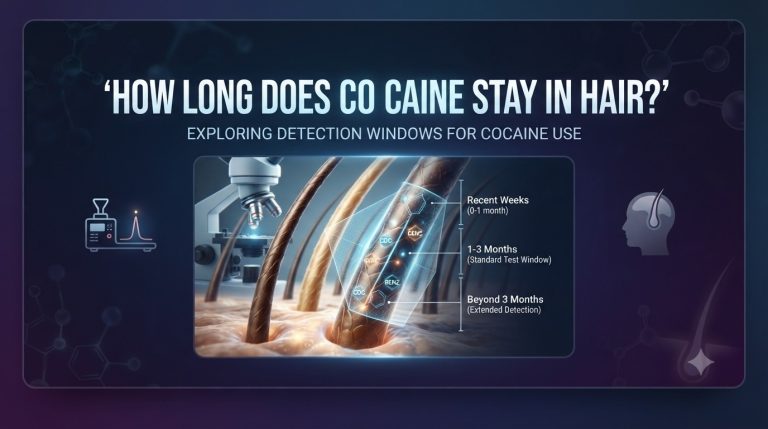
Cocaine and its metabolites are typically detectable in hair for up to 90 days, based on the standard testing sample of the 1.5 inches of hair closest to the scalp.
This 90-day figure comes directly from the average human hair growth rate of about half an inch per month. Since standard testing analyzes roughly 1.5 inches of hair, that translates to approximately three months of potential exposure history.
- Standard testing window: approximately 90 days
- Heavy, frequent use: concentrations can be high enough to remain detectable beyond six months in some cases
- Longer hair samples can extend the detectable history further back, sometimes up to a year with sufficient hair length
Unlike urine, blood, or saliva testing, which reveal recent use, hair testing is specifically designed to reveal patterns over time rather than a single incident.
100% Confidential Support is Available 24/7
No matter what you’re going through, you’re not alone. Our dedicated team is here to provide a safe, judgment-free space where you can talk openly and honestly. Whether you need emotional support, resources, or just someone to listen.
We’re here for you—completely confidential and always respectful of your privacy. Call us today!
Why There’s a Waiting Period Before Cocaine Shows Up in Hair
Cocaine does not appear in hair immediately after use. It typically takes 7 to 10 days for metabolites to travel from the bloodstream into new hair growth that has emerged far enough above the scalp to be tested. This creates a practical limitation that surprises many people: a very recent use, within the past week or so, will generally not show up on a hair test, even though it would likely register on a urine test taken the same day.
“Standard hair collection excludes the newest growth closest to the scalp, meaning single doses consumed within the past week typically will not appear in hair test results.” (Forensic toxicology industry research)
This gap is exactly why hair testing is often paired with urine testing when both recent use and longer-term patterns need to be assessed.
Concerned about cocaine use or an upcoming hair test? Contact DeLand Treatment Solutions for confidential support.
Deland Treatment Solutions
Battling with Drug and Alcohol Addition? Remember, you are not alone and we are here to help you!
What Segmental Hair Analysis Can and Cannot Tell You
Segmental hair analysis divides a hair sample into sections to estimate when drug exposure occurred, with each half-inch segment roughly representing one month of history.
This sounds precise, but there are real limitations worth understanding.
“Hair growth rate is not constant between or within individuals, and for this reason, segmental analysis should not be relied upon to identify specific, narrow intervals of drug use in a forensically defensible manner.” (Quest Diagnostics, forensic hair testing guidance)
In practical terms, segmental analysis can suggest a general pattern, such as ongoing use over several months versus a single isolated incident, but it should not be treated as a precise month-by-month calendar of use.
Does Hair Color Affect Cocaine Detection?
Yes, hair color and melanin content can meaningfully affect cocaine detection, with darker hair generally binding and retaining more drug metabolites than lighter hair.
“Higher melanin content in darker hair allows for greater binding of drug metabolites, which can increase both detectability and retention time compared to lighter, lower-melanin hair.” (Forensic toxicology research)
This is a genuinely important and often underdiscussed limitation of hair testing. It means two people with identical cocaine use could theoretically produce different test results based partly on natural hair pigmentation, a factor that has drawn scrutiny in forensic and legal settings for its potential to introduce bias into testing outcomes.
Expert’s Advice: Seek assessment early if cocaine use becomes difficult to control.
Can Hair Treatments Remove Cocaine From Your System?
- Chemical hair treatments like bleaching, dyeing, or perming can reduce cocaine concentrations detectable in hair, but they rarely eliminate all traces completely.
- Because metabolites are embedded within the hair shaft’s internal structure rather than sitting only on the surface, these treatments degrade some, but typically not all, of the drug compounds present.
- Bleaching: can meaningfully reduce detectable concentrations, though rarely to zero
- Dyeing: may lower detectability somewhat, with variable results
- Frequent washing: has minimal effect, since metabolites are internally bound, not surface-level residue
Attempting to use these treatments specifically to defeat a hair test is both unreliable and, in most testing contexts, considered a red flag in itself if detected through specialized testing protocols.
If cocaine use is affecting your health or daily life, call DeLand Treatment Solutions to discuss treatment options.
Hair Testing vs Other Cocaine Drug Tests
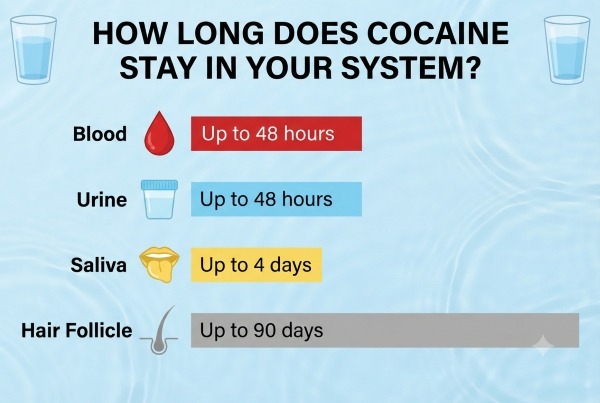
Hair testing offers a dramatically longer detection window than any other common cocaine test, though each method serves a different purpose.
Test Type | Typical Detection Window | Best Used For |
Blood | Up to 12 hours | Very recent use |
Saliva | 1 to 3 days | Recent use, roadside testing |
Urine | 2 to 4 days, longer with heavy use | Standard screening |
Hair | Up to 90 days | Long-term pattern of use |
Employers, courts, and treatment programs often choose a test type based specifically on what question they are trying to answer, recent impairment versus longer-term use patterns.
What a Positive Cocaine Test Actually Means for Use Patterns
A positive hair test indicates cocaine exposure at some point within the detection window, but it does not indicate frequency, exact timing, or current impairment on its own.
This distinction matters, particularly for families trying to interpret a result. A single positive hair test could theoretically reflect anything from one isolated use to a sustained pattern, though heavier, more frequent use does tend to produce higher, more consistently detectable concentrations across hair segments.
When Cocaine Use Needs Professional Support
Cocaine use crosses into a pattern worth addressing when it becomes more frequent, harder to control, or starts affecting responsibilities, relationships, or health.
Watch for:
- Using more often than originally intended
- Failed attempts to cut back or stop
Continuing use despite clear consequences - Physical symptoms like cardiovascular strain or persistent fatigue
- Using specifically to cope with stress, anxiety, or difficult emotions
- “Compulsive drug seeking and use, despite harmful consequences, is the defining characteristic of addiction.” (National Institute on Drug Abuse)
Whether a hair test brought this question to the surface, or something else did, the underlying question, whether use has become something bigger, deserves a real answer either way.
Getting Support at DeLand Treatment Solutions
At DeLand Treatment Solutions, our clinical team provides evidence-based, compassionate care for individuals and families navigating cocaine use, from early concern to full dependence.
Depending on your needs, our team may recommend the following:
- Medical detox for safe, supervised support at the start of recovery
- Dual diagnosis program for co-occurring anxiety, depression, or trauma alongside cocaine use
- Residential treatment for structured, immersive support during early recovery
- Family Therapy to help loved ones understand what is happening and how to support recovery
We are accredited by the Joint Commission, licensed by the Florida Association of Recovery Residences, and recognized by the National Association of Addiction Treatment Providers. Every plan is built around your history, not a generic script.
You do not have to wait for a test result to reach out. Call us or reach out through our contact page any time, day or night.
FAQs
Q: How long does cocaine stay in your hair?
Cocaine and its primary metabolites are typically detectable in hair for up to 90 days using the standard 1.5-inch hair sample collected closest to the scalp. Longer hair samples may provide a broader history of use, depending on laboratory testing methods and hair growth patterns.
Q: How long does cocaine stay in your system overall compared to hair?
Cocaine usually clears from blood within about 12 hours, saliva within one to two days, and urine within several days to two weeks. Hair testing offers the longest detection window, identifying cocaine exposure for up to 90 days or longer after repeated heavy use.
Q: Why does it take time before cocaine shows up in a hair test?
Hair tests do not detect cocaine immediately because metabolites must become incorporated into newly growing hair. This process generally takes about 7 to 10 days, meaning hair testing is ineffective for identifying very recent cocaine use immediately after exposure occurs.
Q: Can a cocaine drug test using hair reveal exactly when someone used?
No. Hair testing can estimate general patterns of cocaine use through segmental analysis, but it cannot determine the exact date or time of use. Individual differences in hair growth rates prevent laboratories from identifying precise timing with complete forensic certainty.
Q: Does hair color affect how long cocaine stays detectable?
Yes. Research suggests darker hair containing higher melanin levels may retain more cocaine metabolites than lighter hair. While this can influence detectable concentrations, laboratories use standardized procedures to improve accuracy and interpretation regardless of natural hair color or individual characteristics.
Q: Can bleaching or dyeing your hair remove cocaine from a test?
Bleaching, dyeing, or other chemical treatments may lower detectable cocaine concentrations but rarely eliminate all drug metabolites. Because cocaine becomes incorporated inside the hair shaft, cosmetic treatments generally cannot completely prevent a properly performed laboratory hair test from detecting prior drug exposure.
Q: How does hair testing compare to a standard urine cocaine drug test?
Hair testing identifies cocaine use over approximately 90 days, making it useful for evaluating long-term patterns. Urine testing typically detects cocaine metabolites for only several days to two weeks, depending on use frequency, making it better suited for identifying more recent exposure.
Q: Does frequency of cocaine use affect hair test results?
Yes. Frequent or heavy cocaine use generally produces higher concentrations of metabolites throughout the hair shaft, increasing the likelihood of detection. A single isolated use may also be detectable, but results are often less consistent than those from repeated or chronic cocaine use.
Q: Is hair testing used for recent cocaine use detection?
No. Hair testing is not designed to identify cocaine use within the previous several days because metabolites require time to appear in newly grown hair. Urine, saliva, or blood testing provides more reliable information when recent cocaine use is the primary concern.
Q: What does a positive hair test for cocaine actually confirm?
A positive hair test confirms that cocaine entered the body during the detection window. However, it cannot determine the exact timing, frequency, amount used, or whether someone was impaired at a particular moment without additional clinical or forensic evidence supporting the findings.
Q: Can body hair be used for cocaine testing if head hair isn’t available?
Yes. Laboratories may use body hair when sufficient head hair is unavailable. Body hair can reflect drug exposure over a longer period, sometimes approaching a year, though it provides less precise information about when cocaine use occurred than scalp hair samples.
Q: When should someone seek help for cocaine use?
If cocaine use is becoming more frequent, difficult to control, causing cravings, or affecting health, relationships, work, or responsibilities, seeking professional treatment is recommended. Early intervention with evidence-based care can reduce risks and improve long-term recovery outcomes and overall well-being.
References
- National Institute on Drug Abuse: Cocaine Research Report
- National Institute on Drug Abuse: Understanding Drug Use and Addiction
- PMC, National Library of Medicine: Molecular Imaging of Cocaine Detection in Hair
- Quest Diagnostics: Hair Drug Testing FAQ
- SAMHSA: Drug Testing Resources
- Mayo Clinic: Drug Addiction Symptoms and Causes
- MedlinePlus: Cocaine
- Cleveland Clinic: Cocaine Addiction
- DeLand Treatment Solutions: Dual Diagnosis Program
- DeLand Treatment Solutions: Detox Care
This article is for informational purposes only and is not a substitute for professional medical advice. If you or a loved one needs support, DeLand Treatment Solutions is available to help.