Quick Answer: Emotionally secure individuals are self-aware; they maintain good boundaries, they manage their emotions, they communicate clearly with others, they have high levels of self-confidence and can usually deal effectively with conflict without getting out of hand. Emotionally secure people know how to share their needs, handle the tough emotions, trust others, and have a steady self-awareness.
Key Takeaways
- Feeling emotionally secure does not imply calmness or happiness at all times.
- Emotionally secure individuals can acknowledge challenging feelings and refrain from allowing feelings to direct their options.
- Emotional security fosters healthy relationships, effective communication, and resilience.
- Self-awareness, nurturing relationships, and counseling by professionals if necessary can help build emotional security over time.
What is Emotional Security?
Therefore, what is emotional security? Emotional security is the feeling of being safe, confident, and not always on the brink of fear or uncertainty. In our daily lives, it is about feeling comfortable with yourself and feeling like you could relate to others without constantly seeking affirmation.
The characteristics of emotionally healthy individuals can be seen in their reactions to everyday difficult situations. They can take criticism without thinking of themselves as worthless. They are able to not agree without making it about a criticism. They feel free to seek assistance.
Emotional security does not imply a lack of occasional feelings of jealousy, anxiety, anger, disappointment, or hurt. These feelings occur to all of us. Emotional security has more to do with what is to come.
An emotionally secure individual can identify an emotion and know why it has occurred and select a behavior instead of reacting automatically.
Emotional security, according to the American Psychological Association, is safety, confidence, and freedom from apprehension.
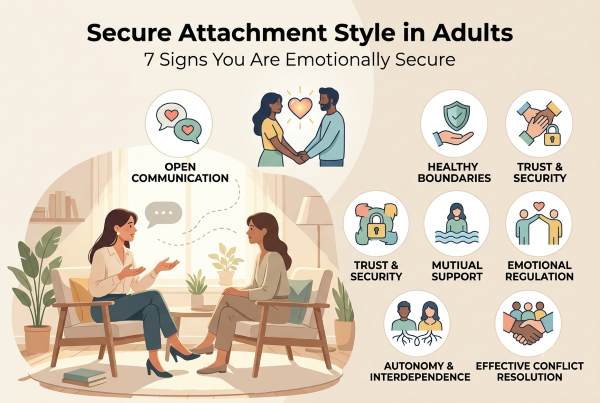
10 Traits of Emotionally Secure People
They communicate their emotions well.
1. They show their feelings.
Emotionally secure people possess one of the easiest characteristics to notice people are aware of their emotions. They are normally able to describe the way they are feeling rather than to simply say that they are “fine” or to become angry and not know why.
For instance, one person could discover that irritation is the same as disappointment, and anger is related to feeling ignored.
Putting emotions into words can help to make sense of and regulate emotions.
2. They don’t need constant reassurance.
Another key is to be able to feel safe without having to constantly test the waters of whether they are loved or loyal or approved of.
Emotionally secure individuals like reassurance but don’t need it to feel great about themselves.
They can be close and keep their independence.
3. They Communicate Their Needs Clearly
Please don’t expect someone to know what they want or need; they will instead be more likely to say, “I was hurt by that” or “I need some time to think on this before we continue the conversation.
Good communication is essential for eliminating needless misunderstandings and dismay.
4. They Have Healthy Boundaries
When you are emotionally secure, you can make no mistake to no one without feeling like a “selfish person.
Can set appropriate limits on their time, energy, relationships and personal space. They are also aware that other individuals have boundaries as well.
Healthy boundaries are NOT walls. They serve to help one connect without losing out on him/her.
5. They Can Handle Conflict
They know that a relationship doesn’t have to be bad when there is an issue.
They can take some time to feel out the situation, listen, and explain their side of the story. They shouldn’t “win” all arguments.
6. They Take Responsibility
Emotionally secure people are able to concede when they are wrong.
Apologizing isn’t humiliating. Instead, they know that trust can be fixed through taking responsibility.
They can say, “I did such a bad thing,” and not say, “I am a bad person.”
That distinction matters.
7. They Can Be Alone Without Feeling Abandoned
While they like relationships to the hilt, they do not think that being alone is a sign of being unwanted.
They are able to enjoy alone time, have personal pursuits, and develop non-romantic friendships.
8. They Accept Difficult Emotions
Emotional security is not “emotional perfection. Emotional security isn’t “emotional perfection.”
A secure person can experience crying, anxiety, frustration, and/or a bad day. What differentiates them is how they do not automatically deem every feeling to be unmanageable.
In emotional regulation, the American Psychiatric Association says it’s about fulfilling the process of acknowledging emotions and our choices around them instead of being ruled by them.
9. They Trust Without Ignoring Reality
Healthy emotional security is also commonly correlated with the characteristics of trust.
Those emotionally secure will allow others a margin of error without adding to the occurrence of hurtful behavior. They know that trust grows with honorable deeds.
They are not needy or need to test someone’s loyalty or look for hidden meanings in every message.
10. They Maintain a Stable Sense of Self
They are able to value praise without continually seeking it. They’re able to get a critical move without one unfavorable comment characterizing them.
This helps with a sense of self to feel more grounded and authentic in relationships
Traits of Emotionally Stable People vs. Emotional Suppression
The qualities of an emotionally stable individual can at times be mistaken for emotional suppression.
They are not alike.
When emotionally stable, an individual is able to accept uncomfortable emotions and think about their actions. A person who practices repression might conceal or deny feelings or hesitate to talk about them.
I’m learning to feel upset but stay in control by saying that I want to talk about this when I feel calmer.
If the thought (feel) is “Nothing bothers me,” but you are carrying a lot of anger about it, you could be avoiding it.
One of the characteristics of a person who is emotionally stable is flexibility. They can experience feelings sensitively without letting all the feelings rule them.
How Emotional Security Affects Relationships
Secure partners tend to be more likely to voice concerns, respect boundaries, accept taking a step back, and resolve conflict.
Another way they can support the other person’s feelings is to not take responsibility for “fixing things.”
Studies cited by the American Psychological Association (APA) underscore how crucial it is to be responsive and feel supported in close relationships to foster emotional security.
This isn’t to say that there are no conflicts in secure relationships. Even a healthy relationship has misunderstandings, disappointments, stresses and changes.
It is often the response to these challenges which makes the difference.
Seeking help from DeLand Treatment Solutions provides essential guidance
Can Emotional Security Be Developed?
Yes. Emotional security is not something just a personality type that someone has or do not have.
Individuals with emotional security can be enhanced by increased self-awareness, improved communication, relationships, and professional assistance where necessary.
Take steps to get started:
- Try to name your emotion so that you don’t let it get in the way of responding to it.
- Recognize situations that elicit intense emotions.
- Practice effective, direct communication.
- Set reasonable boundaries.
- Do not attend to the situation first that is impacting conflict.
- Question negative self-perceptions and others.
- Continue relationships and activities which are beneficial for individuals’ well-being.
- If the emotional patterns are interfering with normal life and relationships, consider therapy.
According to a report from the National Institute of Mental Health, psychotherapy can be a beneficial method for addressing the negative moods, thoughts, and actions that plague people, allowing them to learn to understand and alter their behavior, communication, and problem-solving skills.

Looking for Help With Emotional or Relationship Challenges?
If the anxiety, emotional responses, relationships, or unresolved experiences are hurting your life, it can be beneficial to seek professional support to help you understand the pattern and find more positive ways to react.
DeLand Treatment Solutions is here to help those struggling with mental health and behavioral health issues. Call to express your concerns and look for suitable forms of treatment. Taking the first step does not need to mean having it all sorted out.
Contact Us for Help
Not being perfect, emotionless, or confident every minute of the day is part of the traits of emotionally secure people.
They’re about fully developing a healthier relationship with your emotions and those around you.
Because they come from a secure emotional background, when injured, they are able to communicate with the aggressor by saying, “This hurt me,” and not strike them. They are not too afraid to ask for help. Without feeling like they are shunning, they can set a limit. They can hold on and not presume the worst.
Emotional security is most importantly improved.
If some of these traits are seen in an individual, it’s a reassuring indicator for people with these features. But if you observe that there are behaviors you wish to change, it does not always mean that you’re not normal or that something is wrong with you. Knowing oneself is a great first step to change.
If you have an ongoing emotional state of distress, relationship issues, substance abuse, or other behavioral health issues, professional counseling can help you get to the bottom of your patterns and learn how to live better.
Reach out to DeLand Treatment Solutions if you or a loved one are struggling and to find out about your options for mental health and behavioral health support.
FAQ About the Traits of Emotionally Secure People
What are some signs that someone is emotionally secure?
Common signs include communicating openly, accepting responsibility, maintaining healthy boundaries, tolerating disagreement, and managing difficult feelings without impulsive reactions. Emotionally secure people can seek reassurance while still maintaining self-confidence and independence.
When a woman shuts down in a relationship?
A woman may shut down because she feels overwhelmed, hurt, unheard, unsafe, or unsure how to communicate. Shutdown can have many causes, so it is better to ask calmly rather than assume her motivation.
What are some signs that my needs aren’t being met?
Signs may include repeatedly feeling unheard, unsupported, dismissed, or emotionally disconnected. You may also notice that you regularly suppress your needs to avoid conflict. Honest communication can help clarify whether the issue is temporary or ongoing.
What are 8 signs that a woman might be emotionally immature?
Possible signs include difficulty accepting responsibility, poor emotional control, blaming others, avoiding difficult conversations, needing constant attention, struggling with boundaries, reacting impulsively, and having difficulty considering another person’s perspective. These behaviors should not be used to diagnose someone.
How to tell if chemistry is mutual?
Mutual chemistry may involve comfortable conversation, genuine curiosity, consistent effort, reciprocal attention, emotional warmth, and an interest in spending time together. One person’s feelings alone cannot establish mutual chemistry, so consistent behavior matters more than isolated signals.
What attracts a man to a woman psychologically?
Attraction varies from person to person. Qualities that may contribute include confidence, kindness, emotional availability, humor, authenticity, shared interests, communication, and a sense of mutual respect. There is no single psychological formula that determines attraction.
What are the signs that a woman is emotionally unavailable?
Possible signs include avoiding emotional conversations, difficulty expressing feelings, inconsistent closeness, reluctance to build intimacy, withdrawing during vulnerability, or repeatedly avoiding commitment. These behaviors can have many explanations and should not automatically be treated as a diagnosis.
What are five things every woman wants in a man?
There is no universal list because individual preferences differ. Many people value qualities such as respect, honesty, emotional availability, reliability, and good communication. Healthy relationships are built through mutual needs, compatibility, trust, and respect rather than gender-based assumptions.
Disclaimer
This blog is intended for general educational and informational purposes only. It is not a substitute for professional medical, psychological, psychiatric, or addiction treatment advice, diagnosis, or emergency care. Emotional behaviors can have many causes, and the signs discussed here should not be used to diagnose yourself or another person. If you are experiencing significant or persistent emotional distress, speak with a qualified mental health professional. If you are experiencing an immediate mental health emergency or are at risk of harming yourself or someone else, seek emergency assistance or call/text 988 in the United States.
References and Trust Sources
Primary content reference:
“What It Means to Be Emotionally Secure,” Mind Cafe on Medium
Authoritative supporting sources:
American Psychological Association: Emotional Security
American Psychiatric Association: Understanding Emotional Regulation