
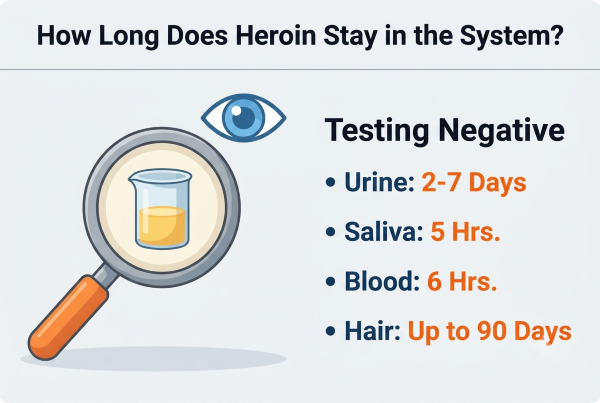
Quick Answer: Heroin does not last long in the body and is instead detected by testing for metabolites. The longest-lasting is morphine, which can be detected in urine for 1 to 3 days, saliva for a day, blood for several hours, and hair for a period of 90 days. Those all change in terms of how much, how, and how often.
Key Takeaways
- Heroin is so quickly metabolized that it rarely shows up in a laboratory test; instead, it is usually detected as metabolites.
- Standard opiate screens are looking for morphine and codeine, as well as several prescription medications and morphine, so a positive score does not indicate that someone used heroin.
- There is only one marker that is unique to heroin, and that is 6-monoacetylmorphine, which is excreted first.
- Tolerance drops during any break from use, which is why a familiar dose after a clean stretch is a common cause of fatal overdose.
Two people can ask how long heroin stays in your system and mean completely different things. One wants to know when the effects wear off. The other wants to know when a test comes back clean. Those answers are hours apart.
What Does the Body Do With Heroin?
Heroin works as a delivery system rather than the active drug. StatPearls describes it as rapidly metabolized to 6-monoacetylmorphine and then morphine, which bind opioid receptors in the brainstem and suppress respiratory drive. Enzymes strip it down within seconds, so what tests find is almost never heroin itself.
Heroin is a semisynthetic opioid made from morphine, from the opium poppy. It is more fat-soluble than morphine, so it reaches the brain faster and produces a sharper rush.
Why Does Heroin Clear So Fast?
Because its half-life is short enough that the drug is gone before most samples get collected. StatPearls notes heroin’s short half-life requires dosing several times a day to maintain effect. Each step down the breakdown chain lasts longer than the one before, which is why morphine is what remains.
The breakdown chain, in order
Compound | What happens to it | What it means in practice |
Heroin (diacetylmorphine) | Metabolized within seconds | Essentially gone before a sample is collected |
6-monoacetylmorphine | Converts onward to morphine | Proves heroin specifically, for a short window |
Morphine | Cleared more slowly than either | The compound most tests actually detect |
What Is Heroin’s Half-Life?
Short enough to be measured in minutes rather than hours, which is why the parent drug is almost never what a laboratory reports.
Half-life means the time the body takes to clear half of a substance from the blood. The shorter it is, the narrower the window for finding the parent drug.
What Do Drug Tests Actually Find?
Morphine, in most cases. Standard opiate screens look for morphine, which codeine and several prescriptions also produce, so a positive opiate result does not establish heroin use. The marker specific to heroin is 6-monoacetylmorphine, and it fades fastest, so its absence rules nothing out.
Approximate detection windows
Test type | Approximate window | What it is actually finding |
Blood | Up to about 6 hours | Morphine, briefly |
Saliva | Up to about 24 hours | Morphine, sometimes 6-monoacetylmorphine |
Urine | About 1 to 3 days | Morphine, occasionally the heroin-specific marker early |
Hair | Up to about 90 days | Metabolites trapped in growing hair |
Lasting freedom from heroin means treating both physical dependence and the underlying stress or trauma driving it. Call DeLand Treatment Solutions to explore personalized residential and outpatient options.
How Long Does Heroin Stay in Your Urine?
One to three days in most cases. Urine is the standard sample because it is cheap and quick, but what the laboratory reads is morphine rather than heroin. The heroin-specific marker appears only in the first several hours, so an early sample proves more than a late one.
How Long Does Heroin Stay in Your Saliva?
About a day. Saliva is collected in front of the person taking the sample, which makes it harder to tamper with, and because it is taken straight from the mouth, it sometimes catches 6-monoacetylmorphine before it fades.
How Long Does Heroin Stay in Your Blood?
A few hours, roughly six at the outside. Blood testing usually happens after a crash, an overdose or a hospital admission, where the question is what is active right now rather than what happened last week.
How Long Does Heroin Stay in Your Hair?
Up to about 90 days, depending on the length of the sample. Hair shows a pattern of use across months rather than a single episode, and it cannot pin down a date. Use in the last few days may not have grown far enough above the scalp to appear yet.
Confidential assessment at DeLand Treatment Solutions today
Which Factors Stretch the Window?
Six variables move it more than anything else: frequency of use, dose and purity, route, liver and kidney function, body composition and age, and the laboratory’s cutoff level. Two people using the same amount on the same day can test differently, which is why ranges beat single numbers.
Factor | Effect on the detection window |
Frequency of use | Daily use builds metabolite levels and extends it |
Dose and purity | Larger or purer doses raise metabolite concentrations |
Route of use | Injecting peaks and falls fast; snorting lingers slightly |
Liver and kidney function | Impairment slows clearance and stretches it |
Body composition and age | Slower metabolism means slower elimination |
Test cutoff level | A lower cutoff detects smaller amounts for longer |
Fact: Heroin itself rarely shows on drug tests; its metabolites do instead.
How Does Heroin Compare With Other Opioids on a Test?
Shorter than most of them. Urine detection charts used in clinical addiction medicine, including the one published by the British Columbia Centre on Substance Use, put the heroin-specific marker at the very bottom of the list while treatment medications sit at the top.
Substance | Approximate urine detection window |
6-monoacetylmorphine (heroin-specific) | Under a day |
Fentanyl, short-term use | Up to about 3 days |
Methadone | Up to about 3 days |
Buprenorphine | Up to about 7 days |
This matters most when a panel comes back clean. The one marker that would have confirmed heroin is the first to disappear, and fentanyl, which is frequently present in what is sold as heroin, needs a test of its own.
Can You Flush Heroin Out Faster?
No method reliably speeds clearance. The enzymes work at their own pace and nothing sold online changes that. Water loading dilutes urine rather than cleaning it, and laboratories check creatinine specifically to catch dilution, so a diluted sample often counts as a failed one.
Detox drinks, vinegar and niacin have no proven effect on opioid metabolites. Time is the only thing that works, and time is short anyway.
The question worth asking is rarely how to pass a test. It is why a test is being taken, and what the answer would change.
How Long Do Heroin Effects Last?
Minutes for the rush, a few hours for everything after it. Route decides the onset, with injection landing almost immediately and smoking or snorting taking several minutes to build.
That gap is where the confusion in the opening comes from. Someone can feel completely clear-headed and still return a positive urine screen, and someone can return a clean screen and still be in serious trouble. Effects and detection run on different clocks.
When Does Heroin Withdrawal Begin?
As levels drop, which is why detection windows and symptom timelines overlap. Withdrawal means the physical reaction a dependent body has when the opioid it adapted to is removed. Symptoms usually begin within six to twelve hours of the last dose and peak over the following days.
Time since last use | What typically happens |
6 to 12 hours | Anxiety, yawning, runny nose and muscle aches begin |
1 to 3 days | Symptoms peak with cramping, nausea, chills and insomnia |
4 to 7 days | Acute symptoms ease while sleep and appetite stay disrupted |
Weeks to months | Low mood, fatigue and cravings can persist |
Expert Advice: A negative test proves nothing about whether someone needs treatment today.
Worried about drug test results, withdrawal symptoms, or losing control over heroin use? Call DeLand Treatment Solutions today for a confidential assessment and clear answers.
What Are the Signs of Addiction?
Loss of control rather than a particular blood level. Four signals carry the most weight: using more than planned, failed attempts to cut back, losing time to getting and recovering from use, and continuing after real consequences. Physical signs include pinpoint pupils and slowed breathing.
Nodding off mid-conversation, constipation and needle marks belong on that list too, alongside behavioral changes like missing money, new secrecy and dropped routines.
Why Does Overdose Risk Rise After Abstinence?
Tolerance falls within days while cravings do not. StatPearls states that following a period of abstinence, such as incarceration or sobriety, returning to a previous dose can cause overdose. It also notes tolerance to respiratory depression develops more slowly than tolerance to euphoric effects.
That second point is the one people miss. Tolerance to the high and tolerance to suppressed breathing do not move together, so feeling less effect is not evidence of safety.
What the national data shows
Measure | 2023 | 2024 | Change |
Heroin overdose death rate per 100,000 | 1.2 | 0.8 | Down 33.3% |
Synthetic opioid death rate per 100,000 | 22.2 | 14.3 | Down 35.6% |
Those rates come from CDC data brief 549, published January 2026. Teen use moved the other way. The 2025 Monitoring the Future survey put past-year heroin use at 0.5% of eighth and tenth graders and 0.9% of twelfth graders, which NIDA calls low but significantly increased from 2024.

Heroin Treatment at DeLand Treatment Solutions
People rarely use heroin for a single reason, so the heroin addiction treatment program works on the opioid use and whatever sits underneath it together. Plans are built at intake rather than set to a fixed length.
What the rest of the plan covers
- Residential treatment running about thirty days, then partial hospitalization and outpatient care
- Daily individual therapy alongside cognitive behavioral therapy and group work
- Trauma therapy and EMDR, where trauma drives the use
- An aftercare program for the months when tolerance has dropped and relapse risk runs highest
“The test question and the real question arrive in the same phone call. People ask about days, and what they mean is whether this is still something they control.” Our clinical team at DeLand Treatment Solutions
If a test date brought you here, a clinician will tell you more than any chart can. DeLand Treatment Solutions reviews what has been happening.
Summary:
Heroin itself clears within minutes, so how long heroin stays in your system depends on its metabolites. Morphine is detectable in urine for 1 to 3 days, saliva about 24 hours, blood roughly 6 hours, and hair up to 90 days. Standard opiate screens detect morphine, not heroin specifically.
Common Questions About Heroin Testing
Will heroin show up on a standard five-panel test?
Often, yes. Standard five-panel drug tests typically include opiates, and heroin is metabolized into morphine, which these tests may detect. However, a positive result does not prove heroin use specifically. Confirmatory testing for 6-monoacetylmorphine, a heroin-specific metabolite, can help establish exposure.
Does drinking water clear heroin faster?
No. Drinking water does not meaningfully accelerate heroin elimination or reliably shorten its detection window. Excessive water intake may dilute a urine sample and cause an invalid or flagged result. Detection depends on metabolism, use patterns, specimen type, and the test’s sensitivity.
Can fentanyl in heroin change test results?
Yes. Fentanyl may be present in substances sold as heroin, but standard opiate panels generally do not reliably detect it. A separate fentanyl test is usually needed. Therefore, a negative opiate screen cannot rule out fentanyl exposure or a potentially life-threatening overdose.
Do prescription painkillers cause the same positive result?
Yes. Some prescription opioids, including morphine and codeine, can trigger positive results on standard opiate screens. Other medications may require different testing methods. Confirmatory laboratory testing and a review of prescribed medications help clinicians and testing providers interpret results accurately.
Is it safe to stop heroin suddenly at home?
Heroin withdrawal is not usually directly life-threatening in otherwise healthy adults, but vomiting, diarrhea, and dehydration can cause complications. Returning to heroin after tolerance decreases also raises overdose risk. Consult a healthcare professional about withdrawal management and treatment options before attempting to stop.
How long do heroin effects last compared to detection?
Heroin’s initial rush may last only minutes, while other effects can continue for several hours. Drug tests may detect metabolites after noticeable effects have disappeared. The detection window varies with the specimen tested, frequency of use, individual metabolism, and the substance’s actual composition.
Does hair testing really go back 90 days?
Hair testing can often detect drug exposure over approximately 90 days when a standard scalp-hair sample is used. The actual window depends on hair length, laboratory methods, and individual factors. Hair testing generally cannot establish an exact use date, and very recent exposure may not appear immediately.
How long does it take to feel normal again?
Acute heroin withdrawal symptoms often improve within several days to about a week, although timelines vary. Fatigue, disrupted sleep, low mood, and cravings may persist longer. Medication for opioid use disorder, including buprenorphine or methadone when appropriate, can reduce withdrawal symptoms and support recovery.
What should someone do if a loved one overdoses?
Call emergency services immediately and administer naloxone if available. Follow dispatcher instructions for rescue breathing or CPR, and give additional naloxone if advised or indicated by the product instructions. If the person is breathing, place them on their side and stay until help arrives.
Does medication for opioid use disorder show on tests?
Methadone and buprenorphine usually require specific testing and may not appear on standard opiate panels. Inform the testing provider about prescribed medications and provide documentation when requested. This helps ensure results are interpreted appropriately and reduces the risk of misunderstandings about legitimate treatment.
How accurate are home drug tests for heroin?
Home drug tests can indicate possible opiate exposure, but false-positive and false-negative results occur. Many standard kits detect morphine rather than heroin specifically, so they cannot reliably identify the original substance. Laboratory confirmation is recommended when results could affect employment, treatment, legal matters, or other important decisions.
References
Medical Disclaimer: This article is for informational purposes only and should not replace professional medical advice, diagnosis, or treatment. If you or someone you know is struggling with substance use, contact DeLand Treatment Solutions or visit https://delandts.com/ to learn about available treatment options.