Quick Answer: Evidence-based treatment for anxiety includes therapy and medicine proven in controlled studies. Cognitive behavioral therapy is the first-line choice, often paired with an SSRI antidepressant. Exposure therapy and acceptance and commitment therapy also carry strong evidence. Most people improve within 8 to 20 sessions.
Key Takeaways
- Cognitive behavioral therapy, exposure therapy, acceptance and commitment therapy, and SSRI medicines have the strongest research support for anxiety.
- Avoidance keeps anxiety going, and treatment reverses it in planned, gradual steps.
- A clinical assessment comes first, because the right treatment depends on symptom severity and any substance use.
Plenty of things get sold as anxiety help. Only some have been tested. Evidence-based treatment for anxiety is the short list that holds up when researchers compare it against a placebo or a waiting list. Talk therapy that retrains avoidance sits at the top, with prescribed medication close behind.
Anxiety responds to four tested approaches. Talk therapy that challenges anxious thinking helps most people. Facing feared situations in planned steps reduces panic and phobias. Learning to act despite discomfort suits long-running worries. Antidepressant medicine lifts moderate and severe symptoms. Clinicians often combine two, and progress shows within three months.
So the real questions are narrower. Which approach fits your symptoms, how fast should it work, and what changes when alcohol or pills have become part of how you cope?
What Is Evidence-Based Anxiety Treatment?
Evidence-based anxiety treatment is a treatment that has been proven to work with a control group. This is not proof because the confidence of a clinic does not make it true. But neither one nor two is a popular treatment.
A method earns the label when three things are true:
- It is effective based on careful studies when compared to a placebo or a waiting list.
- Other research teams obtain the same result when testing others
- It is recommended by health organizations like WHO and NIMH.
A 2023 review of 66 studies covering 6,113 adults found CBT works about as well in everyday clinics as it does in tightly controlled research trials.
Why Untreated Anxiety Needs Real Treatment
Anxiety isn’t a feeling. Your body is always prepared for threats that don’t actually appear, and it’s not healthy.
Common effects include:
- Tight muscles, leading to headaches and jaw pain.
- Frequent waking and inability for the body to truly get a restful sleep.
- Slow digestion, causing nausea and stomach upset
- A resting heart rate that remains elevated for an extended period of time
CDC data from 2024 shows about 1 in 5 US adults have been told by a health professional that they have an anxiety disorder.
What Research Says About Anxiety Treatment
Recent government data shows how common anxiety is and how few people get care.
What the data shows | The number | Source and year |
US adults with anxiety symptoms | 18.2 percent in 2022, up from 15.6 percent in 2019 | CDC National Center for Health Statistics, 2024 report |
People with anxiety disorders worldwide | 359 million in 2021 | World Health Organization, 2023 data |
Share of those people who get treatment | 27.6 percent | World Health Organization |
US adults who took mental health medicine, or had therapy | 19.3 percent and 14.0 percent in 2024 | CDC National Center for Health Statistics, 2026 report |
Sources: NCHS anxiety symptoms report, WHO anxiety disorders fact sheet, NCHS mental health treatment report
Fact: The World Health Organization counts 359 million people living with anxiety disorders.
What Are the Types of Anxiety Treatment?
Four approaches have the most research behind them. Most plans use two of them together.
Treatment | Best for | How long | What you do |
Cognitive behavioral therapy | General worry, panic, social fear | 8 to 20 weekly sessions | Test anxious thoughts against evidence. |
Exposure therapy | Phobias, panic, social fear | 6 to 16 sessions | Face triggers in planned steps |
Acceptance and commitment therapy | Long-running worry, anxiety with pain | 8 to 16 sessions | Allow discomfort, act on values. |
SSRI or SNRI medicine | Moderate to severe symptoms | 6 to 12 months after you improve | Daily dose, reviewed by a prescriber |
How Does CBT Treatment for Anxiety Work?
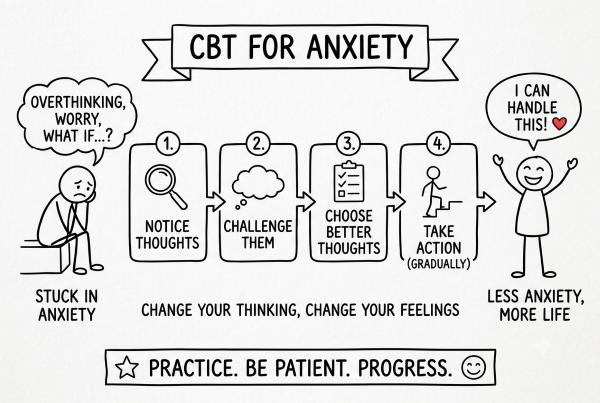
CBT treats anxiety by changing what you do, not only what you think. Most progress happens between sessions.
A typical CBT plan includes:
- A clear goal you can measure, such as driving on the highway again
- A list of situations you currently avoid, ranked from easy to hard
- Weekly practice facing one step on that list
- A repeated score, usually the GAD-7, to track progress
The GAD-7 is a seven-question anxiety checklist that your clinician scores at each review. Your therapist does not argue with you out of fear. They help you collect proof.
What Medication Is Used in Anxiety Treatment?
Antidepressants are the main medicines used in anxiety treatment, and they count as a first-line option, not a last resort. They ease anxiety even when depression is absent.
- SSRIs and SNRIs: Sertraline and venlafaxine are common first choices. Give them four to six weeks to fully work.
- Benzodiazepines: These calm panic fast, but the body grows dependent quickly, so doctors keep courses short.
- Beta blockers: Helpful for a racing heart before one specific event, such as a presentation.
Mild side effects usually settle down. Quitting in week two, before the medicine has had a fair chance, is the most common mistake.
Evidence-Based Treatment for Generalized Anxiety Disorder
Generalized anxiety disorder is worry that spreads across many areas of life and lasts at least six months. It responds best to CBT built around worry itself.
Sessions usually teach four skills:
- Telling the difference between a problem you can solve and worrying you cannot
- Keeping worry to a set time each day instead of all day
- Stopping the habit of seeking reassurance, which feeds the cycle
- Sitting with uncertainty without checking or overplanning
An SSRI often runs alongside this. That pairing matters when worry has lasted years and skills alone move too slowly.
Best Therapy for Anxiety and Depression Together
Anxiety and depression get treated together under one plan, because treating only one usually disappoints. CBT targets the thinking patterns under each, and SSRIs are a first choice for either.
NIMH notes that anxiety disorders often occur alongside depression and that many people live with more than one condition at once.
How Long Does Anxiety Treatment Take?
Improvement follows a rough pattern, and it is rarely a straight line.
Stage | What happens |
Weeks 1 to 2 | Assessment, diagnosis, and a first GAD-7 score |
Weeks 2 to 6 | Skills start landing, and medicine begins to help. |
Weeks 6 to 12 | Exposure practice reopens situations you avoided. |
Months 4 to 12 | Holding gains, preventing relapse, planning any taper |
Expert Advice: Ask your clinician to rescore your GAD-7 every four weeks, then adjust.
Can Anxiety Be Cured Permanently With Treatment?
Anxiety is managed rather than cured, and that is a better goal than it sounds. Sleep, panic frequency, avoidance, and muscle tension all improve reliably.
What treatment will not do is remove anxiety completely. A nervous system that reacts to threats is working correctly. Success means anxiety no longer decides your schedule, your job, or your relationships.
Anxiety Treatment With Substance Use Involved
When alcohol or drugs are in the picture, anxiety treatment has to run alongside addiction care rather than after it.
Alcohol, benzodiazepines, and opioids quiet anxiety for a few hours. Then it rebounds higher than before. People read that rebound as worsening anxiety and use more, which tightens the loop.
NIDA reports that people who experience a mental illness during their lives often develop a substance use disorder too, and the reverse is just as common.
Integrated care puts one team on both problems with one shared plan. Withdrawal is handled medically, because stopping alcohol or benzodiazepines suddenly can be dangerous.
Call DeLand Treatment Solutions treats anxiety and substance use together
What Anxiety Treatment at Home Helps?
Home habits will not replace clinical anxiety treatment, but they make it work better.
- Aerobic exercise: burns off stress hormones and rivals medicine for mild symptoms
- A fixed wake-up time: steadies mood faster than chasing a fixed bedtime
- Cutting caffeine, nicotine, and alcohol lowers baseline tension within days
- Slow breathing: long exhales calm the body during a spike
When Does Anxiety Treatment Become Urgent?
Some symptoms need a same-day call rather than a scheduled visit:
- Chest pain, fainting, or a racing heart that will not settle
- Panic attacks that start during sleep and keep repeating
- Worse mood or restlessness after a medicine change
- Drinking or taking pills more just to get through the day

Evidence-Based Anxiety Treatment at DeLand Treatment Solutions
DeLand Treatment Solutions builds anxiety care around three things working together: acceptance and commitment therapy, medication management, and GeneSight testing. GeneSight is a cheek-swab genetic test showing how your body is likely to process certain psychiatric medicines, which cuts down trial and error.
Our anxiety disorder treatment opens with a full assessment. If alcohol or drugs are tangled up in the worry, clients move into the dual diagnosis program and co-occurring substance use treatment, both booked through our contact page.
Care steps down as you get steadier, moving from a residential structure into partial hospitalization and then aftercare, so your progress holds after you leave. Call us or use our contact page.
FAQs
What is the most effective treatment for anxiety?
Cognitive behavioral therapy has the strongest research record of any talk therapy for anxiety. It works for panic, social fear and general worry. For moderate or severe symptoms, adding an SSRI usually beats either one alone. Your clinician picks the mix based on how severe your symptoms are.
How do you treat anxiety without medication?
CBT, exposure therapy, and acceptance and commitment therapy all work well on their own, especially for mild to moderate anxiety. Regular exercise, steady sleep and less caffeine support them. These habits cannot replace therapy, but they make it work faster and help you hold your gains.
What does a CBT treatment plan for anxiety look like?
A plan sets one measurable goal, such as driving on the highway again. It lists the situations you avoid, ranked easy to hard, and schedules weekly practice facing one step. Your therapist tracks a repeated score, usually the GAD-7. Most plans run 8 to 20 sessions.
Are anxiety medicines addictive?
SSRIs and SNRIs are not addictive. Stopping them suddenly can cause dizziness and flu-like symptoms, so prescribers lower the dose slowly. Benzodiazepines are different. They carry a real dependence risk, which is why doctors keep courses short and watch them closely, especially if you have used substances before.
What is exposure therapy actually like?
You and your therapist rank feared situations from easiest to hardest, then work up that list at a pace you agree on. Each step is planned ahead, repeated, and held long enough for your anxiety to drop on its own. Nothing happens by surprise, and you stay in control.
Can I get anxiety treatment if I drink or use drugs?
Yes, and you should. Dual diagnosis care treats anxiety and substance use at the same time with one team. Treating anxiety alone rarely holds, because untreated drinking or drug use undoes the progress. Tell your clinician exactly what you use, including how much and how often.
How do I know my anxiety needs professional treatment?
Consider an assessment if worry has lasted six months, feels hard to control, and is affecting your sleep, work or relationships. Physical symptoms with no medical cause are another signal, such as a racing heart or stomach trouble. Avoiding places you used to go matters too.
What happens in the first anxiety treatment session?
A clinician reviews your symptoms, medical history, current medicines and any alcohol or drug use, then scores the GAD-7 questionnaire with you. Expect to talk through how daily life looks right now. You leave with a working diagnosis and a proposed plan, not usually a prescription.
Does exercise really help anxiety?
Exercise is a good way to reduce stress hormones and sleep problems, and for mild anxiety, it can be as effective as medication. Walking, cycling, and swimming all qualify! Set up sessions that you can do over and over, but not ones that you dread. Exercise is complementary to treatment and a substitute for therapy or medicine.
What is GeneSight testing?
GeneSight is a genetic test that provides information on the way the body may react to some psychiatric medications. A swab of your cheek is sent to a lab, and the results help to determine what medicines you might be prescribed. It helps most people when they have had negative side effects or no gain from taking medicines in the past.
Who needs residential care rather than weekly sessions?
Residential care suits people whose symptoms are severe, whose daily life has broken down, or whose substance use complicates recovery. You live on-site and get round-the-clock support while your plan settles. Most stays run about thirty days, then step down to less intensive care.
How can families help someone start anxiety treatment?
Offer specific help instead of general encouragement, such as sitting beside them during the first phone call or driving them to the appointment. Avoid taking over the thing they are dodging, because that quietly confirms the avoidance. Ask them directly what would help, then do that.
References
- https://www.cdc.gov/nchs/data/nhsr/nhsr213.pdf
- https://www.cdc.gov/nchs/products/databriefs/db564.htm
- https://www.who.int/news-room/fact-sheets/detail/anxiety-disorders
- https://www.nimh.nih.gov/health/statistics/any-anxiety-disorder
- https://www.nimh.nih.gov/health/topics/anxiety-disorders
- https://doi.org/10.1001/jama.2022.22744
- https://pmc.ncbi.nlm.nih.gov/articles/PMC8475916/
- https://pmc.ncbi.nlm.nih.gov/articles/PMC6829787/
- https://nida.nih.gov/publications/research-reports/common-comorbidities-substance-use-disorders
- https://delandts.com/anxiety-disorder-treatment/
Medical Disclaimer: This article is for informational purposes only and is not a substitute for personalized medical advice from a licensed clinician at DeLand Treatment Solutions.