Quick Answer: The best mental health treatment is the one that corresponds to your diagnosis. In the majority of instances where therapy is required, this involves medication or a combination of therapy and medication appropriately selected on the basis of the evaluation.
Key Takeaways
- No single treatment works for everyone. What works best is decided by the condition being treated.
- For moderate and severe symptoms, therapy combined with medication usually beats either one on its own.
- An accurate diagnosis comes first, because the wrong target wastes months of otherwise good treatment.
Ask ten people what works and you will get ten confident answers, most of them built on one person’s experience. The honest answer is less satisfying and far more useful: it depends on what you are being treated for.
The most effective mental health treatment depends on the diagnosis rather than the brand. Cognitive behavioral therapy leads to anxiety and depression, trauma-focused therapy for PTSD, and medication for bipolar disorder. For moderate to severe symptoms, combining therapy with medication usually works better than either one on its own.
So the question worth asking is not which treatment wins overall. It is which one fits your condition, and what to do when the first attempt falls short.
So What is Good Mental Health Care?
Effective means tested and not popular. A method earns the label when it beats a placebo or a waiting list in controlled research, repeatedly.
There are three things that stand in the way of treatment that works and a slick sales pitch:
- Measured results. Symptoms are scored before, during and after, rather than judged by feel.
- Repeated findings. The same result turns up with different patients and different research teams.
- A named method. Branded programs nobody else offers cannot be checked against anything.
If a provider cannot name the method they plan to use on you, treat that as information.
NIMH points out that psychotherapies go through no formal approval process the way medications do, which makes the published research the only reliable guide to whether an approach actually works. (NIMH)
Most Effective Mental Health Treatment by Condition
Here is the part the ranking pages leave out. Effectiveness changes with the condition.
Condition | Usually first | Often added | Why this order |
Generalized anxiety | CBT | SSRI | Skills hold after therapy ends |
Panic disorder | CBT with exposure | SSRI | Exposure breaks the avoidance loop |
Depression | CBT or behavioral activation | SSRI | Combined care wins for severe cases |
PTSD | Trauma-focused therapy or EMDR | SSRI | Processing beats talking around it |
OCD | Exposure and response prevention | SSRI | Generic talk therapy underperforms |
Bipolar disorder | Mood stabilizer | Therapy and psychoeducation | Medication comes first for stability |
Social anxiety | CBT with exposure | SSRI | Practice in feared situations matters |
Two things follow from that table. OCD and PTSD need specific methods, so general counseling often disappoints. And bipolar disorder is the clearest case where medication leads and therapy supports, not the other way around.
Not sure which column fits you? DeLand Treatment Solutions can check.
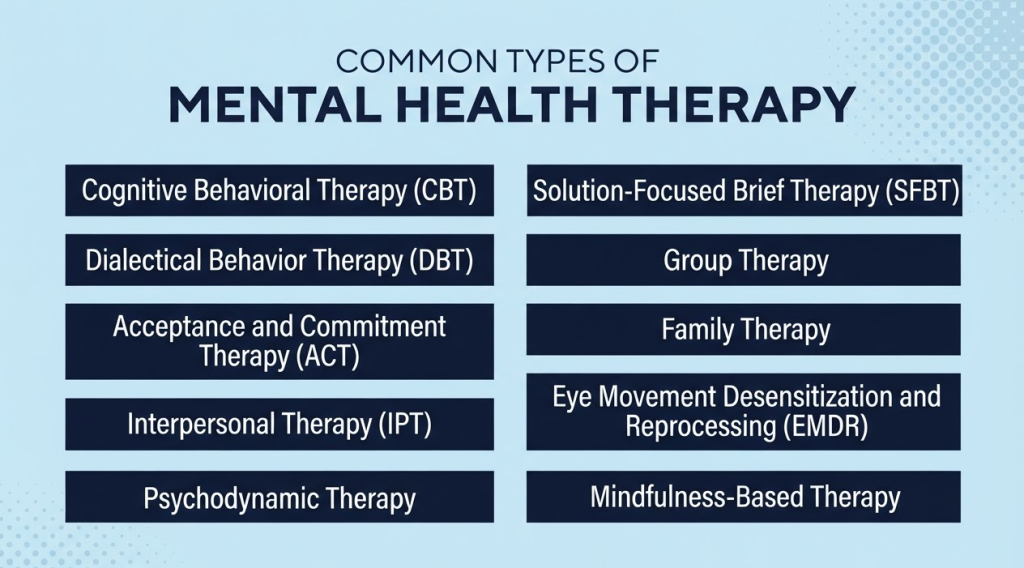
Four Types of Mental Health Treatment
Treatment comes in four forms, and most plans use two of them.
- Talk therapy. Structured approaches such as CBT, ACT, DBT and trauma-focused work, delivered one-to-one or in groups.
- Medication. Antidepressants, mood stabilizers, antipsychotics, and anti-anxiety medicines, prescribed and reviewed by a clinician.
- Levels of care. Outpatient, intensive outpatient, partial hospitalization program, and residential care, chosen by how much structure you need.
- Supporting approaches. Exercise, sleep repair, family involvement, and peer support, which make the other three work better.
Supporting approaches are genuinely useful. They are not replacements.
Fact: CDC found 19.3% of US adults took mental health medication in 2024.
Is Therapy or Medication More Effective?
Neither wins outright. Severity and diagnosis decide it.
For mild to moderate symptoms, therapy performs about as well as medication, and the gains tend to last longer once treatment ends, because the skills stay with you. For severe symptoms, medication often works faster and can steady things enough for therapy to land.
For moderate and severe cases, using both usually beats either alone. That is the finding sitting behind most of the AI answers you have already read on this question.
How Mental Health Treatment Has Changed
Mental health care looks very little like the version most people picture.
What has actually changed:
- Measurement-based care. Scored questionnaires track progress instead of guesswork.
- Genetic testing. Tools such as GeneSight can show how your body is likely to process certain medications.
- Integrated treatment. One team handles the mental health condition and the substance use together.
- Step-down models. Intensity reduces gradually after stabilization rather than stopping dead.
- Family inclusion. Relatives are part of the plan, not people in the waiting room.
MedlinePlus describes good mental health care as a combination of professional treatment and daily habits, with neither one replacing the other.
What has not changed is the foundation. Therapy and medication remain the core of treatment.
How Mental Health Diagnosis Actually Works
This step is worth getting right, because treatment only works when it is aimed at the right thing.
A proper assessment usually includes:
- A full history. When symptoms started, how they have changed, and what has been tried before.
- Scored screening tools. Short questionnaires such as the GAD-7 and PHQ-9.
- A medical review. Ruling out thyroid problems and medication side effects.
- Substance use questions. Alcohol and drugs mimic and worsen many conditions.
- A written plan. The diagnosis is named, the method named, and a review date set.
Most mental illnesses do not have a blood test to diagnose them. Diagnosis is the outcome of a clinician making a judgment based on a weighing of history vis-à-vis clinical criteria.
A clear diagnosis starts the plan. DeLand Treatment Solutions assesses.
Who Actually Gets Mental Health Treatment?
The lack of effective mental health treatment is not because it does not work. The vast majority of individuals do not get it.
What the data shows | The figure | Source and year |
US adults who took medicine for mental health | 19.3 percent in the past year | CDC NCHS, 2024 data |
US adults who saw a therapist or counselor | 14.0 percent in the past year | CDC NCHS, 2024 data |
Adults aged 18 to 29 who had counseling or therapy | 20.2 percent, the highest age group | CDC NCHS, 2024 data |
Adults aged 75 and over who had counseling or therapy | 5.0 percent, the lowest age group | CDC NCHS, 2024 data |
People worldwide living with a mental health condition | Over one billion | WHO, 2025 |
Compare the first two rows. Combined care wins for moderate and severe conditions, yet far more people are taking medication than are sitting in front of a therapist.
WHO reports that effective treatments exist for most mental health conditions, but health systems have not kept pace, leaving a wide gap in every region between the people who need care and the people who receive it.
How Long Does Mental Health Treatment Take?
Most structured therapy runs in weeks and months, not years, which surprises people.
Stage | What usually happens |
Weeks 1 to 2 | Assessment, diagnosis, baseline score |
Weeks 2 to 6 | Skills begin landing, and medication starts working. |
Weeks 6 to 12 | Real change in daily functioning |
Months 4 to 12 | Maintenance, relapse prevention, taper decisions |
NIMH describes structured psychotherapy as short-term for many people, running a few weeks to a few months, with longer courses where the problem calls for it. Medication is usually continued for several months after symptoms improve, because stopping as soon as you feel well raises the chance they return.
Expert Advice: Re-assess symptoms every 4 weeks and modify the plan if not improving.
What If the First Treatment Fails?
A first attempt that does not work is common rather than exceptional.
Reasonable next steps:
- Check the diagnosis. Aiming at the wrong target is the most frequent reason therapy stalls.
- Check the dose and the time. Medication needs weeks at an adequate dose before you can judge it.
- Check the method. OCD and PTSD need specific approaches that general counseling does not provide.
- Check what else is running. Untreated drinking or drug use will hold progress down.
- Consider more support. A higher level of care gives structure that weekly sessions cannot.
NIMH notes that antidepressants commonly take four to eight weeks to show their full effect and that sleep, appetite, and concentration often improve before mood does. (NIMH)
Response rates sit below 100% for every method ever studied. One failed attempt is a reason to change the plan, not to stop.
Holding Gains After Mental Health Treatment
Finishing treatment is not the end of it, and a plan written in advance makes the gains easier to keep.
What does hold up?
- Using the skills regularly instead of filing them away
- Taking medication for the agreed period, not stopping the week you feel well
- Writing down your early warning signs while you are still well
- Protecting sleep, movement, and alcohol limits, since all three move symptoms
- Agreeing in advance who you will call when things slip
Worried the gains will slip? DeLand Treatment Solutions plans.

Mental Health Treatment at DeLand Treatment Solutions
DeLand Treatment Solutions starts with an assessment rather than a fixed program, so the method gets matched to the diagnosis.
- Cognitive behavioral therapy, for anxious thinking and persistent low mood
- Acceptance and commitment therapy, for long-running worry and avoidance
- Dialectical behavior therapy, for intense emotions and unstable relationships
- EMDR and trauma therapy, for memories that stay stuck
- Daily individual sessions alongside group and family therapy for people who need both settings
- Medication management with GeneSight testing, used in bipolar and anxiety planning when past medicines have not fitted
Levels of care, and when each applies:
Medical detox and comprehensive supervision around-the-clock treatment when mixed with withdrawal requirements
- Residential dual diagnosis treatment, around thirty days, for when home is not a workable base for recovery
- A planned step down into a partial hospitalization program, for keeping daily structure while independence returns
- Aftercare and alumni support, for holding the gains once the formal program ends
- One team treats the mental health condition and the substance use together, because each quietly undoes progress made on the other.
To explore options for supervised support, contact DeLand Treatment Solutions
FAQs
What is the single most effective mental health treatment?
There is no single winner. Effectiveness depends on the diagnosis. CBT leads for anxiety and depression, trauma-focused therapy leads for PTSD, and medication leads for bipolar disorder. For moderate and severe symptoms, combining therapy with medication usually outperforms either approach alone.
What is the best medicine for a mental disorder?
It depends entirely on the condition. SSRIs are the first line for anxiety, depression and OCD. Mood stabilizers are the first line for bipolar disorder. Antipsychotics treat psychotic conditions. Only a prescriber who has assessed you can match the medicine to your diagnosis safely.
Is therapy more effective than medication?
For mild to moderate symptoms, therapy matches medication, and its benefits tend to last longer after treatment ends. For severe symptoms, medication often works faster. Most research supports using both together when symptoms are moderate or severe rather than choosing one.
How do I get diagnosed with a mental health condition?
Book an assessment with a clinician who takes a full history, scores a screening questionnaire such as the GAD-7 or PHQ-9, reviews your medicines and asks about substance use. There is no blood test for most conditions, so diagnosis rests on clinical judgement.
Is there a mental illness diagnosis test I can take?
Online quizzes are screening tools, not diagnoses. Validated questionnaires such as the PHQ-9 and GAD-7 flag whether your symptoms warrant a proper assessment, and clinicians use those same tools to track progress over time. A real diagnosis still requires a trained professional reviewing your full history.
What are the main types of mental health treatment?
Talk therapy, medication, different levels of care, and supporting approaches such as exercise and family involvement. Most effective plans combine two of these. Levels of care range from weekly outpatient sessions through intensive outpatient and partial hospitalization programs up to residential treatment.
How long does mental health treatment usually take?
Structured therapy such as CBT often runs a few weeks to a few months rather than years. Medication is usually continued for several months after symptoms improve, because stopping early raises relapse risk. Trauma-focused and longer-term approaches can run considerably longer depending on what is being treated.
Can mental illness be cured or only managed?
Most conditions are managed rather than cured, though some single episodes resolve fully and never return. The realistic goal is symptoms mild enough that they no longer shape your decisions, supported by relapse prevention skills you keep using long after treatment ends.
Does mental health treatment work for everyone?
No treatment helps everyone. Response rates in research sit well below 100 percent for every approach. A first attempt that does not work is common, and usually means the diagnosis, the dose or the method needs revisiting rather than abandoning treatment.
When should treatment move beyond weekly sessions?
When symptoms are severe, when daily functioning has broken down, when substance use complicates recovery, or when weekly sessions are no longer held. Intensive outpatient, partial hospitalization program program and residential care each provide more structure while a treatment plan stabilizes.
References
- NIMH, psychotherapies
- NIMH, caring for your mental health
- NIMH, finding help for co-occurring substance use and mental disorders
- CDC, mental health treatment among adults
- CDC, mental health conditions and care
- WHO, mental health strengthening our response
- MedlinePlus, how to improve mental health
- MedlinePlus, mental disorders
- NIH, cognitive behavioral treatments for anxiety and stress
Medical Disclaimer: This article is for informational purposes only and is not a substitute for personalized medical advice from a licensed clinician at DeLand Treatment Solutions.