Perhaps you are scheduled for a drug test and you’re counting the days since your last dose. Perhaps you are a parent seeking to know what is normal for your kid’s prescription. Or perhaps a friend or family member is exhibiting shifts, and you ask yourself how severe is this?
You don’t deserve some vague guess as to what you should expect, regardless of the reason you’re here. Adderall 20mg typically stays in your system for a few days, depending on the type of test used and a few individual factors.
A 20mg dose of Adderall typically stays in your system for 2 to 4 days. Since its half-life is roughly 9 to 14 hours, most of the dose clears within 4 to 5 half-lives, a timeline that stays fairly consistent whether the dose is 10 mg or 20 mg, since it’s driven more by metabolism than dose size. Detection varies by test type: about 12–48 hours in blood, up to 50 hours in saliva, 1–4 days in urine, and up to 90 days in hair.
What Is Adderall 20mg Used For
Adderall 20mg is a standard therapeutic dose of Adderall prescribed for ADHD and narcolepsy for adolescents and adults. It is in the usual range for a medication after a doctor has started an increased dose, if the person responds to it.
Doctors usually begin patients on a lower dose, often 5 to 10mg, and increase gradually as needed. Reaching 20mg often reflects several weeks of dose adjustment rather than a starting point.
At this dose, most patients experience meaningful symptom control for ADHD, though the right amount always depends on the individual and should be set by a prescribing doctor.
FACT: Early treatment for behavioral disorders can significantly improve long-term social, emotional, and academic outcomes.
How Long Does Adderall Stay In Your System
Adderall generally stays in your system for 2 to 4 days after the last dose, though small traces can sometimes be detected slightly longer depending on the test used. This applies to 20mg doses just as it does to other common doses.
The amphetamine salts in Adderall have a half-life of roughly 9 to 14 hours, meaning it takes that long for the body to clear half of a given dose. Full elimination typically takes about 4 to 5 half-lives.
This timeline holds fairly steady across dose sizes, since half-life is largely about how quickly the body metabolizes the drug, not how much was taken. Higher doses simply mean there’s more of the drug to clear before it’s fully gone.
Adderall Detection Time and Detection Window
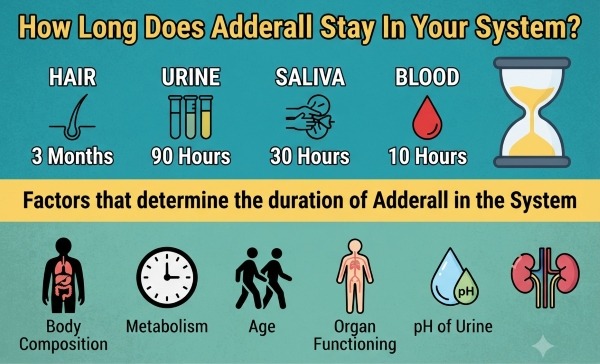
Adderall detection time varies significantly depending on the type of test used, ranging from same-day detection in blood to several months in hair. This table breaks down the most common testing methods.
Test Type | Typical Detection Window |
Saliva | Up to 50 hours |
Blood | 12 to 48 hours |
Urine | 1 to 4 days, longer with chronic use |
Hair | Up to 90 days |
Urine testing remains the most common method for workplace and clinical screening, largely because it’s non-invasive and covers a practical detection window.
Experts Advice: Seek a professional evaluation early, as timely intervention often leads to better long-term recovery outcomes.
What Affects Adderall Detection Time
Several individual factors can shift how long Adderall stays detectable beyond these general ranges. No two people clear the medication at the same rate.
- Dosage size and how frequently it’s taken
- Individual metabolism and kidney function
- Urine pH, since more acidic urine speeds elimination
- Age, with older adults often clearing it more slowly
- Other medications that affect liver metabolism
- Hydration and overall health
Chronic, long-term use tends to extend detection windows compared to a single occasional dose, since the drug accumulates more before use stops.
Common Adderall Side Effects To Know
Common Adderall side effects include decreased appetite, dry mouth, trouble sleeping, and increased heart rate, most of which are considered a normal part of stimulant use at a therapeutic dose. These often lessen as the body adjusts.
Other common side effects include:
- Headache
- Nervousness or irritability
- Weight loss
- Stomach upset
- Elevated blood pressure
Most people tolerate these effects reasonably well, especially once a doctor helps fine-tune the dose and timing.
Serious Adderall Side Effects To Watch For
Serious Adderall side effects are less common but require prompt medical attention, since they involve the heart and mental health. These go beyond typical stimulant discomfort.
Watch for:
- Chest pain or a racing, irregular heartbeat
- Severe agitation, paranoia, or hallucinations
- Signs of a heart attack or stroke
- Uncontrolled muscle movements or tics
- Extreme mood swings or aggressive behavior
If any of these appear, especially chest pain or hallucinations, seek emergency medical care right away rather than waiting to see if symptoms pass.
Signs Of Adderall Dependence Or Misuse
Adderall dependence develops when the body and brain adapt to regular use, often showing withdrawal symptoms or the need for higher doses to get the same effect. Misuse means using the medication differently than prescribed.
Warning signs include:
- Taking more than the prescribed amount
- Using someone else’s prescription
- Crushing or snorting the medication
- Feeling unable to focus or function without it
- Anxiety, fatigue, or low mood when not using it
Recovery Timeline After Stopping Adderall
Stopping Adderall, whether prescribed or misused, follows a general pattern as the body readjusts. This table offers a realistic overview, not a guarantee.
Timeframe | What Typically Happens |
Days 1 to 3 | Fatigue, low mood, increased appetite begin |
Days 3 to 7 | Symptoms often peak, along with strong cravings if misused |
Weeks 1 to 2 | Energy and mood gradually start to stabilize |
Weeks 2 to 4 | Sleep and concentration continue improving |
Beyond 1 month | Most physical symptoms resolve, ongoing support helps sustain progress |
Anyone stopping after misuse or high-dose use should talk to a doctor first, since abrupt changes can be uncomfortable and are best managed with guidance.
Steps To Take If You’re Worried About Adderall
If you’re concerned about your own use or a loved one’s, a clear next step can make this feel less overwhelming.
- Have an honest conversation with a doctor about current use and concerns
- Avoid adjusting the dose or stopping suddenly without medical guidance
- Get a full assessment if misuse or dependence seems likely
- Explore treatment options, including therapy or a structured program
- Involve family for support, especially if trust has been affected
- Build a long-term plan for managing ADHD symptoms safely, with or without medication
Seeking help from DeLand Treatment Solutions provides essential guidance
Adderall Addiction Treatment At DeLand Treatment Solutions
If you’ve read this far because something about your own use, or someone else’s, doesn’t feel right anymore, that instinct is worth trusting.
DeLand Treatment Solutions provides comprehensive prescription drug addiction treatment for stimulant misuse, supported by medically informed detox, residential treatment, and step-down outpatient care.
We’re accredited by The Joint Commission, licensed through the Florida Association of Recovery Residences, and proud members of the National Association of Addiction Treatment Providers, so care here meets real clinical standards, not guesswork.
Concerned about behavioral disorders and their impact on daily life? Call DeLand Treatment Solutions to learn about compassionate, evidence-based care.
FAQs
How long does Adderall 20mg stay in your urine?
Adderall is typically detectable in urine for 1 to 4 days after the last dose, including a 20mg dose. Chronic or heavy use may extend detection to about a week, depending on metabolism, kidney function, hydration, urine pH, and overall health.
How long does Adderall stay in your blood?
Blood tests usually detect Adderall for approximately 12 to 48 hours after the last dose. Because the detection window is relatively short, blood testing is primarily used to confirm recent use rather than identify medication taken several days earlier.
Does Adderall show up the same in a hair test?
Yes, hair follicle testing can detect Adderall use for up to 90 days after exposure. Hair tests provide the longest detection window of common drug tests but are used less frequently than urine testing for routine workplace or clinical screening.
Does a higher dose like 20mg stay in your system longer than 10mg?
Not significantly. Adderall’s half-life remains fairly consistent across different doses, although a 20mg dose contains more medication to eliminate. This may slightly extend detection times in some cases, but individual metabolism and urine pH usually have a greater influence.
What is Adderall 20mg used for?
Adderall 20mg is commonly prescribed to treat attention-deficit/hyperactivity disorder (ADHD) and narcolepsy. It is often reached after gradually increasing from a lower starting dose, allowing healthcare providers to balance symptom control with minimizing potential side effects and ensuring safe, effective treatment.
What are the most common Adderall side effects?
Common Adderall side effects include decreased appetite, dry mouth, headache, difficulty sleeping, nervousness, and increased heart rate. These effects are often mild and may lessen as the body adjusts, although persistent or bothersome symptoms should be discussed with a healthcare provider.
What are the serious side effects of Adderall?
Serious side effects include chest pain, irregular heartbeat, severe agitation, hallucinations, shortness of breath, and symptoms of heart attack or stroke. Although uncommon, these reactions require immediate medical attention because they may indicate potentially life-threatening cardiovascular or neurological complications requiring urgent evaluation.
Can a prescription explain a positive drug test for Adderall?
Yes, standard drug tests detect amphetamines but cannot determine whether they came from prescribed Adderall or another source. Providing documentation of a valid prescription to the Medical Review Officer usually explains the result and prevents it from being reported as unauthorized use.
How do I know if I’ve become dependent on Adderall?
Dependence may involve needing higher doses for the same effect, feeling unable to function without the medication, or experiencing fatigue, irritability, or low mood when doses are missed. A healthcare provider can evaluate symptoms and recommend appropriate adjustments or support if needed.
Is it safe to stop taking Adderall suddenly?
It is generally best to consult your prescribing provider before stopping Adderall, particularly after long-term or higher-dose use. Abrupt discontinuation can trigger fatigue, mood changes, increased sleep, and strong cravings that are often easier to manage with medical guidance and supervision.
How long do Adderall withdrawal symptoms last?
Adderall withdrawal symptoms usually peak during the first week after stopping and gradually improve over two to four weeks. Some symptoms, including low mood, fatigue, or difficulty concentrating, may persist longer depending on duration of use, dosage, and individual recovery factors.
When should I be concerned about someone else’s Adderall use?
Concern is warranted if someone takes more than prescribed, uses another person’s medication, seeks extra prescriptions, or cannot function without Adderall. Addressing these warning signs early with compassionate support and professional guidance can reduce the risk of dependence or addiction
References
- National Institute on Drug Abuse, Prescription Stimulants DrugFacts
- Mayo Clinic, Adderall and Adderall XR Dosing Information
- U.S. Food and Drug Administration, Adderall Prescribing Information
- DEA, Drug Scheduling Overview
- SAMHSA, Substance Use and Co-Occurring Mental Disorders
- Cleveland Clinic, ADHD Overview and Treatment
- MedlinePlus, Amphetamine Overdose
- National Institute of Mental Health, Attention-Deficit/Hyperactivity Disorder
- DeLand Treatment Solutions, Prescription Drug Addiction Rehab
- DeLand Treatment Solutions, Cognitive Behavioral Therapy
This blog is for educational purposes only and is not a substitute for professional medical advice. Never adjust or stop a prescribed medication without consulting your doctor. If you or a loved one needs support, DeLand Treatment Solutions is available to help.