In This Blog:
- Determining the Co-occurring Disorders of mental health and substance disorders.
- The importance of integrated support at the same time.
- General combinations of psychological and use disorders.
- Structured care with behavioral therapies.
- The role of long term professional supervision.
A dual diagnosis is a case where a person experiences both mental health conditions and a substance abuse disorder at the same time.
Both of these concerns are often closely interrelated with each other where one of these concerns tends to inflate the effects of the other.
As an example, the individual may resort to some substances as a mode of self-medicating himself due to an unexamined sense of anxiety or chronic substance use may frequently cause the disposition of a mood disorder.
With each of the conditions interacting with each other, there is often the chance of a setback where one side is handled and the other is ignored.
It takes effective recovery that deals with the biological and psychological causes of both problems to get over it efficiently.
Such an integrated approach implies that the person is getting an integrated assessment and an integrated plan which is based on the unique needs.
With professional oversight within the setting, one will be able to attain some degree of stability and lay the foundation of a healthy future.
Expert Advice: A professional support environment offers essential tools for managing complex mental health conditions.
The Integrated Treatment Model
The gold standard for the treatment of a dual diagnosis is the integrated support. In this paradigm the same professional addresses the symptoms of mental health issues and the substance use issues simultaneously.
This serves to make sure that the sufferer does not receive conflict in information or care. With a combination of things, the treatment environment becomes a cohesive space to heal completely.
Common Co-occurring Conditions
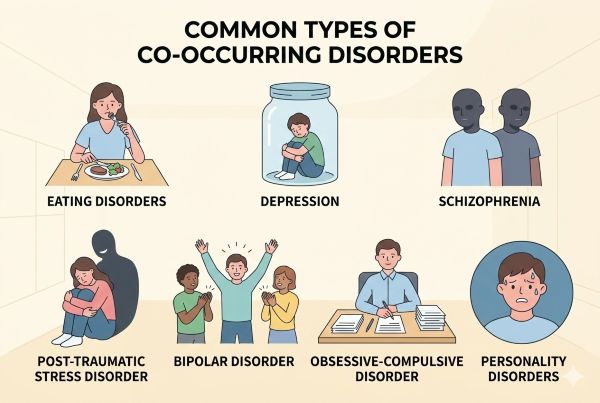
Numerous subsets of disorders may be found in an individual. Usually anxiety and depression are experienced with the taking of alcohol or stimulant use.
Other combinations are post-traumatic stress disorder (PTSD) or bipolar disorder, that occur with substance use.
To make their contributions towards the right recovery services identifying the specific pairing should be established.
Mental Health Condition | Common Co-occurring Substance Concern |
Alcohol or sedatives for self-medication | |
Stimulants or alcohol to alter mood | |
PTSD | Various substances used to numb trauma triggers |
Bipolar Disorder | Substances used during manic or depressive phases |
Transitioning to Supervised Support
The two conditions can be stabilised safely in a monitoring environment.
This is the type of setting that will facilitate the kind of constant professional control, which would be necessary to manage the intricate symptoms.
The Importance of Simultaneous Care
The presence of the two conditions needs to be treated at the same time due to the likelihood of having similar biological pathways.
The desire to use substances to cope is likely to continue till there is remedial intervention to any underlying depression.
On the other hand, as long as drug use continues, it can be a hindrance to mental health support. Integrated recovery services addresses this cycle.
Seeking help from DeLand Treatment Solutions provides essential guidance
Behavioral Therapies in Dual Diagnosis
An additional important component to dual diagnosis care plan would be behavioral therapies.
The very basis of CBT is helping people to find the negative thought patterns that bring around substance use as well as emotional distress.
Dialectical Behavior Therapy (DBT) is used which assists in the regulation of feelings and emotional distress tolerance therapy.
These tools are trained in a treatment setting, in order to create a long term resiliency.
Core Therapeutic Goals
- Trigger Identification: The identification of the emotional and social warning signs, leading to use.
- Coping Strategies: Good healthy habits of coping without a substance.
- Relapse Prevention: Creating a medical strategy concerning the stability in daily life.
- Emotional Regulation: Tricks to learn to control the intense emotions in a safe, rational way.
The Role of Medication Management
For most, the maintenance of a supervised support system includes medication. It can be used to stabilize the mood, take away the anxiety and even regulate the need to take some substances.
Professional supervision makes sure that medications that are being prescribed, do not affect each other adversely. This surveillance thus is required for any physical and mental security.
Building a Support Network
Recovery is hardly an individual task, and it entails a strong community of colleagues, and professionals.
Group sessions are a form through which people exchange their experiences with other human beings who are well versed with the complex aspects of co-occurring disorders.
This connection is a counter against existing isolation which can be a result of mental health struggles.
Organized support provides the structure of development for these significant relations.
Components of a Strong Network
- Peer Support: It involves interaction with other people in a recovery services setting.
- Family Involvement: Educating family regarding co-occurring disorders.
- Professional Guidance: Constant contact with a support group on a periodic basis.
- Aftercare Planning: Establishing a long-term strategy for continued health.

Reclaiming a Fulfilling Life
The end goal of the recovery services is to help individuals to return to their life with a sense of purpose.
This involves patching up relationships, reentering work and back to finding joy in day-to-day activities.
The continuity of care ensures that the person is having a safety net as they experience the changes.
Everything is quite possible with the right equipment and you can lead a stable life and remain healthy.
To explore options for supervised support, contact DeLand Treatment Solutions
Choosing to address both mental and substance issues is a courageous step and it is not an easy bet to make.
It has been found that the integrated treatment environment is what many people have been looking for when it comes to bringing clarity.
It is focused on the whole person in comparison to focus on a set of symptoms. Professional oversight offers a way to recover and lead to a much more balanced and lead to a much more fulfilling life.
FACT: Co-occurring disorders require simultaneous support for both specific health concerns.
Medical Disclaimer: This blog is for informational purposes only and is not a substitute for professional medical advice.
Key Takeaways
- Co-occurring disorder involve a mental health condition and substance use disorder appearing together.
- It is through following integrated care plans that the conditions are treated simultaneously.
- CBT, as a behavioral therapy is critical in finding out what are the triggers and the building of resiliency.
- Professional oversight ensures that medication and therapy work together safely and effectively.
- Long-term stability is achieved through a combination of structured support and aftercare.
FAQs
Can one disorder cause the other to happen?
While one does not necessarily cause the other, they are often deeply related. For example, a mental health struggle may lead to substance use as a way to cope with emotional pain. Conversely, heavy substance use can alter brain chemistry and lead to mood instability.
Why is it harder to treat these together?
It requires a more comprehensive approach because the symptoms of each condition can overlap and mask one another. A professional treatment environment is needed to carefully untangle these symptoms. This ensures that both the psychological and physical needs of the individual are met.
What happens if I only treat the addiction?
If the underlying mental health concern is ignored, the original reason for using substances may still exist. This often leads to a higher risk of returning to old patterns once the initial care ends. Integrated recovery services are designed to prevent this by addressing the root causes.
Is medication always required for co-occurring disorders?
Not always, but it is often an important tool for stabilizing symptoms during the early stages of care. A supervised support system will provide an assessment to determine if medication is right for you. Every plan is tailored to the specific needs of the individual.
How long does this type of care take?
The timeline for wellness is unique to every person and depends on the complexity of their specific conditions. Some may benefit from several months of high-intensity care, followed by long-term outpatient support. Professional oversight helps determine the appropriate duration for your journey.
References
- https://my.clevelandclinic.org/health/diseases/24426-dual-diagnosis
- https://www.nimh.nih.gov/health/topics/substance-use-and-mental-health
- https://www.drugabuse.gov/publications/drugs-brains-behavior-science-addiction/treatment-recovery
- https://www.nami.org/About-Mental-Illness/Common-with-Mental-Illness/Substance-Use-Disorders