Quick Answer: The general term for any treatment that facilitates healing is therapy. One type of therapy, in particular, is psychotherapy, which involves formal verbal communication with a qualified mental health practitioner.
Key Takeaways
- Therapy includes speech therapy and physical therapy. It’s merely mental health therapy.
- Psychotherapy is formal, evidence-based talk therapy that is provided by a licensed clinician.
- Most people use the word “therapy” for “psychotherapy” in everyday conversation, and that’s okay.
You searched this because there was somebody who used both words, but didn’t know which one they meant. Perhaps a physician recommended therapy or an insurance policy indicated psychotherapy. Perhaps you have to start looking around for whom to call.
The word “therapy” is an umbrella that covers all treatments that are intended to cure a disease or improve a person’s well-being. One type is psychotherapy, which involves regular, structured discussions with a licensed mental health worker. All psychotherapy sessions are therapy sessions. Not all therapy sessions qualify as psychotherapy, and it can make a difference in selecting therapy.
However, the answer won’t help you choose a provider. To do this, you must understand who is licensed to do what and what insurance covers it.
What Does Therapy Actually Mean?
Therapy means any treatment designed to heal, ease symptoms, or improve how you function. It stretches far outside mental health: physical therapy restores movement, speech therapy rebuilds communication, and chemotherapy treats cancer.
In mental health, therapy almost always means talk-based care with a professional.
What Does Psychotherapy Mean in Mental Health?
Psychotherapy is structured talk treatment for emotional, mental, and behavioral problems. The National Institute of Mental Health describes it as treatment that helps you identify and change troubling emotions, thoughts, and behaviors.
Three things make it psychotherapy rather than a supportive chat:
- It follows a recognized clinical method
- It comes from someone licensed and trained in that method
- It works toward measurable goals, usually tied to a diagnosis
NIMH notes there is no FDA approval process for talk therapies as there is for medicines, so research evidence separates proven approaches from untested ones.
Not sure which you need? Call DeLand Treatment Solutions.
100% Confidential Support is Available 24/7
No matter what you’re going through, you’re not alone. Our dedicated team is here to provide a safe, judgment-free space where you can talk openly and honestly. Whether you need emotional support, resources, or just someone to listen.
We’re here for you—completely confidential and always respectful of your privacy. Call us today!
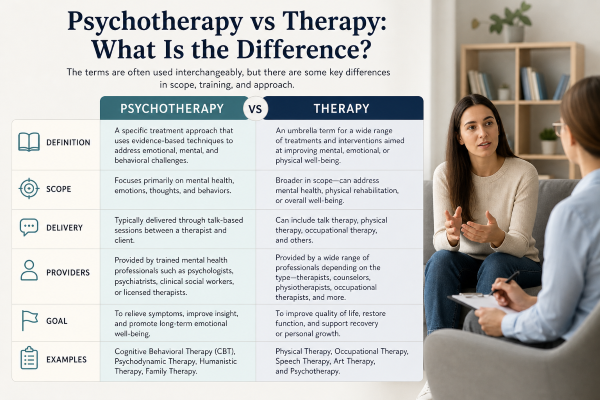
Psychotherapy vs Therapy: The Key Differences
The comparison most people are looking for:
What differs | Therapy (general mental health use) | Psychotherapy |
Scope | Umbrella term, includes non-mental health care | Mental and emotional health only |
Main focus | Current stress, grief, coping skills | Long-standing patterns, trauma, diagnoses |
Typical length | Shorter and goal-focused | Medium to long term |
Structure | Flexible and supportive | Follows a defined clinical method |
Who delivers it | Counselors, social workers, various providers | Licensed clinicians trained in psychotherapy |
Diagnosis involved | Often not | Usually yes |
These are tendencies, not rules. One therapist may do brief supportive work and deep trauma processing in the same week.
Deland Treatment Solutions
Battling with Drug and Alcohol Addition? Remember, you are not alone and we are here to help you!
Who Can Provide Psychotherapy and Therapy?
Credentials vary more than people realize, and this is where the difference gets real.
Provider | Training | What they can usually do |
Psychiatrist (MD or DO) | Medical school plus residency | Diagnose, prescribe, provide psychotherapy. |
Psychologist (PhD or PsyD) | Doctorate plus supervised hours | Diagnose, test, provide psychotherapy. |
Licensed clinical social worker | Master’s plus supervised hours | Diagnose, provide psychotherapy, and link you to services. |
Licensed mental health counselor | Master’s plus supervised hours | Diagnose and provide psychotherapy and counseling. |
Marriage and family therapist | Master’s plus relational hours | Psychotherapy for couples and families |
Psychiatric nurse practitioner | Nursing plus psychiatric specialty | Diagnose, prescribe, and sometimes provide psychotherapy. |
Life coach | No license required | Goal setting only, not clinical treatment |
That last row matters. Coaching is unregulated in most places, so a coach cannot diagnose or treat a condition. For depression, trauma, or addiction, you need a licensed clinician.
One Florida detail worth knowing. Psychologists can prescribe in only seven states, and Florida is not one. Medication here comes from a psychiatrist or psychiatric nurse practitioner.
What Are the Main Types of Psychotherapy?
Psychotherapy is a family of methods, each suited to different problems.
- Cognitive behavioral therapy (CBT): finds the thoughts driving distress and tests them against evidence
- Dialectical behavior therapy (DBT): teaches skills for intense emotions and unstable relationships
- Acceptance and commitment therapy (ACT): helps you stop fighting difficult thoughts and act on your values
- Psychodynamic therapy: explores how early experiences shaped patterns you repeat
- EMDR: uses guided eye movements while recalling trauma, so the memory loses its charge
- Exposure therapy: faces feared situations in planned steps
- Family therapy: treats the pattern between people, not one person in the room
Most clinicians blend two or three rather than following one strictly.
Fact: A 2024 review of 441 trials tested psychotherapy across eight mental disorders.
How Does Psychotherapy Compare to Counseling?
Counseling sits between general support and full psychotherapy, which is why the words blur.
Counseling means shorter work on one present problem, such as grief or work stress. Psychotherapy goes further back, asking why a pattern repeats. Many professionals offer both, and care may shift between them.
What Does the Research Say About Psychotherapy?
Talk therapy works, though honest numbers are more modest than marketing suggests.
What the data shows | The figure | Source and year |
US adults who got counseling or therapy in a year | 14.0 percent | CDC, 2024 survey |
US adults who took mental health medicine | 19.3 percent | CDC, 2024 survey |
Adults aged 18 to 29 who got counseling or therapy | 20.2 percent, the highest age group | CDC, 2024 survey |
Adults aged 75 and over who got counseling or therapy | 5.0 percent, the lowest age group | CDC, 2024 survey |
Trials in a major psychotherapy review | 441 trials, 33,881 patients | World Psychiatry, 2024 |
That 2024 World Psychiatry review found psychotherapy beat control conditions for seven of eight disorders studied, with response rates near 42 percent for major depression.
A first attempt that does not work is common, not a sign you are beyond help.
Which Kind of Therapy Do You Need?
Match care to the problem rather than the word.
Short-term counseling often fits when:
- One recent event knocked you off balance
- You want coping tools for a defined stress
- Daily functioning is mostly intact
Psychotherapy fits better when:
- The same pattern keeps returning across years
- You have a diagnosis or suspect one
- Trauma is part of the picture
- Substance use has become part of how you cope
Book an assessment with DeLand Treatment Solutions todayBook an assessment with DeLand Treatment Solutions today
Call Now: (386) 866-8689
Does Insurance Cover Psychotherapy or Therapy?
Insurance usually pays for psychotherapy from a licensed provider, not for coaching.
What affects coverage:
- Provider license: claims are billed under recognized credentials
- A diagnosis code: most plans need one to approve sessions
- Session limits: some plans cap the number per year
- Network status: in-network costs are far less
Check before you start, not after the third session. Most clinics, including DeLand Treatment Solutions, will verify your coverage first.
CDC data from 2024 shows 14.0 percent of US adults received counseling or therapy, while 19.3 percent took medication for their mental health.
When Talk Therapy Alone Is Not Enough
Sometimes psychotherapy needs support from other care, and spotting that early saves months.
Signs more intensive help is needed:
- Symptoms worsen despite regular sessions
- You cannot keep up with work, school, or self-care
- Alcohol or drug use is increasing
- You are having thoughts of harming yourself
Medication or a higher level of care gives the stability that makes therapy work. If you are in immediate danger, call 988 or go to your nearest emergency room.
Expert Advice: Ask any provider directly about their license, training, and treatment method.
How to Choose the Right Provider for You?
Asking questions before you commit is expected:
- What is your license, and what are you trained to treat?
- Which psychotherapy methods do you use most?
- Have you worked with my concern before?
- How will we measure whether this is working?
- What happens if I need medication or more intensive care?
If you do not feel heard after a few sessions, say so. Changing providers is not a failure.

Psychotherapy and Therapy at DeLand Treatment Solutions
Most people start with weekly psychotherapy, and that is enough. Some need more than an hour a week, especially when substance use is tangled up in it. DeLand Treatment Solutions works with the second group.
Psychotherapy approaches used here:
- Acceptance and commitment therapy, our main approach for anxiety
- Cognitive behavioral therapy, for anxious thinking and low mood
- Dialectical behavior therapy, for intense emotions
- EMDR and trauma therapy, for experiences that still intrude
- Family therapy, for households carrying this together
How often you would attend:
- Intensive outpatient, several sessions weekly while you live at home
- Partial hospitalization, most of the day, several days a week
- Residential, full-time support when home is not workable yet
- Aftercare and alumni support, for holding gains afterwards
Mental health and substance use are handled by one team here, which matters when one feeds the other. GeneSight testing guides medication choices when earlier ones did not suit you.
We work from DeLand, Florida. Call us or use our contact page if weekly sessions are not held.
FAQs
Is psychotherapy the same as therapy?
Not exactly. Therapy is a broad word covering many treatments, including physical and speech therapy. Psychotherapy is one specific type, focused on mental and emotional health through structured talk with a licensed clinician. In casual conversation, people use them interchangeably, and that rarely causes confusion.
Is a psychotherapist better than a therapist?
Neither is better. A psychotherapist is a therapist with specific training in psychotherapy methods. What matters is whether the person is licensed, trained in your particular concern, and someone you feel comfortable talking to. Credentials and fit predict results far better than job titles.
What is the difference between psychotherapy and counseling?
Counseling usually addresses one current problem over a shorter period, such as grief or work stress. Psychotherapy explores longer-standing patterns, trauma, and diagnosed conditions over more sessions. Many licensed professionals provide both and adjust as your needs shift, sometimes without ever naming the change.
How long does psychotherapy usually take?
It depends on what you are treating. Structured methods such as CBT often run 8 to 20 weekly sessions. Psychodynamic or trauma-focused work can last a year or more. Your clinician should give you an estimated timeframe early and review progress regularly against it.
Can a psychotherapist prescribe medication?
Usually not. Psychiatrists and psychiatric nurse practitioners can prescribe because of their medical training. Counselors, social workers, and, in Florida, psychologists cannot. Many clinics pair a therapist with a separate prescriber, so medication and talk therapy are reviewed together rather than drifting apart.
Which type of psychotherapy is most effective?
It depends on the condition being treated. CBT has the strongest evidence for anxiety and depression. EMDR suits PTSD, and DBT helps with intense emotions and self-harm urges. Your clinician should match the method to your diagnosis rather than offering one approach to everyone.
Can psychotherapy help with addiction?
Yes. CBT, DBT, motivational approaches, and family therapy are all used in addiction treatment. When a mental health condition sits alongside substance use, treating both together works better than treating one and hoping the other follows. This combined approach is called dual diagnosis care.
Is online psychotherapy as effective as in-person?
Research generally finds video-based psychotherapy performs comparably to in-person care for common conditions, though not every clinic offers it. Ask before you book. In-person care fits better when symptoms are severe, safety is a concern, or substance use needs monitoring.
How do I know if therapy is working?
You and your clinician should track progress with a repeated score, not just a feeling. Sleep, mood, avoidance, and daily functioning are usual markers. Some improvement is reasonable to expect within six to eight weeks. If nothing has shifted, raise it rather than quietly continuing.
What if I do not connect with my therapist?
Say so directly. A good clinician will adjust their approach or help you find someone who fits better. Research shows the working relationship strongly predicts whether treatment succeeds, so a poor match is a real clinical issue rather than something you should quietly push through.
References
- https://www.nimh.nih.gov/health/topics/psychotherapies
- https://www.nimh.nih.gov/health/find-help
- https://www.cdc.gov/nchs/products/databriefs/db564.htm
- https://www.cdc.gov/mental-health/about-data/conditions-care.html
- https://onlinelibrary.wiley.com/doi/10.1002/wps.21203
- https://pmc.ncbi.nlm.nih.gov/articles/PMC8475916/
- https://www.nimh.nih.gov/health/topics/caring-for-your-mental-health
- https://nida.nih.gov/publications/research-reports/common-comorbidities-substance-use-disorders
- https://www.who.int/news-room/fact-sheets/detail/mental-disorders
- https://delandts.com/
Medical Disclaimer: This article is for informational purposes only and is not a substitute for personalized medical advice from a licensed clinician at DeLand Treatment Solutions.