When you’re living with Histrionic Personality Disorder it can feel like you’re constantly onstage, constantly seeking reassurance, a
And you can never be good enough without the audience. That fatigue is very real, and so is the confusion it causes in those around you.
This is the important part. One of the most studied and proven methods for combating this condition is called Cognitive Behavioral Therapy. It’s not a personality change, but it may be a shift in the way you interact with your emotions and your loved ones.
Let’s discuss what you can expect during treatment, what happens quickly, what may take longer and what a true recovery timeline looks like before you decide whether or not this path is right for you or your loved one.
What Is Histrionic Personality Disorder?
Histrionic personality disorder (HPD) is a mental disorder characterized by a chronic pattern of excessive attention-seeking and approval-seeking behaviors. Individuals with HPD tend to be uncomfortable when not in the spotlight.
This isn’t about vanity. It’s a deep-rooted pattern of seeking validation because self-worth feels unstable without it. Emotions tend to shift fast and get expressed loudly, sometimes in ways that feel bigger than the situation calls for.
HPD falls under what psychiatry calls “Cluster B personality disorders,” the same group that includes Borderline and Narcissistic Personality Disorder. These conditions share overlapping traits like emotional intensity and unstable relationships.
FACT: Personality disorders are described by clinicians as chronic and treatment-resistant patterns that require individualized, long-term psychotherapeutic care rather than a quick fix.
Common Symptoms Of Histrionic Personality Disorder
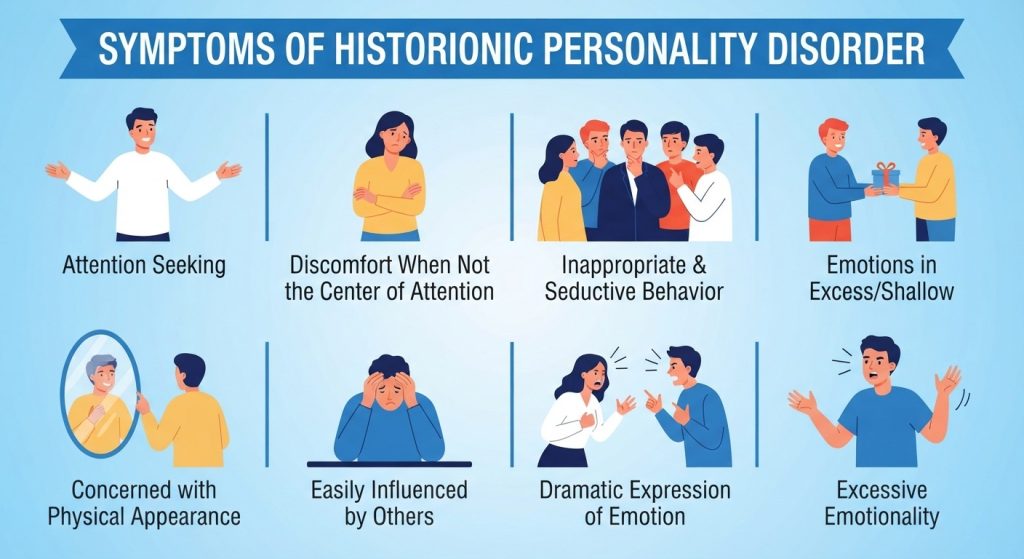
People with HPD usually show a cluster of behaviors that affect relationships, work, and self-image. Recognizing these patterns is the first step toward getting the right kind of help.
- Constant need to be the center of attention
- Rapidly shifting and shallow emotional expression
- Overly dramatic or theatrical reactions to small events
- Using physical appearance to draw attention
- Speech that’s vague, impressionistic, and light on detail
- Believing relationships are closer than they actually are
- Being easily influenced by others or by circumstances
Warning Signs Families Notice First
Families often notice the emotional swings before anything else. One moment things seem fine, and the next there’s a crisis that feels impossible to predict or calm down.
Loved ones also describe feeling manipulated or exhausted, even when they can’t quite explain why. That reaction is common and it doesn’t mean you’re wrong to feel it.
Watching a loved one’s emotional swings feel unpredictable? DeLand Treatment Solutions can guide your family toward real answers.
How Cognitive Behavioral Therapy Works
Cognitive Behavioral Therapy treats HPD by targeting the thoughts that drive attention-seeking behavior, not just the behavior itself. It’s a structured, short-term approach that gives people real tools instead of vague advice.
A therapist helps you notice automatic thoughts like “nobody will care about me unless I make a scene.” From there, you learn to test whether that thought is actually true.
Over time, this rewires the link between a triggering moment and your reaction to it. You start pausing before reacting instead of running on autopilot.
CBT helps clients recognize the connection between attention seeking behaviors and underlying fears of rejection, then teaches them to validate themselves instead of relying on outside approval.
CBT Techniques Used For Histrionic Personality Disorder
Therapists use a handful of proven techniques, adjusted to fit each person’s specific triggers and history.
- Thought records to catch and challenge distorted beliefs
- Behavioral experiments that test fears in real situations
- Role play to practice calmer responses before they’re needed
- Emotion regulation skills borrowed from DBT when reactions run hot
- Homework between sessions to build consistency outside the therapy room
What CBT Changes In Histrionic Personality Disorder
CBT can noticeably shift the thought patterns that fuel attention seeking behavior, usually within the first few months of consistent sessions. This is the part clients notice fastest.
People often report catching themselves before an outburst, questioning whether a reaction fits the situation, and feeling less dependent on constant reassurance from others.
Relationships tend to improve as communication becomes more direct and less theatrical. Partners and family members frequently notice this shift before the client fully recognizes it in themselves.
Experts Advice: Build a strong therapeutic relationship, since consistency predicts treatment success.
If attention-seeking patterns and substance use are both present, DeLand Treatment Solutions offers coordinated, dual-diagnosis care today.
Limits Of Cognitive Behavioral Therapy
CBT cannot rewrite a personality overnight, and it doesn’t erase the core traits that make someone who they are. Personality forms over decades, so change happens gradually, not instantly.
Deep-seated fears of abandonment, formed in childhood, often need additional approaches like schema therapy or psychodynamic work layered alongside CBT for lasting change.
Dropout is also a real limit. A meta-analysis in the American Journal of Psychiatry found dropout rates near 17 percent for CBT in personality disorder treatment, which is why consistency and a strong therapeutic relationship matter so much.
Effective treatment of personality disorders depends heavily on a stable therapeutic relationship, since inconsistent engagement is one of the biggest predictors of poor outcomes.
Histrionic Personality Disorder Recovery Timeline
Recovery isn’t a straight line, but most people follow a general pattern as therapy progresses. This table gives you a realistic picture, not a promise.
Timeframe | What Typically Happens |
Weeks 1 to 4 | Building trust with the therapist, identifying core triggers |
Months 1 to 3 | Learning to catch distorted thoughts before reacting |
Months 3 to 6 | Noticeable drop in dramatic outbursts, better self-awareness |
Months 6 to 12 | Steadier relationships, less reliance on external validation |
Beyond 12 months | Maintenance work, relapse prevention, deeper trauma processing |
Every timeline shifts depending on whether addiction, depression, or anxiety are also part of the picture.
Steps In Cognitive Behavioral Therapy Treatment
Getting started with CBT for HPD follows a fairly predictable process, even though the pace differs from person to person.
- A licensed clinician completes a full psychological assessment
- You and your therapist set specific, measurable treatment goals
- Sessions begin, usually weekly, focused on thought and behavior patterns
- Skills practice happens both in session and as homework
- Progress gets reviewed and the plan adjusts every few weeks
- Family sessions get added if relationships need direct repair
- A relapse prevention plan is built before treatment winds down
Histrionic Personality Disorder And Addiction Risk
People with HPD face a higher risk of substance misuse, often because alcohol or drugs offer quick relief from emotional intensity or fear of rejection. This overlap is called a co-occurring disorder.
Treating only the addiction, or only the personality disorder, usually leads to relapse. Both need attention at the same time, ideally from a team trained in dual diagnosis care.
Individuals with mental health disorders are significantly more likely to turn to substances as a way of self-medicating unmanaged symptoms, which is why integrated treatment produces better long-term outcomes than treating either condition alone.

Cognitive Behavioral Therapy At DeLand Treatment Solutions
At DeLand Treatment Solutions, we treat Histrionic Personality Disorder using Cognitive Behavioral Therapy alongside Dialectical Behavior Therapy, individual counseling, and structured family therapy sessions that help repair relationships strained by years of miscommunication.
Many of our clients arrive with a co-occurring substance use disorder, which is why our dual diagnosis program treats addiction and personality disorder symptoms together, under one coordinated plan, instead of two disconnected ones.
You don’t have to figure this out alone tonight. Call us or reach out through our contact page to talk with someone who understands exactly what you’re facing.
FAQs
Q: Is Histrionic Personality Disorder curable?
No cure eliminates Histrionic Personality Disorder, but symptoms often improve significantly with consistent treatment. Therapy helps people build healthier relationship patterns, improve emotional regulation, strengthen self-awareness, and reduce attention-seeking behaviors. Many individuals experience meaningful, lasting improvements in daily functioning and overall quality of life.
Q: What is the best therapy for HPD?
Cognitive Behavioral Therapy (CBT) is one of the most effective treatments for HPD because it helps identify unhealthy thinking and behavior patterns. Dialectical Behavior Therapy (DBT) may improve emotional regulation, while psychodynamic therapy can address unresolved attachment issues and long-standing interpersonal patterns contributing to symptoms.
Q: How long does CBT take to work for HPD?
Many people begin noticing improvements in emotional awareness and thinking patterns within two to three months of regular CBT sessions. However, changing deeply rooted personality patterns usually requires six to twelve months or longer. Progress depends on treatment consistency, motivation, and the presence of co-occurring mental health conditions.
Q: Can medication treat Histrionic Personality Disorder?
There are no medications specifically approved to treat HPD itself. However, psychiatrists may prescribe antidepressants or anti-anxiety medications when conditions like depression, anxiety, or mood symptoms occur alongside HPD. Medication works best when combined with psychotherapy rather than used as a standalone treatment.
Q: Is HPD the same as Borderline Personality Disorder?
No. Although both disorders involve emotional intensity and relationship difficulties, they have different core features. HPD primarily involves excessive attention-seeking and emotional expression, while Borderline Personality Disorder is characterized by fear of abandonment, unstable identity, impulsivity, and rapidly changing relationships.
Q: Does group therapy work for HPD?
Yes, group therapy can be beneficial, particularly after progress has been made in individual therapy. It provides opportunities to practice healthier communication, receive constructive feedback, and develop interpersonal skills. Many clinicians recommend beginning with individual therapy before transitioning into a structured therapeutic group setting.
Q: What causes Histrionic Personality Disorder?
Researchers believe HPD develops through a combination of genetic factors, personality traits, and early life experiences. Inconsistent caregiving, excessive praise for dramatic behavior, or conditional attention during childhood may contribute. No single cause explains every case, and multiple influences usually interact throughout development.
Q: Can someone with HPD have healthy relationships?
Yes. With appropriate treatment, many people with HPD develop healthier, more stable relationships. Therapy helps strengthen self-esteem, improve emotional regulation, reduce reliance on external validation, and build communication skills that support genuine intimacy, trust, and long-term relationship satisfaction.
Q: Is Histrionic Personality Disorder linked to addiction?
Yes. People with HPD have a higher risk of substance misuse than the general population. Drugs or alcohol may be used to cope with emotional distress, impulsivity, or relationship difficulties. Integrated dual diagnosis treatment addresses both personality disorder symptoms and substance use simultaneously.
Q: How is HPD diagnosed?
A licensed mental health professional diagnoses HPD through a comprehensive clinical evaluation, reviewing symptoms, personal history, relationship patterns, and functioning. Diagnosis follows DSM-5 criteria and may include structured assessment tools. Self-diagnosis is unreliable because personality disorders share symptoms with several other mental health conditions.
Q: Does insurance cover HPD treatment?
Most private health insurance plans provide coverage for medically necessary mental health services, including therapy for personality disorders. Coverage varies depending on your specific plan, deductible, provider network, and authorization requirements. Treatment centers can usually verify benefits before you begin care.
Q: What happens if HPD goes untreated?
Without treatment, HPD can contribute to ongoing relationship conflicts, workplace difficulties, emotional distress, depression, anxiety, and an increased risk of substance misuse. Over time, these challenges may become more disruptive. Early diagnosis and consistent therapy improve long-term functioning, relationships, and overall emotional wellbeing.
References
- Cleveland Clinic, Histrionic Personality Disorder
- NCBI StatPearls, Histrionic Personality Disorder
- PMC, The Effectiveness of Cognitive Behavioral Therapy for Personality Disorders
- American Journal of Psychiatry, Effectiveness of Psychodynamic Therapy and CBT for Personality Disorders
- Mayo Clinic, Personality Disorders Overview
- National Institute of Mental Health, Personality Disorders
- SAMHSA, Mental Health and Substance Use Co-Occurring Disorders
- American Psychological Association, What Is Cognitive Behavioral Therapy
- DeLand Treatment Solutions, Histrionic Personality Disorder Treatment
- DeLand Treatment Solutions, Cognitive Behavioral Therapy
This blog is for educational purposes only and is not a substitute for professional medical advice. If you or a loved one needs support, DeLand Treatment Solutions is available to help.