If you’re searching for cognitive therapy for dissociative identity disorder, you probably want a straight answer to a hard question: can CBT actually help with dissociation? The short version is yes, in a specific and limited way. CBT is rarely the whole treatment for a dissociative disorder, but it’s often one of the most practical pieces of it, because it teaches skills you can use the next time you feel yourself drifting away from the present moment.
This guide from DeLand Treatment Solutions explains what dissociative disorders are, where CBT fits, and what it looks like in practice. No jargon, no false promises.
Cognitive behavioral therapy for dissociation focuses on the link between thoughts, emotions, and behavior. A therapist helps you notice the thought patterns that feed distress (“I’m losing control,” “I’ll never feel normal”), test whether those thoughts hold up, and build steadier responses.
According to the Cleveland Clinic, dissociative disorders involve disruptions in memory, identity, consciousness, or perception, most often connected to overwhelming trauma. Treatment guidelines from the International Society for the Study of Trauma and Dissociation (ISSTD) recommend a phased approach, and CBT skills tend to do their best work in the first phase: safety and stabilization.
Key takeaways
- Dissociative disorders disrupt memory, identity, awareness, and perception.
- Trauma, especially repeated childhood trauma, is the most common factor behind them.
- CBT for dissociative identity disorder targets unhelpful thinking patterns and builds coping skills. It doesn’t try to merge identities or force memory recovery.
- CBT is usually one component of a phased, individualized plan, not a standalone cure.
- Grounding skills and emotional regulation techniques can reduce distress between sessions.
- Earlier mental health diagnosis and consistent support improve long-term outcomes.
100% Confidential Support is Available 24/7
No matter what you’re going through, you’re not alone. Our dedicated team is here to provide a safe, judgment-free space where you can talk openly and honestly. Whether you need emotional support, resources, or just someone to listen.
We’re here for you—completely confidential and always respectful of your privacy. Call us today!
What is a dissociative disorder?
A dissociative disorder is a mental health condition that disrupts how a person experiences their own thoughts, memories, emotions, identity, or surroundings. This is different from zoning out during a boring meeting. Dissociation at a clinical level interferes with work, school, relationships, and daily responsibilities.
People often describe it as watching their life from outside their body or discovering hours have passed with no memory of them.
Common experiences include:
- Feeling detached from reality or from your own body
- Memory gaps you can’t explain
- Losing track of time
- Emotional numbness
- Confusion about who you are
- Trouble keeping relationships stable
- Difficulty concentrating
These experiences can be frightening, but they’re recognized medical conditions with real treatment options, not personality flaws.
Why understanding dissociation matters
Many people live with dissociative symptoms for years before anyone names them correctly. The symptoms overlap heavily with anxiety, depression, and PTSD, so misdiagnosis is common. Some research has found that people with dissociative identity disorder spend years in the mental health system before receiving an accurate diagnosis.
Knowing what dissociation is helps you recognize symptoms earlier, feel less afraid of experiences that seem strange, and ask better questions when you do seek help. It also chips away at stigma.
Need help making sense of dissociation?
If you or someone you love is dealing with these symptoms, talking to a professional is worth it even if you’re not sure what’s going on yet. Call DeLand Treatment Solutions at (386) 866-8689 to speak confidentially with our team.
What is cognitive behavioral therapy (CBT)?
CBT is one of the most heavily researched forms of psychotherapy. The core idea: thoughts shape emotions, emotions drive behavior, and behavior reinforces the original thoughts. When that loop turns unhealthy, distress compounds. CBT interrupts the loop.
Unlike therapies that spend most of their time in the past, CBT is skills-first. You leave sessions with things to practice: thought records, grounding exercises, and behavioral experiments. For someone whose symptoms include losing contact with the present, having concrete tools matters.
How CBT may help someone living with dissociation
Dissociation often runs on autopilot. A trigger appears, distress spikes, and the mind checks out before the person even notices what happened. Behavioral therapy slows that sequence down so each step becomes visible and workable.
In practice, that means learning to spot your specific triggers, catching the catastrophic thoughts that follow (“something is wrong with me”), and practicing grounding before the dissociation fully takes hold. It also means rebuilding routines. Sleep, meals, and structure sound mundane, but instability in daily life makes dissociative episodes more frequent and harder to recover from.
The goal isn’t to erase every symptom in month one. It’s to function a little better each week.
Why is CBT still so widely used
Feature | Why it matters |
Structured | Sessions follow clear goals with measurable progress |
Practical | Skills get practiced between sessions, in real situations |
Collaborative | You’re an active participant, not a passive patient |
Well researched | Decades of trials across dozens of conditions |
Adaptable | Pacing and content adjust to a person’s stability and readiness |
For dissociation specifically, that last row is the important one. A good therapist adapts CBT to your current stability rather than pushing a standard protocol.
Types of Dissociative Disorders
Dissociative identity disorder (DID)
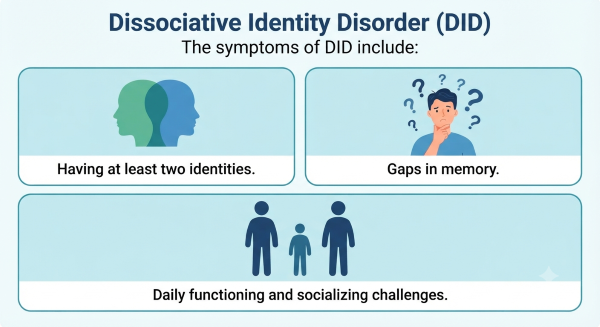
DID involves two or more distinct identity states that influence a person’s behavior, memory, and sense of self. People with DID often report significant memory gaps, identity confusion, and finding evidence of things they’ve done with no recollection of doing them.
When people ask about cognitive therapy for dissociative identity disorder, the honest answer is that CBT is one component of a longer, phased treatment plan. It is not a quick fix, and it doesn’t work in isolation for DID.
Dissociative amnesia
Memory loss that ordinary forgetting or a neurological condition can’t explain. The gaps usually involve personal history, traumatic events, or specific periods of time. Some people recover memories gradually on their own; others need sustained psychological support.
Depersonalization/derealization disorder
Depersonalization is feeling detached from your own body, thoughts, or emotions. Derealization is the feeling that the world is unreal, foggy, or dreamlike. Unlike psychosis, people experiencing these states usually know the sensations aren’t accurate, which is part of what makes them so distressing.
Can someone have more than one condition?
Yes, and it’s the norm rather than the exception. Dissociative disorders frequently occur alongside PTSD, depression, anxiety disorders, and substance use disorders. Because the symptoms overlap, a full evaluation matters. Treating only the depression while missing the dissociation (or vice versa) leaves half the problem untouched.
Symptoms and Causes of Dissociative Disorders
Symptoms vary widely. Some people notice occasional detachment; others lose whole stretches of time and can’t hold a job or a relationship steady because of it.
Common symptoms:
- Feeling disconnected from yourself or your surroundings
- Unexplained memory gaps
- Losing track of time
- Emotional numbness
- Confusion about personal identity
- Sudden mood shifts
- A sense that the world isn’t real
- Trouble concentrating or sleeping
What causes them?
There’s no single cause, but the research points overwhelmingly toward trauma. The Cleveland Clinic notes that dissociative disorders are most often linked to overwhelming or repeated trauma, particularly in childhood. Dissociation appears to start as a survival mechanism: the mind walls off experiences too painful to process all at once. The problem is the wall doesn’t come down when the danger ends.
Contributing factor | How it may contribute |
Repeated or severe trauma makes dissociation a learned coping response | |
Emotional abuse or neglect | Sustained distress changes how the brain processes experience |
Physical or sexual abuse | Strongly associated with disruptions in memory and identity |
Witnessing violence or disaster | Can trigger dissociative symptoms even without direct harm |
Chronic stress | Worsens existing symptoms |
Not everyone who experiences trauma develops a dissociative disorder. Genetics, temperament, and whether a child had at least one safe, supportive adult all influence risk.
CBT vs. Trauma-focused psychotherapy
People often ask which approach is “better.” Wrong question. They do different jobs, and most treatment plans for dissociation use both, in sequence.
CBT | Trauma-focused psychotherapy | |
Primary focus | Thoughts, behaviors, coping skills | Processing traumatic memories |
Session style | Structured, goal-oriented | Flexible, often phased |
Main objective | Improve daily functioning and emotional regulation | Address the impact of traumatic memories |
Homework | Common | Sometimes |
When it’s typically used | Early: stabilization and skill-building | Later: once the person is stable enough to process trauma safely |
Attempting trauma processing before a person can regulate their emotions and stay grounded tends to backfire. That’s why skills come first.
CALL US NOW
DeLand Treatment Solutions will iron out the details for you in a manner that will make you confident in your path to sobriety. That first simple call is your ticket to making DeLand Treatment Solutions your solution for addiction. Get the freedom from addiction that you deserve today.
Dissociative disorder test
A lot of people land on this page after searching for a dissociative disorder test. Online screeners like the Dissociative Experiences Scale (DES) exist, and they can be useful conversation starters.
They cannot diagnose you. A real assessment includes a detailed personal history, a review of current symptoms and daily functioning, and screening for overlapping conditions like PTSD and depression. If an online quiz worries you, treat that worry as a reason to book an evaluation, not as a verdict.
Talk to someone who understands.
Dissociation is isolating, almost by definition. You don’t have to sort it out alone.
Call DeLand Treatment Solutions at (386) 866-8689 for a confidential conversation about your options. Is there medication for dissociative disorders?
No medication is FDA-approved specifically for dissociative disorders. That surprises people, but it’s the current reality. Medication still plays a role for many patients, just indirectly.
A prescriber may recommend medication for co-occurring anxiety, depression, sleep problems, or mood instability, which can make the dissociative symptoms easier to work on in therapy. Medication alone, though, is not considered adequate treatment for dissociation.
The therapy is the treatment; how medication supports mental health is that it supports it.
Dissociative disorder ICD-10 codes
Clinicians and insurers classify dissociative disorders under the ICD-10 F44 category, which covers disruptions in consciousness, identity, memory, sensation, or movement. This includes dissociative amnesia, dissociative fugue, dissociative identity disorder, and depersonalization/derealization disorder. If you’ve seen an F44 code on paperwork or an insurance claim, that’s what it refers to.
Dissociative disorders in the DSM-5
The DSM-5, the diagnostic manual used by mental health professionals in the US, recognizes three primary dissociative disorders:
Disorder | Primary characteristics |
Dissociative identity disorder | Two or more distinct identity states, with gaps in memory and identity |
Dissociative amnesia | Inability to recall important personal information beyond normal forgetting |
Depersonalization/derealization disorder | Persistent detachment from oneself or one’s surroundings |
Two requirements matter for diagnosis. The symptoms must cause significant distress or impair daily functioning, and the clinician must rule out medical conditions, substance use, and other explanations first.
Why early recognition matters
The typical pattern with dissociative disorders is a long delay: people assume their experiences are normal, or feel too embarrassed to describe them, and years pass. Every one of those years is a year of coping alone.
Getting help earlier means learning grounding and regulation skills before symptoms calcify into avoidance patterns, and before co-occurring problems like substance use take root as self-medication. Recovery isn’t one big breakthrough. It’s a lot of small, repeatable steps, and starting sooner means more of them.
Dissociative disorder treatment
No single plan works for everyone.
Effective treatment is built around the person’s specific symptoms, history, and goals, and it usually includes several of the following:
- Individual psychotherapy (the core of treatment)
- Emotional regulation and grounding skills
- Family education and support
- Stress management
- Relapse prevention for co-occurring substance use
- Sleep, nutrition, and routine work
- Peer support where appropriate
Progress tends to be gradual. Fewer episodes, shorter episodes, faster recovery when they happen. Those small shifts compound.
Cognitive behavioral therapy examples
CBT is easiest to understand through concrete situations:
Situation | Automatic thought | Healthier CBT response |
Feeling disconnected during a stressful meeting | “I’m losing control.” | “This is dissociation. I can pause, breathe, and ground myself.” |
Avoiding social gatherings | “Something bad will happen.” | “I can go for 30 minutes and leave if I need to.” |
Feeling emotionally numb | “I’ll never feel normal again.” | “Numbness is a symptom, not a prognosis. Feelings return gradually.” |
An intrusive memory hits | “I’m back in danger.” | “The memory feels real, but I’m safe right now.” |
Notice what CBT is not doing here. It’s not pretending everything is fine. It’s separating the feeling from the fact.
Cognitive behavioral therapy techniques
The core CBT toolkit includes:
Cognitive restructuring: Identify a distressing thought, examine the evidence for and against it, and build a more accurate replacement.
Journaling: Tracking emotions, triggers, and daily experiences reveals patterns that aren’t visible in the moment.
Behavioral activation: Gradually returning to activities you’ve withdrawn from, at a manageable pace, instead of waiting to “feel ready.”
Relaxation strategies: Breathing exercises, progressive muscle relaxation, and mindfulness to lower baseline stress.
Problem-solving: Breaking overwhelming problems into steps small enough to actually start.
Self-monitoring: Rating moods and symptoms over time so you and your therapist can see what’s working.
CBT techniques for dissociation
For dissociation specifically, CBT gets adapted. Stability comes before everything else.
Grounding exercises. The 5-4-3-2-1 technique (name five things you can see, four you can hear, and so on); holding a textured or cold object; pressing your feet into the floor, describing the room out loud. Grounding is the single most immediately useful skill for dissociative episodes because it works mid-episode, not just before or after.
Trigger mapping. What was happening, what you felt in your body, and what you were thinking right before episodes. Over a few weeks, patterns emerge that neither you nor your therapist could have guessed.
Thought awareness. Fearful or self-critical thoughts (“I’m broken,” “I’m dangerous”) intensify dissociation. Catching and questioning them lowers the emotional temperature.
Emotional regulation. Learning to notice emotions at a 4 out of 10 instead of a 9, when there’s still time to intervene.
Routine building. Consistent sleep and meals aren’t glamorous, but a dysregulated body dissociates more easily.

Cognitive behavioral therapy for dissociative identity disorder
For DID specifically, here’s the honest framing: CBT is a tool inside a larger, phased plan, not the plan itself.
ISSTD treatment guidelines for DID describe three broad phases: establishing safety and stabilization, processing traumatic memories, and integration into daily life. CBT skills carry most of the weight in phase one. That’s where a person learns to identify triggers, regulate emotions, communicate more effectively, reduce avoidance, and keep daily life running while deeper work happens.
Two things good therapy for DID does not do: it doesn’t force identities to merge, and it doesn’t push memory recovery before the person is stable. The goal is safety, stability, and a life that works. Everything else builds on that.
Finding CBT for dissociation near you
Not every CBT therapist has experience with dissociation, and that experience matters. When you’re evaluating providers, ask directly:
- Have you worked with trauma-related and dissociative conditions?
- Do you use a phased approach for trauma?
- How do you handle it if a client dissociates during a session?
- Can you coordinate care if I also need psychiatric medication or have a substance use history?
A provider who answers those questions comfortably is a provider worth considering.
At DeLand Treatment Solutions, our team builds individualized plans for people dealing with dissociation, trauma, and co-occurring substance use. Call (386) 866-8689 to talk through your situation confidentially and find out what support would look like for you.
Final thoughts
CBT won’t erase a dissociative disorder on its own, and anyone who promises that isn’t being straight with you. What it does is more useful: it gives you skills that work in the moment, on a Tuesday afternoon when the room starts to feel far away. Paired with trauma-informed care and a phased plan, those skills are how people get their days back.
If you or someone you care about is showing signs of a dissociative disorder, call DeLand Treatment Solutions at (386) 866-8689.
Author Bio
Dr. Zach Miller, Ph.D., LMHC, MCAP, CRRA, is the Chief Clinical Officer and Co-Founder of Solutions Healthcare, bringing over 13 years of experience in behavioral mental health. A U.S. Coast Guard veteran and Wake Forest University alumnus with a Master’s in clinical mental health counseling, Dr. Miller combines extensive clinical expertise with personal dedication to trauma-informed and comprehensive care across multiple licensed treatment facilities in Florida and North Carolina.
Disclaimer
This blog is provided for educational and informational purposes only. It should not be considered medical advice, diagnosis, or a substitute for professional mental health care. If you are experiencing symptoms of a dissociative disorder or another mental health concern, seek guidance from a qualified healthcare professional. If you are experiencing a mental health emergency, call 911 or go to your nearest emergency department immediately.
Frequently Asked Questions
1. Can CBT help someone with a dissociative disorder?
Yes. CBT may help individuals recognize unhelpful thought patterns, develop healthier coping strategies, improve emotional regulation, and manage daily stress. It is often adapted to meet each person’s specific symptoms and recovery goals.
2. Is cognitive therapy for dissociative identity disorder effective?
Research suggests that cognitive therapy for dissociative identity disorder can be beneficial when incorporated into a comprehensive, individualized treatment plan. CBT often focuses on improving coping skills, emotional stability, and day-to-day functioning rather than addressing trauma alone.
3. What causes dissociative disorders?
Dissociative disorders are commonly associated with overwhelming trauma, particularly during childhood. However, not everyone exposed to trauma develops a dissociative disorder. Genetics, resilience, and environmental factors may also play important roles.
4. Are dissociative disorders permanent?
Not necessarily. Many individuals experience significant improvement with personalized care, healthy coping strategies, and consistent professional support. Recovery is often gradual and varies depending on each person’s unique experiences and needs.
5. Can someone have both PTSD and a dissociative disorder?
Yes. PTSD and dissociative disorders frequently occur together. Because symptoms often overlap, a comprehensive mental health evaluation helps ensure an accurate diagnosis and an individualized care plan.
6. Is medication enough to treat dissociative disorders?
No. While medication may help manage symptoms such as anxiety or depression, there is no medication specifically approved for dissociative disorders. Psychotherapy and supportive coping strategies remain essential parts of comprehensive care.
7. When should someone seek help for dissociation?
Anyone experiencing ongoing memory gaps, identity confusion, emotional detachment, or disruptions in daily life should consider seeking professional guidance. Early support may improve coping skills, emotional well-being, and overall quality of life.
References
- Cleveland Clinic. Dissociative Disorders. https://my.clevelandclinic.org/health/diseases/17749-dissociative-disorders
- Brand BL, Loewenstein RJ, Spiegel D, et al. Dispelling Myths About Dissociative Identity Disorder Treatment. PubMed. https://pubmed.ncbi.nlm.nih.gov/33848810/
- American Psychiatric Association. Diagnostic and Statistical Manual of Mental Disorders (DSM-5-TR).
External Resources
- Cleveland Clinic – Dissociative Disorders: https://my.clevelandclinic.org/health/diseases/17749-dissociative-disorders
- National Library of Medicine (PubMed): https://pubmed.ncbi.nlm.nih.gov/33848810/