You’ve always been afraid. Afraid of judgment. Afraid of rejection. You are scared of coming into contact with individuals because you believe they will notice that you are inadequate and turn you away. So you stay alone. This is a safer alternative. But there’s loneliness that is deep. There’s a huge need for connection, but a profound fear of rejection is even greater than the need for connection.
Avoidant personality disorder is characterized by this struggle. The hard and strange juxtaposition of wanting closeness and fearing closeness. This is not only a lack of courage or having an introverted personality. It is an entrenched way of thinking and acting that interferes with function, relationships and enjoyment. If you understand what avoidant personality disorder is, you might be able to identify if you have it, and the treatment options available.
Experts Advice: Identify the underlying belief driving avoidance, since treatment differs by root cause.
What does avoidant personality disorder feel like?
Avoidant personality disorder is a recognized mental health condition characterized by a persistent pattern of social inhibition, feelings of inadequacy, and extreme sensitivity to criticism and rejection.
The keyword is persistent. This isn’t temporary shyness or occasional social anxiety. This is a lifelong pattern that typically begins in early adulthood and continues throughout life unless treated. People with avoidant personality disorder experience profound discomfort in social situations. They’re convinced people will judge them negatively. They believe they’re fundamentally unworthy of connection.
But here’s what makes it more complex than simple shyness: people with avoidant personality disorder desperately want connection and intimacy. They’re not antisocial or indifferent to others. They want relationships. They want friendship. They want to belong. But their fear of rejection is so overwhelming that they avoid social situations entirely as a protection mechanism.
What are the main characteristics of avoidant personality disorder?
Avoidant personality disorder has several core characteristics that mental health professionals look for when making a diagnosis.
- Intense Fear of Social Judgment: People with avoidant personality disorder experience disproportionate fear of being negatively evaluated. They’re convinced that criticism is inevitable and that any social interaction will result in rejection. This fear is often much greater than the actual risk.
- Feelings of Inadequacy: There’s a persistent, pervasive belief that they’re fundamentally inadequate, incompetent, and unworthy. They compare themselves negatively to others and conclude they fall short. This isn’t occasional self-doubt. It’s a constant, gnawing sense of inferiority.
- Social Avoidance: To protect themselves from the pain of rejection, people with avoidant personality disorder avoid social situations. They avoid work activities involving interpersonal contact. They avoid making friends. They avoid romantic relationships. They avoid putting themselves in situations where they might be evaluated or criticized.
- Reluctance to Take Risks: Not just social risks, but any risks. They avoid new activities or hobbies because they’re afraid of failing or being judged. They stay within narrow comfort zones because the uncertainty and potential for criticism feel intolerable.
- Hypersensitivity to Rejection: Even minor criticism or perceived rejection hits much harder than it would for most people. A casual comment someone else wouldn’t think twice about can send a person with avoidant personality disorder into a spiral of shame and self-criticism.
- Physical Symptoms in Social Situations: Anxiety in social settings can manifest physically. Racing heartbeat. Sweating. Trembling. Nausea. These physical symptoms reinforce the belief that social situations are dangerous and should be avoided.
- Desire for Connection Despite Avoidance: This paradox is central to the disorder. The person wants relationships and connection but simultaneously does everything to prevent them. This internal conflict creates deep suffering and loneliness.
How is avoidant personality disorder diagnosed?
Diagnosis requires meeting specific DSM-5 criteria and having a mental health professional conduct a comprehensive evaluation.
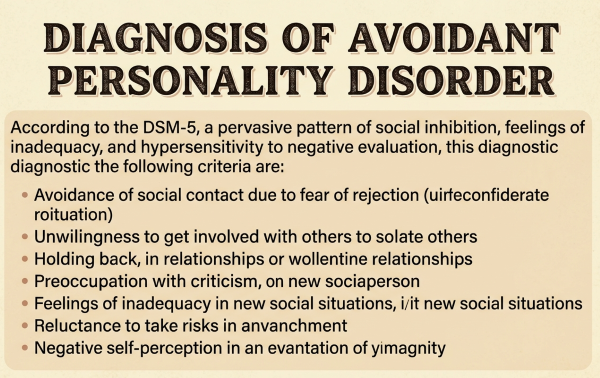
According to the DSM-5, avoidant personality disorder diagnosis requires two things. First, a persistent pattern of social inhibition, feelings of inadequacy, and hypersensitivity to negative evaluation that begins by early adulthood and occurs across multiple contexts.
Second, at least four of the following seven specific criteria must be present:
Avoidance of occupational activities involving significant interpersonal contact because of fears of criticism, disapproval, or rejection. Unwillingness to get involved with people unless certain of being liked. Restraint within intimate relationships because of fear of being shamed or ridiculed. Preoccupation with being criticized or rejected in social situations. Inhibition in new interpersonal situations because of feelings of inadequacy. View of self as socially inept, personally unappealing, or inferior to others. Reluctance to take personal risks or engage in new activities because they might be embarrassing.
The pattern must cause clinically significant distress or impairment in social, occupational, or other important areas of functioning. And it can’t be better explained by another mental disorder, a medical condition, or substance use.
Wondering if these patterns describe you or someone you love? DeLand Treatment Solutions provides a thorough diagnostic evaluation.
How common is avoidant personality disorder?
Understanding how common the condition is can help you recognize you’re not alone.
Research suggests that avoidant personality disorder affects roughly 1 to 2 percent of the general population. Some studies suggest it might be more common, affecting up to 5 percent of people. It appears to affect men and women equally, though some research suggests slightly higher rates in women.
The disorder is one of the more common personality disorders, though it’s less well-known than some others. It typically emerges in late adolescence or early adulthood and continues throughout life without treatment.
FACT: Avoidant personality disorder affects roughly one to two percent of the general population.
How is avoidant personality disorder different from social anxiety disorder?
This distinction is important because the two conditions are related but different, and treatment approaches can differ.
Both conditions involve fear of social judgment and avoidance of social situations. But the key difference lies in the underlying belief system.
- Social Anxiety Disorder is primarily about fear and anxiety. The person experiences intense anxiety in social situations where they might be evaluated. They worry about being judged. But outside anxiety-triggering situations, their self-esteem can be relatively normal.
- Avoidant Personality Disorder involves both anxiety and pervasive low self-esteem. The person doesn’t just fear judgment. They believe the negative judgments are true. They believe they’re genuinely inadequate and unworthy. This belief extends across all areas of life, not just social situations.
Social anxiety disorder can develop suddenly in response to a specific event. Avoidant personality disorder develops gradually over years, rooted in childhood experiences and long-standing beliefs about their worth.
Someone with social anxiety might feel anxious about giving a presentation but execute it well. Someone with avoidant personality disorder might avoid the presentation because they’re convinced they’re incapable and will fail.
Both conditions can exist together, and treating one often helps the other.
What factors contribute to developing avoidant personality disorder?
Understanding the origins helps explain why the condition develops and why it’s so entrenched.
- Genetic Factors: Twin studies show avoidant personality disorder has a genetic component. If parents have avoidant personality traits, children are more likely to develop them. This doesn’t mean genetics are destiny, but they create vulnerability.
- Childhood Experiences: Most research points to childhood as the critical period. Children who experience parental rejection, emotional neglect, criticism, or shame are more likely to develop avoidant personality traits. Children who are bullied or experience peer rejection often develop avoidant patterns.
- Temperament: Children born with behavioral inhibition, who are naturally cautious and withdrawn in new situations, are more vulnerable. Combined with negative childhood experiences, this temperament increases risk.
- Attachment Patterns: Early attachment relationships with caregivers shape how people expect others to treat them. Insecure attachment styles, where caregivers were unavailable or rejecting, often lead to avoidant personality patterns.
- Social Learning: Children learn by watching others. If parents model avoidance and fear of social judgment, children internalize this as normal.
These factors interact and compound. A genetically vulnerable child who experiences parental rejection and bullying at school develops stronger avoidant patterns than a similar child in a supportive environment.
Using substances to cope with loneliness or rejection fears? Call DeLand Treatment Solutions for integrated, long-term care.
Comparison: How Avoidant Personality Disorder Compares to Related Conditions
Understanding these distinctions helps clarify what avoidant personality disorder actually is:
Condition | Primary Feature | Duration | Scope | Self-Esteem | Treatment Response |
Avoidant Personality Disorder | Pervasive inadequacy + fear of rejection | Lifelong pattern | All areas of life | Persistently low | Slower, long-term |
Social Anxiety Disorder | Fear and anxiety in social situations | Can be episodic | Specific situations | Normal outside anxiety | Moderate, 60-80% improve |
Dependent Personality Disorder | Need to be taken care of | Lifelong pattern | Relationships | Low, but wants support | Variable |
Schizoid Personality Disorder | Indifference to relationships | Lifelong pattern | All relationships | Neutral about others | Limited motivation to change |
Introversion | Preference for solitude | Stable trait | Social situations | Can be normal to high | Not a disorder, normal variation |
The distinction matters because treatment approaches differ based on the underlying cause.

Getting Help at DeLand Treatment Solutions
If you recognize yourself in the characteristics of avoidant personality disorder, or if you’re concerned about someone you love, DeLand Treatment Solutions provides comprehensive mental health treatment.
We understand that avoidant personality disorder is painful. We understand the loneliness of wanting connection while being terrified of rejection. We understand that this condition often co-occurs with substance use as people try to manage the emotional pain.
We recognize that personality disorders require long-term, intensive treatment. We’re committed to working with you over time to change deeply ingrained patterns and build a life with more connection and less isolation.
If you’re ready to understand yourself better and begin healing, reach out. Call us or visit our contact page. Our team is ready to help you.
FAQs
Q: Is avoidant personality disorder the same as being shy?
No. Shyness is a normal personality trait that may cause temporary discomfort in social situations. Avoidant personality disorder is a mental health condition involving persistent feelings of inadequacy, intense fear of rejection, and significant difficulties in relationships, work, and everyday functioning across many areas of life.
Q: Can avoidant personality disorder be cured?
Avoidant personality disorder is generally considered a long-standing condition rather than something that can be completely cured. However, treatment can significantly reduce symptoms and improve quality of life. Many people experience meaningful progress through therapy, developing healthier relationships, improved self-esteem, and better coping skills.
Q: Is avoidant personality disorder a mental illness?
Yes. Avoidant personality disorder is a recognized mental health condition classified as a personality disorder in the DSM-5. It involves persistent patterns of thinking, feeling, and behaving that cause significant distress and interfere with relationships, work performance, and other important areas of daily functioning.
Q: What’s the difference between avoidant personality disorder and avoidant attachment?
Avoidant attachment refers to a relationship style that influences how someone connects with others, often developing from early experiences. Avoidant personality disorder is a diagnosable mental health condition with specific criteria and broader impairment. Someone can have an avoidant attachment style without having avoidant personality disorder.
Q: Can someone have avoidant personality disorder without wanting connection?
Generally, no. People with avoidant personality disorder typically want close relationships and meaningful connections but avoid them because they fear rejection, criticism, or embarrassment. A lack of interest in relationships may suggest another condition, such as schizoid personality disorder, rather than avoidant personality disorder.
Q: Is avoidant personality disorder a lifelong condition?
Without treatment, avoidant personality disorder often persists over time. However, many people experience significant improvement with therapy and support. Symptoms can become less severe, relationships can improve, and functioning can increase substantially, allowing individuals to lead fulfilling and meaningful lives despite ongoing challenges.
Q: Can avoidant personality disorder lead to substance abuse?
Yes. Some people with avoidant personality disorder use alcohol or drugs to cope with anxiety, loneliness, or feelings of inadequacy. This can increase the risk of developing a substance use disorder, making integrated treatment for both conditions important for long-term recovery and emotional well-being.
Q: How does avoidant personality disorder affect work?
Avoidant personality disorder can make workplace interactions challenging. Individuals may avoid positions involving frequent social contact, struggle with feedback, or hesitate to pursue promotions due to fear of criticism or rejection. These difficulties can limit career growth and contribute to stress and reduced job satisfaction.
Q: Can trauma cause avoidant personality disorder?
Trauma is an important risk factor for avoidant personality disorder. Experiences such as abuse, neglect, bullying, or repeated rejection during childhood can contribute to the development of avoidant patterns. However, trauma alone does not guarantee the disorder, as genetics and other factors also play a role.
Q: Is there medication for avoidant personality disorder?
There is no medication specifically approved to treat avoidant personality disorder itself. However, medications may help manage co-occurring conditions such as anxiety or depression. Psychotherapy remains the primary treatment approach and focuses on improving self-esteem, reducing avoidance, and strengthening interpersonal functioning and coping skills.
References
- Lumen Learning. “Avoidant Personality Disorder | Abnormal Psychology.” https://courses.lumenlearning.com/wm-abnormalpsych/chapter/avoidant-personality-disorder/
- Personality Couch. “Avoidant Personality Disorder in the DSM.” January 2026. https://personalitycouch.com/blog/dsm-avoidant-personality-disorder
- Analyze Psychiatry. “Avoidant Personality Disorder (AvPD): Signs, DSM-5 Criteria, and Treatment.” July 2024. https://analyzepsych.com/treatments/avoidant-personality-disorder-avpd-signs-dsm-5-criteria-and-treatment/
- Britannica. “Avoidant Personality Disorder (AVPD).” April 2026. https://www.britannica.com/science/avoidant-personality-disorder
- ScienceDirect. “A Network Analysis of DSM-5 Avoidant Personality Disorder Diagnostic Criteria.” December 2021. https://www.sciencedirect.com/science/article/pii/S0191886921008333
- Merck Manual Professional Edition. “Avoidant Personality Disorder (AVPD).” January 2026. https://www.merckmanuals.com/professional/psychiatric-disorders/personality-disorders/avoidant-personality-disorder-avpd
- Wikipedia. “Avoidant Personality Disorder.” May 2026. https://en.wikipedia.org/wiki/Avoidant_personality_disorder
- NCBI Bookshelf. “Avoidant Personality Disorder – StatPearls.” February 2024. https://www.ncbi.nlm.nih.gov/books/NBK559325/
- NCBI. “Avoidant Personality Disorder: Current Insights.” https://pmc.ncbi.nlm.nih.gov/articles/PMC5848673/
- American Psychiatric Association. “Diagnostic and Statistical Manual of Mental Disorders, Fifth Edition, Text Revision (DSM-5-TR).” 2022. https://www.psychiatry.org/
This content is for informational purposes only and does not constitute medical advice or a clinical recommendation. For a personalized assessment, please consult a licensed mental health professional. To learn more about evidence-based mental health and addiction treatment in Florida, visit delandts.com or call (386) 866-8689.