When you search the query: ” What is borderline personality disorder: symptoms and treatment?” You most likely wanted to have a few simple and direct answers. Borderline Personality Disorder (BPD) is a complex mental disorder which affects a human being on how he/she thinks, feels and cope with others. Though this may be overwhelming, there are good therapies that can be put in place, and on the positive side, it can and will be cured provided that the right form of support is provided.
We have a belief that first comes understanding at DeLand Treatment Solutions. We can chop this down in a manner that makes sense.
What is Borderline Personality Disorder
BPD is a mental illness in which the person is emotionally sensitive, extreme in relationships, impulsive, and having low self-esteem. The symptoms are more towards fear of abandonment and mood swings as well as the inability to cope with emotions. DeLand Treatment Solutions has faith in BPD as a treatable illness that could be resolved through the following therapeutic planning, such as Dialectical Behavior Therapy (DBT), medication management and structured mental care treatments. Much can be added by early diagnosis and regular treatment.
Understanding Borderline Personality Disorder
Borderline Personality Disorder is not feeling moody or over-emotional. A disorder where emotional responses are intense and prolonged and seem to be in control is rarely known as a disorder. BPD patients can experience it all in a much more emotionally charged way: love, anger, fear and sadness.
These emotional changes may affect the relationships, self-image and the functioning of everyday life. Fear of being dumped by many who might be in a stable relationship also constitutes a strong force leading to practices of push and pull.
Common Symptoms of BPD
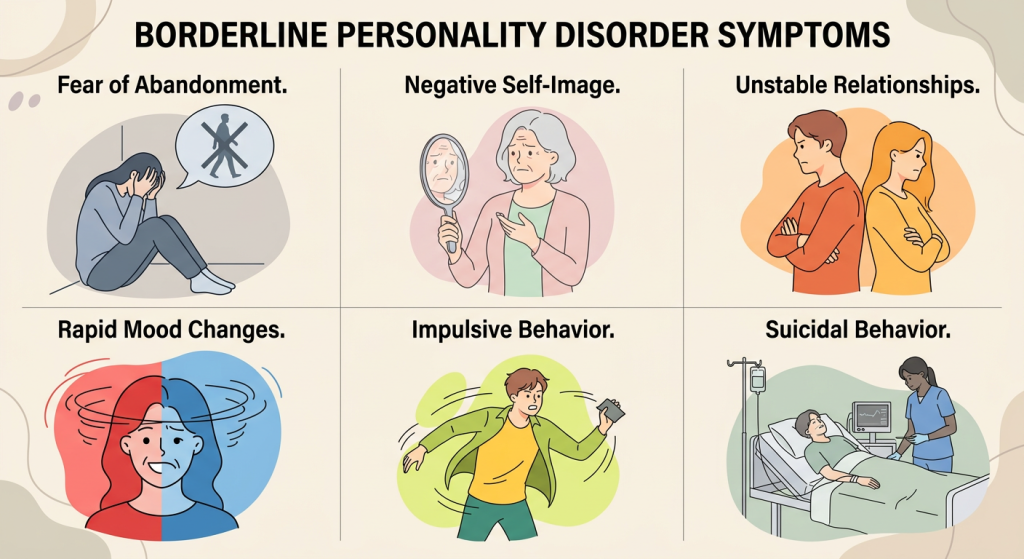
BPD is not a single symptom, and its symptoms can differ; however, they will be separated into several groups:
Emotional Instability
BPD individuals usually undergo sudden mood changes which may change in just a few hours. Such sentiments can be frightening and uncontrollable.
Fear of Abandonment
There is such a fear of abandonment that he or she even goes to the extremes of trying to avoid real or seeming abandonment.
Unstable Relationships
The relationships can be extreme and short-lived founded on idealization and devaluation.
Distorted Self-Image
Lack of knowledge about ourselves and what we want in life may lead to confusion with who we are.
Impulsive Behavior
It may include risk-taking activities like spending sprees, drug or driving at high speeds.
Prolonged Empty feelings.
A feeling of emptiness in the soul is not unique and can be quite unpleasant.
Difficulty Managing Anger
Strong anger or inability to control it can result in conflicts or emotional outbursts.
Self-Injury or Suicide.
Some may find themselves self-harming or even having the habit of regularly thinking of having to commit suicide and require immediate professional help.
Causes and Risk Factors of BPD
There isn’t a single cause of BPD. Rather, it is quite a conglomeration of numerous reasons:
- Genetics: A genetic predisposition is a risk factor in mental illnesses.
- Brain Structure: Abnormalities in areas that regulate moods and impulses.
- Environment: Childhood trauma, neglect, or unstable relationships.
Diagnosis: How BPD is Identified
BPD is diagnosed by taking some of the criteria mentioned in clinical guidelines by mental health professionals. In most cases, the individual would have to exhibit at least five chronic symptoms.
- Diagnosis involves
- An in-depth psychological assessment and family history conversation. Emotional and behavioral styles.
- One should also keep in mind that sometimes BPD may be confused with such illnesses as depression or anxiety; this is why an in-depth examination is essential.
Seeking help from DeLand Treatment Solutions provides essential guidance
Treatment Options for Borderline Personality Disorder
And now that you are left wondering about borderline personality disorder: symptoms and treatment, here is where hope is truly mustered, as BPD can be treated.
Psychotherapy (Talk Therapy)
This is the best mode of treatment.
- Psychotherapy: The therapy assists the client in controlling emotions, developing relationships, and minimizing self-destruction.
- Cognitive Behavioral Therapy (CBT): This is geared towards changing negative thoughts.
Schema Therapy: Addresses internalized patterns of emotions.
Medication
Although BPD is not a disease that can be addressed with a certain type of drug, some of them can alleviate the symptoms of the disorder (anxiety, depression, or mood swings).
Structured Treatment Programs
The outpatient care programs or intensive therapy programs are those programs that offer round-the-clock care and advice, especially to those individuals who need a structured program of treatment.
Living with BPD: What Recovery Looks Like
Being cured does not necessarily mean that you can be cured within a day. It entails the learning of the art of controlling emotions and creating healthier relationships and a more stable self.
Numerous sufferers of BPD live a full life. With a good support system and treatment plan in place long-term improvement is quite possible.
Why Professional Help Matters
Attempting management of BPD may be isolating and tiring. The difference is the knowledge, structure, and tools that are provided by professional support.
Mental health care at DeLand Treatment Solutions is personalized and this meets you at our level.

Take the First Step Toward Healing
And do you have to work it out yourself? And when somebody is in pain or somebody you love is in pain, contact DeLand Treatment Solutions, which offers compassionate care that is evidence-based and is provided according to your needs.
Call a mental health professional and get started on your recovery today.
The initial discussion will begin your progress to stability, sanity, and emotional equilibrium.
To explore options for supervised support, contact DeLand Treatment Solutions
Key Takeaways
Borderline Personality Disorder (BPD) is a disorder related to emotions, relationships, and self-image.
Some of the symptoms include emotional instability, being abandoned and irresponsibility.
It has been attributed to elements that are connected with genes, the functioning of the brain and childhood experiences.
DBT, CBT and structured therapy programs have proven to be effective.
It can be cured within the framework of regular, expert assistance.
Ready to Get Help?
And there is no more cause to continue with that, what borderline personality disorder is: symptoms and treatment, without knowing the answers. Practical help is available.
Call DeLand Treatment Solutions and make a bold stride towards becoming emotionally stable and healthier.
Disclaimer
This content is for informational and educational purposes only and is not intended to replace professional medical or mental health advice, diagnosis, or treatment. Always seek the guidance of a qualified healthcare provider with any questions regarding a mental health condition.
Frequently Asked Questions (FAQs)
What is a borderline personality disorder person like?
A person with BPD often experiences intense emotions, unstable relationships, and a strong fear of abandonment. They may struggle with self-image and impulsive behavior but can improve significantly with proper therapy and support.
What are the 9 signs of borderline personality disorder?
The nine signs include fear of abandonment, unstable relationships, identity issues, impulsivity, self-harm, mood swings, chronic emptiness, intense anger, and stress-related paranoia or dissociation.
What is the new name for borderline personality disorder?
There is no officially accepted new name, but some professionals refer to it as “emotionally unstable personality disorder” (EUPD), especially in certain regions, to better reflect its core emotional regulation challenges.
What are the 7 symptoms of BPD?
Seven common symptoms include emotional instability, fear of abandonment, impulsive behavior, unstable relationships, distorted self-image, chronic emptiness, and difficulty controlling anger.
Is BPD a form of bipolar disorder?
No, BPD and bipolar disorder are different conditions. While both involve mood changes, BPD mood shifts are more rapid and triggered by relationships, whereas bipolar disorder involves longer mood episodes.
Do people with BPD love people?
Yes, people with BPD can love deeply. However, their intense emotions and fear of abandonment may make relationships feel overwhelming or unstable without proper support and coping strategies.
References
- American Psychiatric Association – Diagnostic and Statistical Manual of Mental Disorders (DSM-5-TR)
- National Institute of Mental Health – Borderline Personality Disorder Overview
- Mayo Clinic – Borderline Personality Disorder: Symptoms and Causes
- Cleveland Clinic – BPD Diagnosis and Treatment
- National Alliance on Mental Illness – BPD Resources and Support