You don’t like social interactions. You have a fear of criticism. You don’t go out to parties anymore. You feel that you are not as good as others. You feel like people are looking down on you”. You’ve had therapy for social anxiety, but there’s something about it that doesn’t seem to be going right. Sometimes the treatment is successful, but the sense of worthlessness persists.
You may have Social Anxiety Disorder. It is possible that you may have an avoidant personality. Or possibly both. The trouble with all this is that the conditions overlap so much that they’re commonly misidentified. Sometimes mental health professionals can’t even tell the difference. However, the difference is important as there are different treatment strategies. Knowing the type you’re experiencing will help you get the proper assistance.
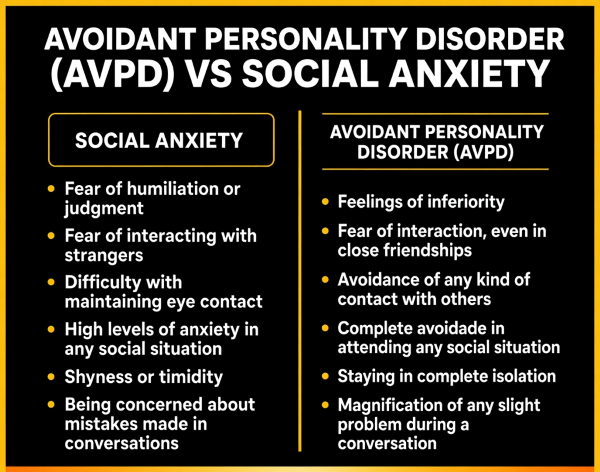
This is the difference between the two: social anxiety is the fear of judgment. Avoidant Personality Disorder is characterized by perceiving oneself as inferior in some way. One is about the thoughts of others. The latter is a question of one’s own opinion.
What is Social Anxiety Disorder
Social Anxiety Disorder is an anxiety disorder characterized by intense fear in social situations where you might be evaluated or judged by others. The core feature is anxiety. You’re not necessarily convinced you’re worthless. You’re convinced others will judge you negatively. That fear drives avoidance of social situations.
Someone with social anxiety might be fine giving a presentation at work once they’re actually doing it. They worry beforehand. Their hearts race. They’re anxious. But the actual performance might go well. The anxiety was about anticipated judgment, not about their actual ability.
Social anxiety is typically situation-specific. You might fear public speaking but be fine one-on-one. You might fear meeting new people but be comfortable in familiar groups. The fear centers on specific social contexts where evaluation is likely.
Experts Advice: Treat co-occurring anxiety and low self-esteem together for the most lasting improvement.
What is Avoidant Personality Disorder?
Avoidant Personality Disorder is a personality disorder characterized by a pervasive pattern of social inhibition, feelings of inadequacy, and hypersensitivity to rejection. The core feature is low self-esteem. You fundamentally believe you’re inadequate, unworthy, and inferior.
Someone with avoidant personality disorder doesn’t just fear being judged. They believe the negative judgments are true. They believe they’re genuinely less valuable than others. This belief extends across nearly all areas of life. It affects work, relationships, friendships, family connections, and every social domain.
FACT: Avoidant personality disorder is classified as a personality disorder, not an anxiety disorder.
Differences Between Social Anxiety Disorder & Avoidant Personality Disorder
- Scope of Impact: Social anxiety disorder typically affects specific situations. Public speaking. Job interviews. Meeting new people. Avoidant personality disorder affects nearly all social domains. Work, relationships, family, casual interactions. It’s pervasive.
- Underlying Belief: Social anxiety disorder involves fear of judgment. Avoidant personality disorder involves belief in your own inadequacy. Someone with social anxiety worries “They’ll think I’m stupid.” Someone with an avoidant personality believes “I am stupid.”
- Duration and Course: Social anxiety disorder can develop in response to a specific event or gradually over time. It can also improve or resolve. Avoidant personality disorder is chronic and persistent. It’s been present for years or decades. It doesn’t just come and go.
- Self-Esteem: People with social anxiety disorder often have normal self-esteem outside the anxiety-triggering situations. People with avoidant personality disorder have pervasively low self-esteem across contexts.
- Occupational Impact: Someone with social anxiety might avoid certain jobs but be functional in others. Someone with avoidant personality disorder struggles across all work environments due to low self-esteem and fear of criticism.
- Relationship Patterns: Social anxiety involves fear of social judgment. Avoidant personality involves expecting rejection and maintaining distance to protect yourself from the pain of rejection. The motivation is different.
- Onset: Social anxiety can develop acutely. Avoidant personality develops gradually over years, typically rooted in early childhood experiences of rejection or criticism.
Similarities Between the Two
Despite differences, these conditions share significant features.
Fear of Judgment: Both involve intense fear of being evaluated negatively by others. Both conditions make social interaction feel unsafe.
Social Avoidance: Both involve avoiding social situations. People with social anxiety avoid situations where they’ll be judged. People with avoidant personalities avoid situations where they might experience rejection.
Physical Anxiety Symptoms: Both can involve a racing heart, sweating, trembling, and physical discomfort in social situations.
Hypersensitivity to Criticism: Both conditions involve sensitivity to negative feedback. Criticism feels more painful and impacts self-perception deeply.
Negative Self-Focus: Both involve intense focus on how you’re coming across to others, how you might be perceived, and what others think of you.
Perfectionism: Both can involve perfectionism because anything less than perfect feels like confirmation of inadequacy.
Co-Occurrence: The conditions frequently co-occur. Someone can have both social anxiety disorder and avoidant personality disorder simultaneously.
Avoidant Personality Disorder vs. Social Anxiety Disorder
Here’s how the conditions compare across key dimensions:
Factor | Social Anxiety Disorder | Avoidant Personality Disorder |
Classification | Anxiety disorder | Personality disorder |
Primary Fear | Fear of judgment | Belief in inadequacy |
Scope | Situation-specific | Pervasive across all areas |
Core Belief | “They’ll judge me” | “I am inadequate” |
Self-Esteem | Normal to good in other contexts | Consistently low |
Duration | Can be episodic or chronic | Chronic, lifelong pattern |
Onset | Any age, often adolescence | Early childhood origins |
Occupational Impact | Can succeed in non-anxiety situations | Struggles across all work |
Relationship Pattern | Anxious avoidance | Withdrawn avoidance |
Treatment Response | 60-80% improve with therapy and medication | Slower progress, requires long-term therapy |
Severity Range | Mild to severe | Mild to severe |
Anxiety as Core Feature | Yes | No, anxiety secondary to low self-esteem |
Avoidant Personality Disorder vs. Social Anxiety Disorder
Here’s how the conditions compare across key dimensions:
Factor | Social Anxiety Disorder | Avoidant Personality Disorder |
Classification | Anxiety disorder | Personality disorder |
Primary Fear | Fear of judgment | Belief in inadequacy |
Scope | Situation-specific | Pervasive across all areas |
Core Belief | “They’ll judge me” | “I am inadequate” |
Self-Esteem | Normal to good in other contexts | Consistently low |
Duration | Can be episodic or chronic | Chronic, lifelong pattern |
Onset | Any age, often adolescence | Early childhood origins |
Occupational Impact | Can succeed in non-anxiety situations | Struggles across all work |
Relationship Pattern | Anxious avoidance | Withdrawn avoidance |
Treatment Response | 60-80% improve with therapy and medication | Slower progress, requires long-term therapy |
Severity Range | Mild to severe | Mild to severe |
Anxiety as Core Feature | Yes | No, anxiety secondary to low self-esteem |
Unsure if it’s social anxiety, avoidant personality, or both? DeLand Treatment Solutions offers thorough clinical assessment.
Different Types of Treatment Approaches
Treatment differs depending on the primary condition.
Social Anxiety Disorder: Cognitive Behavioral Therapy is highly effective, showing 60-80 percent improvement rates. The focus is on changing thoughts about judgment, gradually exposing yourself to feared situations, and reducing anxiety responses. Medications like SSRIs can help. The treatment usually takes several months to a few years.
Avoidant Personality Disorder: Treatment is typically longer-term therapy focusing on building self-esteem, developing positive self-perception, and healing from experiences that created the core belief in inadequacy. CBT helps change thought patterns. DBT can help with emotion regulation. Treatment is usually longer and more intensive than social anxiety treatment.
When Both Are Present: Treatment addresses both conditions. Medication can help with anxiety. Therapy addresses both the anxiety and the underlying low self-esteem. Treatment is comprehensive and typically long-term.
Isolation can fuel depression and substance use over time. Call DeLand Treatment Solutions to start treating the whole picture.

Getting Help at DeLand Treatment Solutions
If you’re struggling with social anxiety, avoidant personality traits, or both, DeLand Treatment Solutions provides comprehensive mental health treatment.
We understand that distinguishing between these conditions is complex. We understand that the symptoms overlap and the underlying causes are different. We provide a thorough assessment to understand which condition or combination of conditions you’re experiencing.
We recognize that avoidance of social situations often leads to isolation, which can fuel depression and substance use. We treat the whole picture, not just the social anxiety or personality patterns.
If you’re ready to understand what you’re experiencing and get help, reach out. Call us or visit our contact page. Our team is ready to help you build a life with more connection and confidence.
FAQs
Q: Can you have both social anxiety and avoidant personality disorder?
Yes. Social anxiety disorder and avoidant personality disorder frequently occur together and are considered one of the most common anxiety-personality disorder combinations. Some people experience intense fear of social situations alongside long-standing patterns of inadequacy, rejection sensitivity, and avoidance that meet criteria for both conditions.
Q: Is avoidant personality disorder just severe social anxiety?
No. Although the two conditions share many symptoms, research suggests they are distinct diagnoses. Avoidant personality disorder involves deeply ingrained patterns of low self-worth and interpersonal avoidance, whereas social anxiety disorder primarily centers on fear of negative evaluation and social embarrassment.
Q: Which condition is more treatable?
Social anxiety disorder generally responds more quickly to treatment, with many people experiencing significant improvement through therapy and medication. Avoidant personality disorder can also improve substantially, but treatment often requires longer-term psychotherapy focused on self-esteem, relationships, and deeply rooted patterns of thinking and behavior.
Q: Can avoidant personality disorder develop later in life?
No. Avoidant personality disorder is believed to develop from a combination of temperament and early life experiences. The pattern usually begins in childhood or adolescence and becomes clearly established by early adulthood rather than suddenly appearing later in life.
Q: Will medication help with avoidant personality disorder?
Medication may help treat co-occurring conditions such as anxiety or depression, but it does not directly address the core personality patterns of avoidant personality disorder. Psychotherapy remains the primary treatment and focuses on improving self-esteem, relationships, and healthier coping strategies.
Q: How do I know which condition I have?
Only a qualified mental health professional can determine whether you have social anxiety disorder, avoidant personality disorder, or both. A comprehensive evaluation considers your symptoms, personal history, relationship patterns, and underlying beliefs to develop an accurate diagnosis and appropriate treatment plan.
Q: Is it my fault I have these conditions?
No. Both social anxiety disorder and avoidant personality disorder arise from a combination of biological, psychological, and environmental factors. They are legitimate mental health conditions, not personal weaknesses or character flaws, and effective treatment options are available to support recovery and improved functioning.
Q: Can therapy really change low self-esteem in an avoidant personality?
Yes. Long-term therapy can help people challenge deeply rooted beliefs about themselves, process painful experiences, and build healthier self-perceptions. Progress often occurs gradually, but research shows that meaningful improvements in self-esteem, relationships, and daily functioning are possible with consistent treatment.
Q: What if I don’t get treatment?
Without treatment, both conditions often persist and may worsen over time. Ongoing isolation and avoidance can contribute to depression, substance use problems, relationship difficulties, and reduced quality of life. Seeking professional help significantly improves the chances of long-term emotional well-being and functioning.
Q: How do I start getting help?
Begin by scheduling an appointment with a qualified mental health professional for a comprehensive assessment. Being honest about your symptoms, fears, and relationship patterns helps clinicians understand your experiences and create a treatment plan tailored to your specific needs and goals.
References
- Grouport Therapy. “Avoidant Personality Disorder and Social Anxiety: Differences and Similarities.” January 2026. https://www.grouporttherapy.com/blog/avoidant-personality-disorder-vs-social-anxiety
- Moment of Clarity. “Avoidant Personality Disorder vs Social Anxiety.” March 2025. https://momentofclarity.com/avoidant-personality-disorder-vs-social-anxiety/
- Choosing Therapy. “Avoidant Personality Disorder Vs. Social Anxiety: Key Differences.” September 2025. https://www.choosingtherapy.com/avoidant-personality-disorder-vs-social-anxiety/
- Psych Central. “Avoidant Personality Disorder vs. Social Anxiety.” June 2022. https://psychcentral.com/anxiety/avoidant-personality-disorder-vs-social-anxiety
- ReachLink. “Social Anxiety vs. Avoidant Personality Disorder: Key Differences.” January 2026. https://reachlink.com/advice/social-anxiety/social-anxiety-vs-avoidant-personality-disorder-key-differences/
- Cleveland Clinic. “Avoidant Personality Disorder: Symptoms and Treatment.” October 2025. https://my.clevelandclinic.org/health/diseases/9761-avoidant-personality-disorder
- The Lovett Center. “Social Anxiety vs Avoidant Personality Disorder.” February 2026. https://thelovettcenter.com/social-anxiety-vs-avoidant-personality-disorder/
- Simply Psychology. “Social Anxiety vs. Avoidant Personality Disorder: Key Differences.” August 2025. https://www.simplypsychology.org/avoidant-personality-disorder-vs-social-anxiety.html
- Talkiatry. “Social Anxiety Disorder vs. Avoidant Personality Disorder.” May 2026. https://www.talkiatry.com/blog/social-anxiety-vs-avoidant-personality-disorder
- PMC National Center for Biotechnology Information. “Avoidant Personality Disorder.” https://pmc.ncbi.nlm.nih.gov/articles/PMC4376891/
This content is for informational purposes only and does not constitute medical advice or a clinical recommendation. For a personalized assessment, please consult a licensed mental health professional. To learn more about evidence-based mental health and addiction treatment in Florida, visit delandts.com or call (386) 866-8689.