Quick Answer: What is the Difference Between Mental and Emotional Health? Mental health may impact your ability to think, learn, make decisions and cope with everyday problems. Emotional health revolves around the ability to identify, comprehend, share, and control your emotions. These are associated with each other and are relevant for good health.
Demonstrating the distinction between mental and emotional wellness will help you identify your needs, cultivate much healthier partnerships, and discover when it’s time for you to get support. Mental health is how you think, pay attention and behave; emotional health is how you react to your feelings of joy, anger, sadness, and fear. Both are important, and tending to one can aid the other.
Key Takeaways
- Mental health encompasses thoughts, behavior, memory, decision-making, and well-being.
- Emotional well-being includes being aware of and expressing emotions and how to deal with them healthily.
- There’s a close association between mental and emotional health, but they’re not the same thing.
- Both can be impacted by stress, grief, trauma, and other significant life changes.
- Mental and emotional wellness does not necessarily occur at every moment and is not limited to having a “happy” feeling.
- Wellness can be affected by healthy habits, positive relationships, counseling, and treatment by professionals.
- If there continue to be mood changes, thinking, sleeping, or functioning, then it may indicate that professional help might be needed.
What is Mental Health?
Mental health is about how you feel emotionally, mentally, and socially. It impacts thinking, learning, problem-solving, decision-making, relationships, and daily stressors. Having good mental health doesn’t mean that you don’t have problems. It means having access to the support and ability to cope with a challenge and engage in everyday life.
Mental health is different at every age. It could be influenced by work pressure, family issues, trauma, substance abuse, or health issues. Often, mental health issues, such as depression and anxiety disorders, may also have an impact on functioning.
As per the World Health Organization (WHO), mental health is not just the absence of mental disorders; it is an important component of overall health.
What is Emotional Health?
Emotional health is linked to the ability to identify, comprehend, reveal and regulate your emotions. It can help you deal with disappointing things, how to handle conflict, communicate your needs and recover from a difficult experience. We human beings can still feel sad, scared, and frustrated/agitated, even if we are emotionally healthy. The difference with them is that they can take action with their emotions and not have to be led by their emotions to make every decision.
How emotional health relates to others is also important.
For instance, if you are angry in an argument, find a way to express your concerns calmly instead of lashing out. Emotional wellness isn’t about stuffing your emotions or putting on a brave face. It is about being aware of how you feel and how you will react in a positive manner.
Looking for help with mental and emotional health? Treatment and support options are available; contact DeLand Treatment Solutions to discuss.
What Is the Difference Between Mental and Emotional Health?
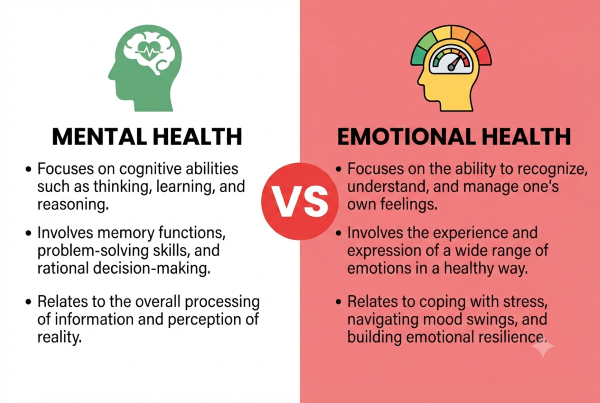
The difference is that mental health is a more general concern: thinking, understanding, decision-making, and the ways people behave and think emotionally, and emotional health is specifically about knowing and regulating emotions. The spaces overlap because what emotions affect one’s thinking and what one thinks affects one’s emotions. They both play a role in your stress response, relationship skills, and daily responsibilities.
For instance, when you get bad news, your mental well-being affects how you interpret the event and the next steps to be taken. How you deal with the sadness, fear, or anger that ensues is related to your emotional health. Neither works alone. When it comes to coping, it’s often helpful to be able to think clearly and deal with feelings in an appropriate way.
Area | Mental health | Emotional health |
Main focus | Thoughts, reasoning, behavior, and psychological functioning | Feelings, emotional awareness, and emotional regulation |
Everyday example | Planning how to solve a problem | Managing frustration while solving it |
Common challenges | Poor concentration, persistent worry, difficulty making decisions | Difficulty expressing feelings, frequent emotional outbursts |
Helpful skills | Problem-solving, attention, flexible thinking | Self-awareness, emotional regulation, communication |
Professional support | Psychological assessment, therapy, psychiatric care when appropriate | Counseling, emotional skills training, therapy when needed |
What Is the Difference Between Mental Health and Emotional Well-Being?
Mental health is the general term for psychological health, and emotional well-being is one aspect of mental health in particular that involves dealing with emotions and what they mean. An individual could be performing well at his or her occupation and suffering from sadness or loneliness. Some individuals might also deal with a psychological health disorder and not develop any healthy emotional understanding and sustain relationships.
Healthy emotions are feeling connected, safely expressing emotions, and managing emotions during setbacks. It is not all about being happy. The Centers for Disease Control and Prevention (CDC) says mental health has an impact on emotional, psychological, and social health. This is why mental and emotional wellness go together and shouldn’t be separated as individual issues.
What is the Difference between Mental and Psychological Health?
The terms “mental health” and “psychological health” are interchangeable. Both are associated with thinking, feeling, actions, coping with stress, and functioning. In some situations, psychological health and psychological well-being focus more on the aspects of thought patterns, behavior, coping, and psychological functioning, but no fixed line can be drawn between the two terms.
Emotional health is more specifically about emotional awareness and emotion control. For example, constant anxiety can be thoughts of danger, physical tension, and upsetting feelings. A qualified professional can make judgments about the interplay of experiences and suggest appropriate supports. What is key is to identify chronic problems, but not the best label for them.
Is Mental and Emotional Health the Same?
No, mental health and emotional health are two different aspects, yet very similar. Your mental health is about your thinking, learning, decision-making, behavior and psychological health. Emotional health is understanding and controlling emotions. Both can impact your reactions to problems, relationship development and quality of life.
Consider what it is like to get ready for a tough talk. Mental health will equip you to think about your options and to plan what you say. Emotional wellness teaches you how to identify nervousness, appropriately process frustration and express yourself with respect. With both of these in play, dealing with tougher challenges and bouncing from the regular setbacks of life could be easier.
Examples of Mental and Emotional Health
Mental & emotional health is expressed in everyday environments, from a hectic day to personal tragedy. These are a few examples to help you grasp the difference, without dividing the two regions into separate entities. All the changes can happen at once—the cognitive, affective, and behavioral.
Let’s look at 5 real-life examples of mental and emotional health:
Problem-solving: Dividing a task into smaller pieces.
- Emotional awareness: Identification of feelings of worry or disappointment.
- Healthy Communication: Communicating your needs without pointing out the fault of others.
- Stress Management: Using movement, breaks or breathing exercises to manage stress.
- Resilience: Valuing and using setbacks as learning opportunities and asking for assistance when necessary.
What Are the Signs of Good Mental and Emotional Health?
Flexibility of thought, realistic expectations, healthy relationships, and ability to function in daily activities can be indicators of good mental and emotional health. Identify challenges and plan actions without judgment, pivot when things change and seek assistance when they are becoming too hard. They take time to build and can be different depending on one’s life.
Someone cannot exhibit all the changes each day. If the sadness, concern, anger or difficulty concentrating is temporary, it’s not always a sign there’s something wrong with a person’s mental health. Note the pattern, duration and interference of the symptoms with activities, sleep, work, and relationships. If the difficulties are ongoing, a professional evaluation might be helpful.
Do something positive for your well-being. Contact DeLand Treatment Solutions to find out what support and treatment is available.
How Do Mental and Emotional Health Affect Each Other?
Everyday life examples of how mental and emotional health are interconnected. Negative thinking can lead to fear or sadness, whilst strong feelings can make it difficult to focus, plan, and make decisions. If one part is under pressure, so might be the other. If you can become aware of this link, you will go towards healthier responses.
Repeated thoughts about making mistakes might lead to anxiety, which could then make it difficult for them to engage in important tasks. Avoidance is in turn likely to worsen distress and to further perpetuate the initial concern. Anxiety about thoughts and learning to challenge any thoughts that may not be helpful could help to break this cycle. Therapy can give practical ways of understanding these patterns as well as responding in various and different ways.
What Can Affect Mental and Emotional Health?
Mental and emotional health is influenced by biological, psychological, social, and environmental factors. It can be due to genetics, physical health, sleep, financial stress, relationships, trauma, and/or major life changes. Mood, judgment, sleep, and emotional control can also be impacted by substance use, which can make challenges more difficult.
The impact of these influences varies among individuals. Two individuals can feel two different ways about the same stressful situation due to past experiences, resources, and support systems. NIMH offers information on mental health, symptoms, and treatment. Early interventions can make it easier to determine contributing factors.
Did you know? Nearly 1 in 8 people worldwide were estimated in 2019 to be living with a mental disorder by WHO. Unfortunately, this refers to mental disorders, not any individual with emotional distress, and illustrates why it’s vital to have accessible mental health support from a psychiatrist
How Can You Improve Mental and Emotional Health?
Do not try to change it all at once; make it possible step by step. Try walking, talking to a trusted individual, writing your concerns, or slow breathing. In doing so, if you are experiencing distress that persists or causes you a problem, you might want to contact a trained mental health professional. Self-care is sometimes helpful but can never replace treatment when treatment is required.
When Should You Seek Professional Mental Health Support?
When changes in your thoughts, mood, feelings, sleep, or behavior and relationships make it difficult to function through your day, you might need to seek support. You don’t have to react in an emergency. It’s time to talk to a therapist, psychologist, psychiatrist, or other licensed health care provider about your concerns and what’s a good fit for you.
If you believe you can no longer protect yourself, or if you feel like you’re considering suicide, seek help now. Contact the emergency/crisis Hotline. Be open about the feelings or body changes from drinking and/or using drugs. Drug and alcohol addiction and mental health disorders often go hand in hand, and both conditions must be treated for a successful recovery.

How DeLand Treatment Solutions Can Help?
Self-care for mental and emotional well-being starts by taking an active approach; by recognizing yourself as deserving of care and support. If mental health or addiction problems are affecting your health, DeLand Treatment Solutions is available to talk about the treatment and recovery solutions available. What would be the next logical step you would take, depending on your situation, with the services in place?
Don’t think twice about contacting and inquiring about what to do if you are not sure where to start. Schedule an appointment with DeLand Treatment Solutions today at (386) 866-8689 to talk about the services. In case of a mental health crisis, please call emergency services instead of scheduling an appointment at a later stage.
To explore options for supervised support, contact DeLand Treatment Solutions
Frequently Asked Questions About Mental and Emotional Health
1. What is the main difference between mental and emotional health?
Mental health involves thinking, reasoning, behavior, and psychological functioning. Emotional health focuses on recognizing, understanding, expressing, and managing feelings. Both are connected and influence how you handle stress, relationships, and everyday challenges.
2. What are five examples of mental and emotional health?
Five examples include solving problems, recognizing emotions, communicating needs clearly, managing stress, and recovering from setbacks. These skills support daily functioning, healthier relationships, and more balanced responses to difficult experiences.
3. What are seven signs of emotional health?
Seven signs include recognizing feelings, expressing emotions appropriately, managing stress, setting boundaries, communicating clearly, maintaining supportive relationships, and adapting to change. These skills vary among individuals and can improve with practice.
4. What is the difference between mental and emotional strength?
Mental strength involves adapting your thinking, solving problems, and continuing through challenges. Emotional strength involves recognizing feelings, tolerating discomfort, and responding thoughtfully. Neither means suppressing emotions or refusing help when you need it.
5. How can you tell if someone is struggling mentally or emotionally?
Possible signs include persistent sadness, irritability, withdrawal from others, sleep changes, difficulty concentrating, or losing interest in usual activities. These signs are not proof of a condition, but lasting changes deserve attention and compassionate support.
6. What are the signs that someone is emotionally healthy?
Emotional health may appear as self-awareness, healthy communication, empathy, realistic expectations, and the ability to cope with disappointment. Emotionally healthy people still experience difficult feelings but can often process them constructively and seek support when needed.
7. What falls under emotional health?
Emotional health includes recognizing feelings, expressing them appropriately, managing stress, coping with disappointment, setting boundaries, and developing supportive relationships. It also involves accepting difficult emotions without letting them consistently control decisions or everyday behavior.
8. What are the three most common mental health issues?
Anxiety disorders, depressive disorders, and substance use disorders are major categories of mental health concerns. Prevalence varies by population and country. Only a qualified professional can assess symptoms and determine an appropriate diagnosis.
9. What are five signs that I might need a mental health day?
You may need a break if you experience persistent exhaustion, difficulty concentrating, increased irritability, feeling overwhelmed, or trouble managing ordinary tasks. If symptoms persist or worsen, consider professional support rather than relying only on rest.
10. Is stress a mental or emotional feeling?
Stress is a physical and psychological response to demands or perceived threats. It can involve worried thoughts, emotional tension, muscle tightness, and sleep changes. Stress is not exclusively mental or emotional because it affects the body too.
11. What are some signs that someone is emotionally strong?
Emotional strength may include acknowledging difficult feelings, asking for help, setting boundaries, learning from mistakes, and responding calmly when possible. It does not mean never crying, avoiding vulnerability, or handling every problem alone.
12. What are 13 things mentally strong people don’t do?
Mentally strong people generally avoid dwelling endlessly on the past, seeking constant approval, fearing every change, neglecting self-care, refusing feedback, blaming others for everything, or expecting perfection. They also work to avoid resentment, unhealthy comparisons, impulsive decisions, and giving up after setbacks.
Expert References and Medical Sources
The following authoritative resources support the information in this article and offer further reading about mental health, emotional well-being, and treatment.
- World Health Organization (WHO): Mental Health: Strengthening Our Response
- Centers for Disease Control and Prevention (CDC): About Mental Health
- National Institute of Mental Health (NIMH): Mental Health Information and Resources
- World Health Organization (WHO): Mental Disorders
- Mindful Health Solutions: Difference Between Mental and Emotional Health
Medical Disclaimer
This article is intended for educational purposes only. It does not replace professional medical advice, psychological assessment, diagnosis, or treatment. Mental and emotional health needs differ from person to person. If symptoms persist, worsen, or interfere with daily life, consult a qualified healthcare professional. If you are in immediate danger or experiencing a mental health emergency, contact your local emergency services.
DeLand Treatment Solutions encourages individuals and families to seek appropriate professional guidance when mental health concerns or substance use affect everyday life.