Deciding to obtain a mental health diagnosis is a courageous one. For many people, that decision comes after months or years of feeling like something is not quite right, carrying symptoms quietly, or wondering whether what they are going through is serious enough to warrant professional attention.
The answer to the last question is usually almost always yes. However, no one knows what actually takes place when they go to a clinic and check in for a mental health assessment. One of the most common reasons why people postpone getting assessed is the uncertainty about the process.
This guide removes that uncertainty. It’s a walk-through of exactly what it looks like to be diagnosed with mental health issues, who performs the test, what tools the clinicians use, what the DSM-5 is and why it is important, and what happens after the diagnosis is set.
What is a mental health diagnosis test?
A mental health diagnosis test is not a single test in the way a blood glucose test or an X-ray is. There is no single laboratory result or brain scan that definitively identifies most mental health conditions.
Instead, a mental health diagnosis is reached through a comprehensive clinical assessment: a structured process in which a licensed mental health professional gathers information about your symptoms, history, functioning, and physical health from multiple sources and evaluates that information against established diagnostic criteria.
The goal is not to apply a label. It is to build an accurate picture of what is happening and why, so that treatment can be genuinely effective.
Who Conducts a Mental Health Evaluation?
Several different licensed professionals can conduct a mental health assessment, each with a different scope of practice.
Professional | Credentials | What They Can Do |
Psychiatrist | Medical doctor (MD or DO) with psychiatric specialty | Full psychiatric evaluation, diagnosis, prescribe medication |
Psychologist | Doctoral degree (PhD, PsyD, EdD) | Comprehensive psychological testing and assessment, diagnosis, therapy |
Licensed Clinical Social Worker | Master’s degree (LCSW) | Clinical interviews, assessment, diagnosis, therapy |
Licensed Professional Counselor | Master’s degree (LPC, LMHC) | Assessment, diagnosis, therapy |
Primary Care Physician | Medical doctor | Initial screening, physical exam, lab work, referral |
For many people, the assessment journey begins with their primary care physician, who conducts initial screenings and rules out physical conditions, then refers to a specialist for comprehensive evaluation. Others begin directly with a psychiatrist or psychologist, especially when seeking treatment at a specialized behavioral health center.
100% Confidential Support is Available 24/7
No matter what you’re going through, you’re not alone. Our dedicated team is here to provide a safe, judgment-free space where you can talk openly and honestly. Whether you need emotional support, resources, or just someone to listen.
We’re here for you—completely confidential and always respectful of your privacy. Call us today!
The Mental Health Diagnosis Test: Step by Step
A comprehensive mental health evaluation typically unfolds across several connected components. Understanding each one helps you know what to expect and how to prepare.
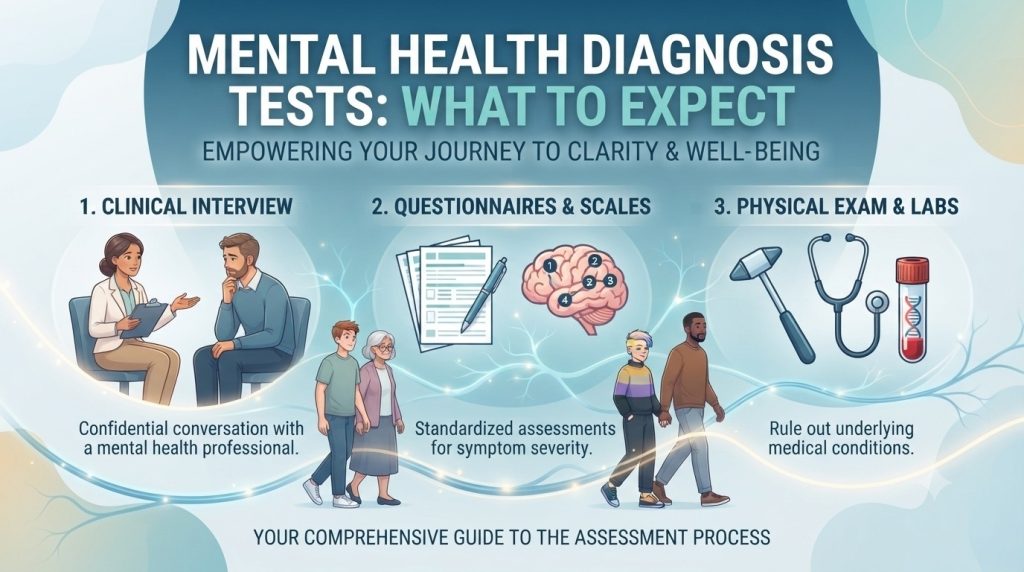
Step 1: Physical Examination and Laboratory Tests
Before a mental health diagnosis is made, a physical exam and basic laboratory work are typically conducted to rule out underlying medical conditions that can produce symptoms resembling psychiatric disorders.
This matters because several physical conditions closely mimic mental health conditions. Thyroid dysfunction can produce symptoms nearly identical to depression or anxiety. Vitamin B12 deficiency can cause cognitive impairment and mood disturbance. Neurological conditions can present as psychosis or personality change.
Laboratory tests commonly ordered include:
- Complete blood count (CBC) and metabolic panel
- Thyroid function tests
- Vitamin D and B12 levels
- Hormone panels where relevant
- Drug and alcohol screening
- Neuroimaging such as MRI or CT scan in specific cases
For people with a co-occurring substance use disorder, drug and alcohol screening is particularly important. Substance use can both mimic and mask mental health symptoms, and an accurate dual diagnosis requires understanding what symptoms persist independent of substance use.
Step 2: Clinical Interview
The clinical interview is the central component of any mental health assessment. It is a structured conversation between you and the clinician, typically lasting between 45 and 90 minutes, that covers:
- Your current symptoms: what they are, when they started, how long they last, how severe they are
- Your personal history: childhood, family relationships, education, work history, significant life events
- Your psychiatric history: any previous diagnoses, treatments, hospitalizations, or medications
- Your family history: mental health conditions, substance use, or medical conditions in biological relatives
- Your substance use history: alcohol, prescription medications, illicit substances, frequency and patterns
- Your current functioning: how symptoms are affecting work, relationships, sleep, daily responsibilities
- Your social context: support systems, stressors, living situation, cultural background
Clinicians may use a structured or semi-structured format. The Structured Clinical Interview for DSM-5 (SCID-5), published by the American Psychiatric Association, is one of the most widely used tools for this purpose. It guides clinicians through diagnostic modules covering mood disorders, anxiety disorders, psychotic disorders, substance use disorders, and more, ensuring nothing important is overlooked.
Step 3: Standardized Psychological Tests
In addition to the clinical interview, standardized psychological tests give clinicians objective, validated measures of symptoms, personality characteristics, and cognitive functioning. These are evidence-based instruments endorsed by the American Psychological Association (APA) and incorporated into clinical practice guidelines.
Commonly used instruments include:
Beck Depression Inventory (BDI): A 21-item self-report questionnaire measuring the presence and severity of depressive symptoms. Widely used in both clinical and research settings.
Beck Anxiety Inventory (BAI): Measures the frequency and severity of anxiety symptoms, helping distinguish anxiety disorders from depression.
Minnesota Multiphasic Personality Inventory (MMPI-2): One of the most extensively researched personality assessment tools in existence. Helps identify personality structure, psychopathology, and patterns of thinking and behavior relevant to diagnosis.
Hamilton Anxiety Rating Scale (HAM-A): A clinician-administered scale measuring anxiety severity across psychic and somatic dimensions.
DSM-5 Level 1 Cross-Cutting Symptom Measure: A 23-item transdiagnostic screening tool developed by the American Psychiatric Association covering 13 domains including depression, anxiety, mania, psychosis, trauma, substance use, and sleep. It gives clinicians a broad picture of symptom burden across multiple areas before diving into specific diagnostic modules.
PHQ-9 (Patient Health Questionnaire-9): A brief, validated screener for depression severity used widely in primary care and specialty settings.
GAD-7 (Generalized Anxiety Disorder 7-item scale): A validated screener measuring the frequency and severity of generalized anxiety symptoms.
These tools do not produce a diagnosis on their own. They provide structured, comparable data that the clinician integrates with interview findings and history to reach a clinical judgment.
Step 4: Behavioral Observation and Mental Status Examination
Throughout the assessment, a trained clinician is observing how you present: your appearance, body language, speech patterns, thought organization, emotional affect, level of alertness, memory, and orientation to time and place.
This is known as a Mental Status Examination (MSE). It is a structured clinical observation of a person’s current mental functioning across several domains:
- Appearance and behavior: Grooming, eye contact, posture, psychomotor activity
- Speech: Rate, rhythm, volume, fluency
- Mood and affect: Self-reported emotional state and observable emotional expression
- Thought process: Whether thinking is logical, organized, and goal-directed
- Thought content: Presence of delusions, obsessions, suicidal or homicidal ideation
- Perceptual disturbances: Hallucinations or illusions
- Cognition: Memory, attention, orientation, and reasoning
- Insight and judgment: Awareness of the problem and capacity for sound decision-making
The Mental Status Examination takes place informally throughout the interview, not as a separate test.
Step 5: Collateral Information
In many cases, especially when the person being assessed is a young person, has significant cognitive impairment, or is in crisis, clinicians will seek additional information from family members, caregivers, or previous treatment providers.
This collateral information fills gaps that a single interview cannot capture, such as what symptoms look like to the people who live with the person, how long a pattern has been present, or what treatment was tried previously.
Deland Treatment Solutions
Battling with Drug and Alcohol Addition? Remember, you are not alone and we are here to help you!
The DSM-5-TR: The Diagnostic Standard
All mental health diagnoses in the United States are made using the Diagnostic and Statistical Manual of Mental Disorders, now in its fifth edition with text revisions (DSM-5-TR), published by the American Psychiatric Association.
The DSM-5-TR provides specific diagnostic criteria for each recognized mental health condition, including:
- Which symptoms must be present
- How long symptoms must have been occurring
- How severely they must impair functioning
- What other conditions must be ruled out first
For example, diagnosing Major Depressive Disorder requires the presence of at least five specific symptoms during a two-week period, with at least one being either persistent low mood or a loss of interest and pleasure in activities once enjoyed.
The DSM-5-TR was updated with new text revisions in September 2024 and September 2025 by the American Psychiatric Association, reflecting the most current clinical evidence. It remains the primary reference used by clinicians, insurers, and treatment programs across the United States.
A parallel international reference, the ICD-11 published by the World Health Organization, is also used in some clinical contexts, particularly for billing and public health reporting.
Diagnosing Co-Occurring Disorders: Dual Diagnosis Assessment
For people whose mental health challenges exist alongside substance use, the assessment process must be designed to identify both conditions, because they consistently affect each other in ways that require integrated treatment.
According to SAMHSA’s 2024 National Survey on Drug Use and Health, 21.2 million adults in the United States have both a mental health condition and a substance use disorder at the same time. Yet research consistently shows that only a fraction of those individuals receive integrated treatment for both.
A thorough dual diagnosis assessment includes:
- A detailed substance use history covering all substances, frequency, quantity, duration, and impact on functioning
- Screening for mental health conditions that both predate and may have contributed to substance use
- Laboratory drug and alcohol screening
- Assessment of withdrawal status and medical stability
- Identification of which symptoms are driven by the substance use, which are independent psychiatric symptoms, and where overlap exists
This distinction is clinically critical. Anxiety that resolves after two weeks of sobriety is different from anxiety that persists. Depressive symptoms during active alcohol use have a different clinical meaning than depression that persists well into abstinence. Accurate dual diagnosis assessment separates these overlapping presentations to ensure treatment targets the actual conditions involved.
Seeking help from DeLand Treatment Solutions provides essential guidance
How Long Does a Mental Health Assessment Take?
The length of a mental health assessment varies depending on its scope and setting.
Assessment Type | Typical Duration |
Brief clinical screening (primary care) | 15 to 30 minutes |
Standard psychiatric evaluation | 60 to 90 minutes |
Comprehensive psychological testing | 3 to 8 hours across multiple sessions |
Dual diagnosis assessment | 90 minutes to several hours |
Neuropsychological evaluation | Full day or multiple sessions |
For most people seeking mental health care at a treatment center, the initial evaluation is a structured clinical interview lasting one to two hours, often supplemented by standardized questionnaires completed before or during the appointment. Comprehensive psychological testing using instruments like the MMPI-2 is typically reserved for complex cases or when specific diagnostic questions require deeper investigation.
What Happens After a Mental Health Diagnosis?
A diagnosis is not an ending. It is a beginning. Once a clinician has a clear diagnostic picture, they can develop a treatment plan tailored to what is actually driving your symptoms.
Following a diagnosis, you can expect:
- A clear explanation of what the diagnosis means, in plain language, not clinical jargon
- Discussion of treatment options appropriate to your specific conditions
- A recommendation for the appropriate level of care, whether outpatient therapy, an Intensive Outpatient Program, a Partial Hospitalization Program, or a higher level of residential care
- Referrals to specialists if needed, such as a psychiatrist for medication management
- Psychoeducation: information to help you understand your condition and what recovery looks like
If the assessment reveals a dual diagnosis, the treatment plan will address both the mental health condition and the substance use disorder simultaneously. Treating one without the other rarely produces lasting results.
Common Conditions Identified During Mental Health Assessment
Mental health evaluations commonly result in diagnoses across these categories:
- Mood Disorders: Major depressive disorder, persistent depressive disorder, bipolar I and II disorder
- Anxiety Disorders: Generalized anxiety disorder, panic disorder, social anxiety disorder, agoraphobia
- Trauma and Stressor-Related Disorders: Post-traumatic stress disorder (PTSD), acute stress disorder, adjustment disorders
- Psychotic Disorders: Schizophrenia, schizoaffective disorder, schizophreniform disorder
- Personality Disorders: Borderline personality disorder, narcissistic personality disorder, antisocial personality disorder
- Neurodevelopmental Disorders: ADHD, autism spectrum disorder
- Substance Use Disorders: Alcohol use disorder, opioid use disorder, stimulant use disorder, cannabis use disorder, and co-occurring combinations
- Obsessive-Compulsive and Related Disorders: OCD, body dysmorphic disorder
- Dissociative Disorders: Dissociative identity disorder, depersonalization disorder
It is common for a mental health assessment to identify more than one condition. Comorbidity, the coexistence of two or more diagnoses, is the rule rather than the exception in behavioral health, particularly when substance use is involved.
How to Prepare for a Mental Health Evaluation
You do not need to prepare extensively, but these practical steps will help the assessment go smoothly and produce the most accurate results.
- Write down your symptoms: Include what they are, when they started, how often they occur, and how they affect your daily life
- List all medications and supplements you are currently taking, including over-the-counter products
- Be honest about substance use: Clinicians are not there to judge. Accurate information about alcohol and drug use is essential to an accurate diagnosis
- Bring relevant records if you have had previous mental health treatment, hospitalizations, or assessments
- Bring a support person if helpful: Some people find it easier to have a trusted family member present, especially during difficult parts of the interview
- Be prepared to answer honestly: The more accurate your answers, the more useful your diagnosis will be for guiding treatment
If you are bringing a loved one who is resistant to the process, know that some ambivalence is normal. A skilled clinician has experience working with people who are not sure they want to be there.

DeLand Treatment Solutions Starts With a Proper Diagnosis
At DeLand Treatment Solutions in DeLand, Florida, every person who walks through the door receives a thorough mental health assessment before treatment begins. DTS believes that accurate diagnosis is the foundation of effective care, and that no treatment plan can be genuinely effective without first understanding the whole picture.
DTS offers a comprehensive Mental Health Diagnosis process and a full range of behavioral health programs, including
- Dual Diagnosis Treatment,
- Co-Occurring Substance Use Disorders Treatment
- Inpatient Mental Health Rehab,
- Medication Management, and Medication-Assisted Treatment (MAT).
Once a diagnosis is established, DTS provides individualized treatment through evidence-based therapies including Cognitive Behavioral Therapy (CBT), Dialectical Behavior Therapy (DBT), EMDR, Acceptance and Commitment Therapy (ACT), Trauma Therapy, Mindfulness Meditation Therapy, Family Therapy, Individual Therapy, Group Therapy, Holistic Therapy, and Recreational Therapy.
You deserve a diagnosis that actually reflects what you are going through, and a treatment plan built around that reality.
Call DeLand Treatment Solutions or visit the contact page to speak with someone today.
FAQs
What is a mental health diagnosis test?
A mental health diagnosis test is not a single test. It is a comprehensive clinical assessment process conducted by a licensed mental health professional. It typically includes a physical exam and lab work to rule out medical causes, a structured clinical interview, standardized psychological questionnaires, behavioral observation, and review of personal and family history. Together, these components allow a clinician to match your symptoms to recognized diagnostic criteria in the DSM-5-TR.
Is there a specific test that confirms a mental health condition?
No. Unlike many physical health conditions, most mental health disorders cannot be confirmed by a single lab test, blood panel, or brain scan. Diagnosis is made through a structured clinical process using validated tools, clinician observation, and established diagnostic criteria. Physical tests and lab work are used to rule out underlying medical conditions that could be causing symptoms, not to confirm a psychiatric diagnosis.
What is the DSM-5-TR, and why does it matter?
The DSM-5-TR is the Diagnostic and Statistical Manual of Mental Disorders, Fifth Edition with Text Revisions, published by the American Psychiatric Association. It is the primary diagnostic reference used by mental health clinicians in the United States. It defines the specific criteria that must be met to diagnose each recognized mental health condition, including which symptoms are required, how long they must be present, and how severely they must affect functioning. The most recent text revisions were published in September 2025.
How long does a mental health evaluation take?
It depends on the type of evaluation. A standard psychiatric assessment typically lasts 60 to 90 minutes. Comprehensive psychological testing with instruments like the MMPI-2 may take several hours across multiple sessions. A dual diagnosis assessment covering both mental health and substance use typically takes 90 minutes to several hours. In all cases, accuracy is more important than speed.
What should I bring to a mental health evaluation?
Bring a list of your current symptoms and when they started, a list of all medications and supplements you are taking, any records of previous mental health treatment or hospitalizations, and honest information about alcohol or drug use. A support person is welcome if that would help you feel more comfortable. The more complete and honest the information you provide, the more accurate the resulting diagnosis will be.
Can a primary care doctor diagnose a mental health condition?
Yes, in many cases. Primary care physicians commonly screen for and diagnose depression, anxiety, and other common mental health conditions. However, for complex presentations, co-occurring conditions, or conditions requiring specialist expertise such as bipolar disorder, PTSD, personality disorders, or psychotic disorders, referral to a psychiatrist or psychologist is typically appropriate.
What happens if I have both a mental health condition and substance use disorder?
This is known as a dual diagnosis or co-occurring disorder. According to SAMHSA’s 2024 data, 21.2 million U.S. adults experience both simultaneously. Both conditions need to be identified during the assessment process and treated together in an integrated program. Treating one without addressing the other significantly reduces the likelihood of sustained recovery.
Will my diagnosis change over time?
It can. Mental health diagnosis is not always a fixed, permanent label. As more information emerges during treatment, as symptoms evolve, or as a person achieves stability and sobriety, the clinical picture can become clearer or shift. Experienced clinicians treat diagnosis as an ongoing, living process that is refined as understanding deepens. A diagnosis given today does not define you permanently.
What standardized tests are commonly used in mental health assessments?
Commonly used tools include the Beck Depression Inventory (BDI), Beck Anxiety Inventory (BAI), Minnesota Multiphasic Personality Inventory (MMPI-2), Hamilton Anxiety Rating Scale (HAM-A), PHQ-9, GAD-7, and the DSM-5 Level 1 Cross-Cutting Symptom Measure. The Structured Clinical Interview for DSM-5 (SCID-5) is widely used as a structured framework for the diagnostic interview itself.
Is a mental health assessment confidential? Yes.
Mental health assessments and records are protected by HIPAA (Health Insurance Portability and Accountability Act), which governs the privacy of all health information in the United States. Information shared during an assessment cannot be disclosed without your consent, with narrow exceptions for situations involving imminent safety concerns. You can ask the provider to explain their specific confidentiality policies before the assessment begins.
How is a mental health diagnosis different from a physical health diagnosis?
Physical health diagnoses can often be confirmed by objective tests such as blood work, imaging, or biopsies. Mental health diagnoses rely primarily on clinical observation, structured interviews, standardized questionnaires, and matching symptoms to established diagnostic criteria. This does not make them less real or less valid. It reflects the current state of the science, which is advancing rapidly as neuroimaging and biomarker research continues to develop.
What if I disagree with my diagnosis?
You have the right to ask questions, seek clarification, and, if you feel strongly that a diagnosis does not fit, seek a second opinion. A good clinician welcomes informed engagement with the diagnostic process. Bring your concerns directly to the provider and ask them to walk through the criteria that led to the diagnosis. Open dialogue between patient and clinician produces the best outcomes.
References
- American Psychiatric Association. DSM-5-TR: Updates to Diagnostic Criteria and Text. Psychiatry.org
- SAMHSA. 2024 National Survey on Drug Use and Health. SAMHSA.gov
- National Alliance on Mental Illness. Mental Health Screening. NAMI.org
- American Psychological Association. Structured Clinical Interview for DSM-5. APA.org
- mentalhealth.com. How Mental Disorders Are Assessed and Diagnosed. MentalHealth.com
- Desert Hope Treatment Center. Tests and Assessments to Diagnose Mental Health Disorders. DesertHopeTreatment.com
- National Institute of Mental Health. Substance Use and Co-Occurring Mental Disorders. NIMH.NIH.gov
- Centers for Disease Control and Prevention. About Mental Health. CDC.gov
- MedlinePlus. Mental Health Screening. MedlinePlus.gov
This content is for educational purposes only and does not constitute medical advice. If you or someone you love is seeking a mental health evaluation or treatment, please consult a qualified healthcare provider or contact DeLand Treatment Solutions for professional support.