If you’re looking this up because you’re scared, you have just asked the right question. Fentanyl overdose doesn’t allow people time to breathe, and knowing what to expect can make all the difference in what happens in the next few minutes.
Perhaps a loved one takes drugs, and you are afraid of what might be added to them. Perhaps you are the one who is using, and there is something inside you that is calling out for a way to escape. In any case, it’s not a subject to mince words about.
Fentanyl is unlike most of the drugs that most people hear about. It’s faster, it’s much less likely to cause harm, and it’s flipped the whole country on its head. To know that difference may be the difference that saves a life, perhaps tonight.
What is Fentanyl and Why Is It So Dangerous
Fentanyl is a synthetic opioid originally developed for severe pain management, and it is significantly more potent than heroin or morphine.
Its strength is exactly what makes it so dangerous outside a controlled medical setting. A quantity too small to see clearly can be enough to cause a fatal overdose, especially in someone who has no tolerance to opioids.
“Illegally made fentanyl is primarily responsible for the sharp increase in overdose deaths in recent years.” (Centers for Disease Control and Prevention)
Fentanyl is also increasingly found mixed into other drugs, including counterfeit pills, cocaine, and methamphetamine, often without the user’s knowledge.
FACT: Fentanyl is roughly 50 to 100 times more potent than morphine
How Long Does It Take To Overdose on Fentanyl
A fentanyl overdose can begin within seconds to a few minutes of exposure, making it one of the fastest-acting overdose risks of any commonly used substance.
Onset speed depends heavily on how fentanyl enters the body:
- Injecting: effects and overdose risk can begin almost immediately, within seconds
- Smoking or vaping: effects begin within a minute or two
- Snorting: effects typically begin within a few minutes
- Swallowing (as in counterfeit pills): severe symptoms can appear in under a minute in some documented cases, with full effects developing over several minutes
Because fentanyl acts so quickly, there is often very little warning between someone appearing fine and someone in respiratory distress.
100% Confidential Support is Available 24/7
No matter what you’re going through, you’re not alone. Our dedicated team is here to provide a safe, judgment-free space where you can talk openly and honestly. Whether you need emotional support, resources, or just someone to listen.
We’re here for you—completely confidential and always respectful of your privacy. Call us today!
Fentanyl Overdose Side Effects
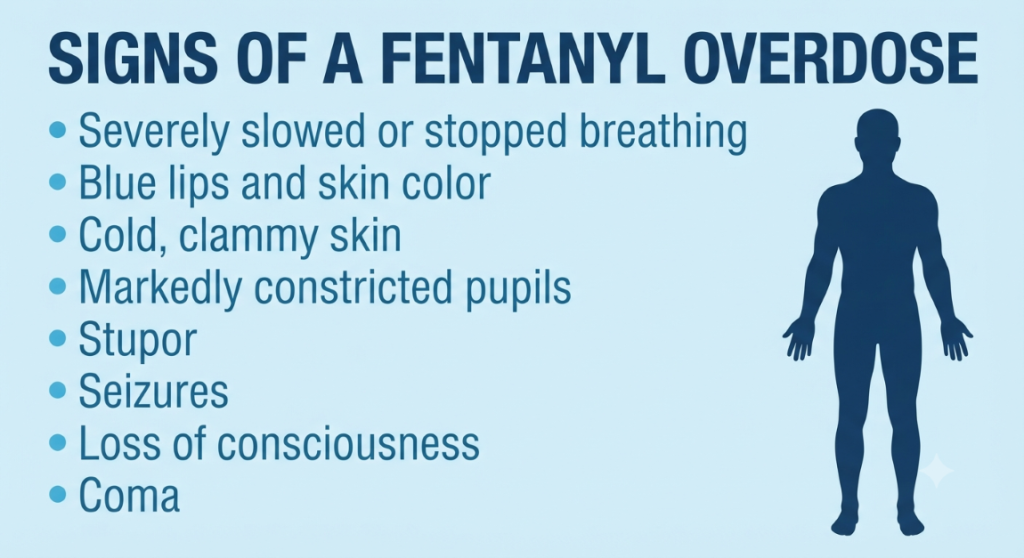
The clearest signs of a fentanyl overdose are slowed or stopped breathing, blue or gray lips and fingertips, and unresponsiveness.
Recognize this combination fast:
- Slow, shallow, or stopped breathing
- Choking or gurgling sounds
- Limp body
- Blue, gray, or pale skin, especially around the lips and fingertips
- Pinpoint pupils
- Unresponsiveness to voice or touch
- Cold, clammy skin
“Overdose deaths from opioids like fentanyl are largely driven by respiratory depression, meaning breathing slows or stops entirely.” (National Institute on Drug Abuse)
If someone cannot be woken up or is not breathing normally, treat it as an overdose immediately. Do not wait to see if it passes.
Ready to move from crisis to real recovery? Call DeLand Treatment Solutions to start a treatment plan built around your needs
Deland Treatment Solutions
Battling with Drug and Alcohol Addition? Remember, you are not alone and we are here to help you!
Overdose Risk of Fentanyl Compared to Other Opioids
Fentanyl carries a dramatically higher overdose risk than other opioids because of its extreme potency and how little of it the body can safely tolerate.
Opioid | Relative Potency | Overdose Risk Level |
Morphine | Baseline reference | Moderate |
Heroin | Roughly 2 to 5 times morphine | High |
Fentanyl | Roughly 50 to 100 times more morphine | Extremely high |
This potency gap explains why fentanyl contamination in other drugs has become so lethal. A person using cocaine or counterfeit pills often has no idea fentanyl is present, and no opioid tolerance to protect them.
“Even people with a high tolerance to other opioids can be caught off guard by the potency of fentanyl, particularly when it is present in a substance they did not expect to contain an opioid at all.” (Clinical toxicology literature)
Experts Advice: Stay for continued monitoring, since naloxone’s effects wear off quickly
Fentanyl Overdose Treatment in an Emergency
Naloxone is the primary treatment for a fentanyl overdose, working within two to three minutes to restore normal breathing when administered in time.
Emergency response typically includes:
- Naloxone administration, given as a nasal spray or injection
- Rescue breathing or CPR if breathing has stopped
- Continuous monitoring, since naloxone’s effects last only 30 to 90 minutes
- Repeat naloxone doses, since fentanyl often requires more than one dose to fully reverse
- Hospital observation for several hours after the overdose, even if the person seems recovered
“Naloxone can restore normal breathing within two to three minutes in a person whose breathing has slowed or stopped due to an opioid overdose.” (CDC, Stop Overdose Program)
This is a critical point families often miss: naloxone wears off before fentanyl fully clears the body, which means symptoms can return even after someone appears to recover.
What To Do If You Suspect a Fentanyl Overdose
If you believe someone is overdosing on fentanyl, call 911 immediately and give naloxone right away if it is available.
While waiting for emergency responders:
- Administer naloxone as soon as you recognize the signs, do not wait
- Perform rescue breathing if the person is not breathing
- Turn them on their side once breathing resumes, to prevent choking
- Stay with them, since a second dose of naloxone may be needed within 3 to 5 minutes if there is no response
- Do not assume they are safe once they wake up, stay until emergency responders arrive
- Tell responders exactly what was taken and when, if you know
Naloxone will not harm someone if opioids are not actually involved, so it is always safer to use it than to hesitate.

Getting Help After a Fentanyl Overdose
Surviving a fentanyl overdose, or being the one who found your loved one in that moment, changes something. It makes the danger real in a way statistics never could. That moment can also be the start of something different.
At DeLand Treatment Solutions, our clinical team works with individuals and families navigating exactly this kind of crisis. Fentanyl’s involvement often means the road to safety requires more than willpower. It requires structured medical support.
Depending on your needs, our team may recommend the following:
- Fentanyl Addiction Treatment is built around the physical and psychological grip of synthetic opioids
- Medication-Assisted Treatment (MAT) to reduce cravings and support long-term stability
- Residential Treatment for 24-hour structured care during the earliest, most vulnerable phase of recovery
- Dual Diagnosis Program for co-occurring mental health conditions that often accompany opioid use
- Family Therapy to help loved ones process what happened and rebuild trust moving forward
Worried a loved one may be exposed to fentanyl unknowingly? DeLand Treatment Solutions can help you understand the risks and next steps.
FAQs
Q: How long does it take to overdose on fentanyl?
A fentanyl overdose can begin within seconds to a few minutes of exposure, depending on how the drug enters the body. Because fentanyl acts so rapidly, recognizing symptoms and calling emergency services immediately can be lifesaving and significantly improve the chances of survival.
Fentanyl is a synthetic opioid that is approximately 50 to 100 times more potent than morphine. Its extreme strength means even tiny amounts can suppress breathing and cause a fatal overdose, particularly in people without opioid tolerance or when unknowingly consumed.
Q: What are the most common fentanyl overdose side effects?
Common signs include slowed or stopped breathing, blue or gray lips and fingertips, pinpoint pupils, extreme drowsiness, a limp body, and inability to respond to voice or touch. These symptoms require immediate emergency medical attention to prevent permanent injury or death.
Q: Why is the overdose risk of fentanyl higher than that of other opioids?
Fentanyl is far more potent than many other opioids, leaving very little margin between a dose that produces effects and one that causes an overdose. Even tiny dosing errors or contamination of other drugs can quickly result in life-threatening respiratory depression.
Q: What is the fentanyl overdose treatment in an emergency?
Emergency treatment includes calling 911 immediately, administering naloxone, providing rescue breathing if necessary, and transporting the person to a hospital. Naloxone often begins restoring breathing within two to three minutes, but continued medical monitoring remains essential after reversal.
Q: How many doses of naloxone does a fentanyl overdose usually need?
Because fentanyl is highly potent, more than one dose of naloxone is often required. If there is little or no improvement after the first dose, another dose should be given every three to five minutes while waiting for emergency medical personnel.
Q: Can someone overdose on fentanyl without knowing they took it?
Yes. Illicit fentanyl is frequently mixed into counterfeit prescription pills, cocaine, methamphetamine, and other drugs without the user’s knowledge. This hidden contamination has become a major cause of accidental opioid overdoses across many communities in recent years.
Q: Does naloxone fully treat a fentanyl overdose?
No. Naloxone temporarily reverses the life-threatening effects of opioid overdose, but its action typically lasts only 30 to 90 minutes. Because fentanyl may remain active longer, symptoms can return, making emergency medical evaluation and observation necessary.
Q: What should you do if you suspect a fentanyl overdose?
Call 911 immediately, administer naloxone if available, begin rescue breathing if the person is not breathing normally, and remain with them until emergency responders arrive. Acting quickly can prevent brain injury, improve survival, and provide the best chance of recovery.
Q: Is it safe to give naloxone if you are not sure fentanyl is involved?
Yes. Naloxone is safe to administer when an opioid overdose is suspected, even if you are uncertain opioids are involved. It will not harm someone who has not taken opioids, making prompt administration the safest course of action in an emergency.
Q: What are the long-term risks after surviving a fentanyl overdose?
A fentanyl overdose can result in long-term complications, including brain injury from reduced oxygen, heart problems, and recurring overdose risk if opioid use continues. Medical follow-up and addiction treatment help reduce complications and support long-term recovery after stabilization.
Q: When should someone seek treatment after a fentanyl overdose?
Treatment should begin immediately after emergency medical stabilization. Entering a structured addiction treatment program helps address opioid use, reduce the risk of another overdose, manage withdrawal safely, and provide support for any co-occurring mental health conditions.
References
- CDC: Fentanyl Facts
- CDC: Lifesaving Naloxone
- National Institute on Drug Abuse: Naloxone DrugFacts
- National Institute on Drug Abuse: Fentanyl DrugFacts
- SAMHSA: Opioid Overdose Prevention Toolkit
- FDA: Naloxone Advisory
- Mayo Clinic: Opioid Use Disorder
- MedlinePlus: Fentanyl
- DeLand Treatment Solutions: Fentanyl Addiction Treatment
- DeLand Treatment Solutions: Medication-Assisted Treatment
This article is for informational purposes only and is not a substitute for professional medical advice. If you or a loved one needs support, DeLand Treatment Solutions is available to help. If you are experiencing a medical emergency, call 911 immediately.