
Quick Answer: When distress or impairment due to the incongruence of gender is great, it is a mental health diagnosis called gender dysphoria. However, being transgender is not a mental illness. The emphasis with modern diagnostic systems is not on the gender identity but on the distress.
If you have looked for an answer to the question “Is gender dysphoria a mental illness?” you might have gotten various responses. Part of the confusion can stem from a lack of understanding of the distinction between gender identity, gender incongruence, and gender dysphoria. Though they are connected words, they don’t imply the same factor.
According to the American Psychiatric Association (APA), “Transgender is NOT a psychiatric diagnosis. However, DSM-5-TR has the diagnosis of gender dysphoria, which is a diagnosis of clinically significant distress around the mismatch between a person’s experienced gender and the gender they were assigned at birth.
That distinction matters. “Transgender” does not necessarily imply that the individual has gender dysphoria. Meanwhile, those who are experiencing ongoing anguish with respect to gender should seek mental health assistance from a professional.
Key Takeaways
- Is Gender Dysphoria a Mental Illness? Gender dysphoria is a condition included in the diagnostic system of psychiatric condition classes (DSM-5-TR) when it meets certain criteria and is associated with distress and impairment.
- Transgenderism is not a psychological illness or psychiatric diagnosis.
- In 2013, the DSM-5 changed the name of “gender identity disorder” to “gender dysphoria.”
- The diagnosis is significant distress due to gender incongruence, not transgender per se.
- Gender incongruence is categorized outside the chapter of mental and behavioral disorders in ICD-11 from WHO.
- Gender dysphoria has many causes; there is no one correct cause or “root.”
- Gender dysphoria does not necessarily mean that a person needs to transition.
- Guided help by a mental health provider to deal with distress, anxiety, depression, relationship issues, and more.
What Is Gender Dysphoria?
Gender dysphoria is defined as a substantial sense of discomfort or distress from incongruence with one’s experienced or expressed gender on the other hand of what is typically associated with the sex one was assigned at birth. The distress can relate to the individual’s body, the role he or she should play, how he or she is being treated, or to how he or she is supposed to act in relation to expectations of the gender role.
According to the APA, there are different diagnostic criteria for children and adolescents/adults in the DSM-5-TR. The diagnosis for adolescents and adults is characterized by a significant mismatch (discrepancy) that persists for at least six months and brings clinically significant distress or impairment.
Thus the terms gender dysphoria” and “transgender” are not the same thing.
For instance, a transgender individual may feel at ease and happy with him or herself and not be experiencing clinically significant distress. There is, first, the fact that in that case, the “transgender” is not the inevitable consequence of “GID” (gender identity disorder).
One of the most important topics in relation to the issue of the pathological nature or mental illness/malfunctioning of gender dysphoria is that of the brain. The focus of diagnosis is on distress and impairment, not on gender diversity being an illness.
100% Confidential Support is Available 24/7
No matter what you’re going through, you’re not alone. Our dedicated team is here to provide a safe, judgment-free space where you can talk openly and honestly. Whether you need emotional support, resources, or just someone to listen.
We’re here for you—completely confidential and always respectful of your privacy. Call us today!
Is Gender Dysphoria A Mental Illness?
Answer as specifically as possible, as depth of detail is good.
Being transgender does not constitute a mental illness; gender dysphoria is a psychiatric diagnosis in the DSM-5-TR.
But in the 2013 published entries in the DSM-5, the APA revised the name of the disorder, no longer using the term “gender identity disorder” and instead, in its place using the term “gender dysphoria.” This indicates a shift away from pathologizing gender identity as “disordered”, and ” towards a discussion of distress that some may feel.
As a result, in response to the question “Is gender dysphoria a mental illness?” it will be important that they explain the diagnosis.
However, a mental health diagnosis does not indicate that someone or their identity or personality is unhealthy. In this case, a diagnosis will be helpful to alert the clinician to consider the level of distress and what sort of support, if any, might be warranted.
The World Health Organization has also changed its classification. ICD-11 took gender incongruence out of the mental and behavioral disorders chapter and placed it in the sexual health chapter. This is due to the understanding now represented that transgender and gender-diverse identities are not considered to be a disease or illness, according to the WHO.
Deland Treatment Solutions
Battling with Drug and Alcohol Addition? Remember, you are not alone and we are here to help you!
Why Is Gender Dysphoria Diagnosed?
A diagnosis might be warranted if gender-related distress is severe enough to interfere with aspects of daily functioning.
The following might happen to a person:
- Ongoing sadness or upset about being the sex or body type the parents had wanted.
- Very strong desire for any other primary or secondary sex traits
- A strong desire to live as another gender
- A wish to be like another gender
- Describe concerns relating to the incongruence of their long-term gender and conventional sex
- Work, school, relationship or home difficulties related to distress
Not all people who have one of these experiences experience gender dysphoria. A licensed mental health professional considers the person’s experiences overall, how long the symptoms have persisted, how distressing they are to the person, and how they interfere with functioning.
Is Gender Identity the Same as Gender Dysphoria?
No.
Gender identity is the feeling of being male or female. Gender incongruence is associated with distress and is called gender dysphoria.
The APA differentiates between these distinctions. It also states that gender identity is not synonymous with gender expression and sexual orientation. Not all people who dress a certain way or look a certain way, or have certain interests, or are a certain sexual orientation, have gender dysphoria.
This distinction can negate the unnecessary stigma and assumptions that all transgender and gender-diverse people must have a mental health disorder.
What Causes Gender Dysphoria?
No single “root” cause for gender dysphoria is known.
The issue of gender identity is a complex one that is brought on by various factors, such as biological, developmental, psychological, and social. Increased research is still underway to understand the role that various factors may play in the development of gender identity and experiences of gender incongruence.
It’s also crucial not to equate gender identity with causes of distress.
When one’s body doesn’t feel like their gender, it could evoke some unease. Having to deal with social rejection, discrimination, family conflicts, bullies, or fear of being judged can also cause a lot of emotional stress.
Therefore, a mental health worker will address the entire individual and not presume that a single explanation fits all.
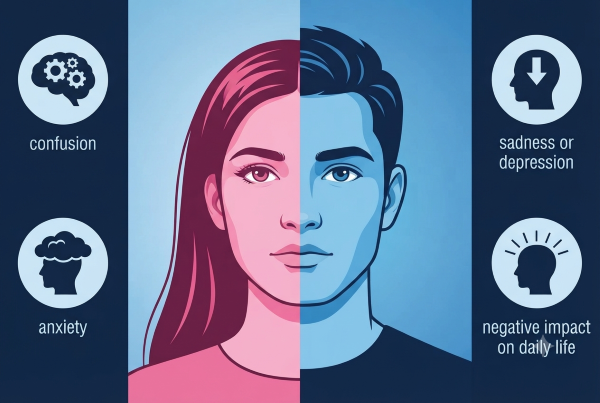
Is Gender Dysphoria Biological or Mental?
But it does not help to categorize gender dysphoria as simply “biological versus mental.”
Experiences of gender, gender identity, and gender is complex. Ongoing research is being conducted on the biological/developmental issues, but there isn’t any single biological test that can diagnose the issue of gender dysphoria.
Clinically, one is diagnosed with gender dysphoria based on his or her stated experiences, distress, and functioning. This places gender incongruence on the list of mental health disorders in the DSM-5-TR, as opposed to the ICD-11 being outside the chapter of mental and behavioral disorders.
That is, whether gender dysphoria is a mental disorder or a disease or illness depends, in part, on the classification system being referred to, as well as what is meant by “gender dysphoria.”
When Did Gender Dysphoria Stop Being Considered a Mental Illness?
There’s more of a history behind it than just one date.
In the U.S., DSM-5 phased out the term “gender identity disorder” in favor of “gender dysphoria” in 2013. The change was to focus on distress rather than the gender identity itself being the disorder.
WHO’s ICD-11 internationally removed the term ‘gender incongruence’ from its classification under mental and behavioral disorders to one under sexual health. In 2019, ICD-11 was adopted, and in 2022, it took effect around the world.
Hence, it can be misleading to say that “gender dysphoria ceased to be a mental disorder.” There are various diagnostic systems and different classifications.
Seeking help from DeLand Treatment Solutions provides essential guidance
Can Gender Dysphoria Affect Mental Health?
Yes. Anxiety, depression, social isolation, low self-esteem, or other emotional issues may accompany gender dysphoria, especially if it is distressing and if a person is not supported.
But mental health challenges can by no means be blamed on a person’s gender identity.
Outside factors can make a difference. Emotional distress could be increased as a result of rejection, discrimination, bullying, family conflicts, and social isolation. Being supported and respectful toward the person can assist them in examining their emotions and addressing mental health issues non-judgmentally.
The therapist is not the person to tell someone who he or she should be. Instead, therapy can provide a place where one can discuss distress, identity, relationships, anxiety, depression, coping skills, and personal decisions.
Does Treatment Mean Transitioning?
Not necessarily.
The treatment plan for someone who feels that they have gender dysphoria is not the same for every person. Some seek social change, some think in medical terms, and some opt to be counseled, or otherwise supported, without transition.
Gender affirmation can manifest in several ways, “social, legal, medical, and/or surgical,” and not everyone will want all of the above, according to the APA.
Thus, the treatment for mental health should be personalized. There is no one solution that fits all, as each and every one of the person’s desires, objectives, emotional health and wellness, support systems, and tastes are different.

When to Consider Mental Health Support
Those who are distressed about their gender, and this distress is interfering with life or relationships at school, work, sleep, and/or emotional health, are encouraged to speak with a trained mental health professional about their concerns.
They can also help if there’s an assumption that they might be suffering from anxiety or depression, isolation and shame, family issues, or significant life changes.
The distress doesn’t have to escalate to crisis proportions.
However, if you or someone you care for has gender-related distress or a mental health issue, DeLand Treatment Solutions will be a nonjudgmental environment where you can and should discuss what’s going on.
Contact DeLand Treatment Solutions to find out about mental health resources and help move your family toward emotional health.
Final Thought:
The question of whether transsexuality, what is often called gender dysphoria, is a mental illness is not so simply answered. This is recognized as a psychiatric disorder (gender dysphoria) when distress or impairment is present, but being transgender is not a mental disorder. Knowing the difference can help more easily access proper, respectful mental health support, if necessary.
Frequently Asked Questions
When did gender dysphoria stop being considered a mental illness?
DSM-5 replaced gender identity disorder with gender dysphoria in 2013, shifting the focus toward clinically significant distress. WHO later moved gender incongruence outside its mental and behavioral disorders chapter in ICD-11.
What is the root of gender dysphoria?
There is no single established root cause of gender dysphoria. Gender identity and related experiences are complex, and research continues to examine biological, developmental, psychological, and social influences.
Is gender dysphoria biological or mental?
Gender dysphoria is a mental health diagnosis in the DSM-5-TR because it involves clinically significant distress. However, gender identity itself is not considered a mental illness, and there is no single biological test for gender dysphoria.
What category does gender dysphoria fall under?
In the DSM-5-TR, gender dysphoria is a psychiatric diagnostic category. In WHO’s ICD-11, gender incongruence is classified under conditions related to sexual health rather than mental and behavioral disorders.
What do psychiatrists say about gender dysphoria?
The American Psychiatric Association distinguishes transgender identity from gender dysphoria. Its position is that gender dysphoria describes clinically significant distress related to gender incongruence, while transgender identity itself is not a psychiatric diagnosis.
Does gender dysphoria ever go away?
Gender-related distress can change over time, and experiences vary considerably between people. Some individuals experience less distress after social, psychological, medical, or other changes, while others continue to experience dysphoria and may benefit from ongoing support.
At what age is gender dysphoria most common?
There is no single age at which gender dysphoria is universally most common. It may become noticeable during childhood, adolescence, or adulthood. Some people do not experience significant gender-related distress until puberty or much later.
Can you cure gender dysphoria without transitioning?
There is no single “cure” for gender dysphoria, and not everyone wants to transition. Mental health counseling can help people understand their feelings, manage distress, address anxiety or depression, and make personal decisions based on their individual needs.
Which gender has more gender dysphoria?
There is no simple answer showing that one gender universally has more gender dysphoria. Reported rates vary depending on the population studied, diagnostic definitions, age, access to care, and how gender-related experiences are measured.
Disclaimer
This article is intended for general educational purposes and should not be considered a diagnosis, medical advice, or a substitute for evaluation by a qualified mental health or medical professional. Gender identity and gender-related distress can be deeply personal. Anyone experiencing significant distress should speak with an appropriately qualified healthcare professional for individualized guidance.
References and Content Sources
- American Psychiatric Association (APA): What Is Gender Dysphoria? The APA explains the DSM-5-TR diagnosis, the distinction between transgender identity and gender dysphoria, and different forms of gender affirmation.
American Psychiatric Association: What Is Gender Dysphoria? - World Health Organization (WHO): Gender Incongruence and Transgender Health in the ICD. WHO explains the ICD-11 classification of gender incongruence and its movement outside the mental and behavioral disorders chapter.
World Health Organization: Gender Incongruence and Transgender Health - American Psychiatric Association: Gender Dysphoria Diagnosis. This resource provides historical context on the change from gender identity disorder to gender dysphoria in DSM-5.