Quick Answer: What is metacognitive therapy (MCT)? Psychotherapy that teaches to react (and not to control or remove thoughts) is typically structured or metacognitive therapy (MCT). It is frequently employed in the therapy of anxiety and depression, OCD, and other mental wellness disorders to help diminish dysfunctional ideas such as worry and rumination.
You may have heard the term “metacognitive therapy” and wondered, “What is metacognitive therapy?” You’re not alone. If stressful situations do occur, many people feel as if their mind wouldn’t shut down because they are having “racing thoughts” or are very worried or replaying the situation.
Metacognitive therapy (MCT) is not the same kind of therapy as a typical talk therapy. Rather than attempting to alter your thoughts, it’s about attempting to alter your response to thoughts. Making this shift can help to reduce anxiety and depression, psychological distress and improve psychological health.
At DeLand Treatment Solutions, we understand that an effective treatment regimen should enable patients to take charge of their lives with real lasting change. Metacognitive therapy may help you decide whether or not this type of therapy is right for you or someone you love.
Key Takeaways
- Metacognitive therapy (MCT) is a therapy that does NOT change thoughts; it is in therapy.
- Good for reducing overthinking, negative thoughts, and rumination.
- In the past, MCT was frequently prescribed for disorders such as anxiety, depression, OCD, PTSD and stress-related disorders.
- Sessions focus on practical skills which help to change unhelpful thoughts.
- Several studies indicate that MCT can help alleviate symptoms and aid in the prevention of relapses in many people.
- Professional guidance is given to enable the safe and effective application of the techniques.
What is Metacognitive Therapy?
Metacognitive therapy (MCT) is a research-validated psychological therapy program that particularly targets responses to one’s thinking style. With MCT, you are not asked “is this idea true or false?” but rather another question:
100% Confidential Support is Available 24/7
No matter what you’re going through, you’re not alone. Our dedicated team is here to provide a safe, judgment-free space where you can talk openly and honestly. Whether you need emotional support, resources, or just someone to listen.
We’re here for you—completely confidential and always respectful of your privacy. Call us today!
How Does Metacognitive Therapy Work?
For example, a worried person can be caught ruminating on “what if I’m going to get what I’m worrying about?” for hours on end. Metacognitive therapy teaches them to pay attention to the thought, let it pass and not give the worry more worry.
The objective of this is to disrupt the string:
- Constant worrying
- Rumination
- Threat monitoring
- Reassurance seeking
- Overthinking
These coping behaviors, or “triggers,” maintain anxiety and depression.
But do you ask: How Does Metacognitive Therapy Work?
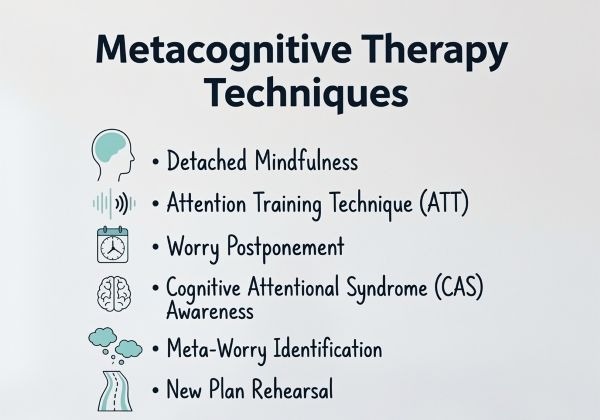
Metacognitive therapy assumes that there is a pattern known as the Cognitive Attentional Syndrome (CAS), which maintains emotional distress.
CAS includes:
- Excessive worry
- Repetitive negative thinking
- The capacity to monitor for hazards continually
- Avoidance behaviors
- Unhelpful coping strategies
Instead of analyzing each thought, therapists can assist clients to:
- Recognize thinking habits
- Ask yourself why you worry. Ask and challenge your worrying thoughts.
- Practice flexible attention
- Don’t engage your intrusive thoughts and limit the time you spend with them
The brain eventually comes to understand that thoughts don’t always need actions.
Deland Treatment Solutions
Battling with Drug and Alcohol Addition? Remember, you are not alone and we are here to help you!
What Conditions Can Metacognitive Therapy Treat?
There are several studies with positive results on the use of this approach for different kinds of mental health.
These include:
- Generalized Anxiety Disorder (GAD)
- Depression
- Obsessive-Compulsive Disorder (OCD)
- Social Anxiety Disorder
- Health Anxiety
- Panic Disorder
- Post-Traumatic Stress disorder (PTSD)
- Chronic stress
Also in high demand is the metacognitive therapy for anxiety and depression.
The answer is yes. Thus, unlike other traditional extinction/reduction approaches to worry and rumination in anxiety and depression, the focus in metacognitive therapy (MCT) is on the reduction of worry and rumination, per se. This can often help people to reduce overthinking behaviors.
How Is Metacognitive Therapy Different from Traditional CBT?
Although both treatments are evidence-based, they work differently.
Cognitive Behavioral Therapy (CBT) | Metacognitive Therapy (MCT) |
Challenges the accuracy of thoughts | Changes your response to thoughts |
Examines evidence for beliefs | Reduces engagement with thinking |
Focuses on thought content | Focuses on thinking processes |
Often uses cognitive restructuring | Uses attention training and detached mindfulness |
Both approaches can be highly effective, and your therapist can recommend the best fit based on your symptoms and goals.
Common Techniques Used in Metacognitive Therapy
Some “hands-on” activities are available for therapists to use.
Detached Mindfulness
An awareness of thoughts, without responding to thoughts.
Do not react to a thought; let it pass.
This is a technique referred to as: Attention Training Technique (ATT).
This will familiarize you with conscious skills for shifting mental focus and will enhance your ability to do so.
You don’t get stuck in your mind; you can learn to shift, concentrate, and focus your mind on the present.
Worry Debriefing
Many people believe:
- If bad things happen to me, I don’t want them do, so if I worry about them enough, I can prevent them!
- I can’t control my thoughts; there’s no way to manage my thoughts.
Having MCT permits us to explore if such beliefs can help or not.
Reducing Rumination
Rumination—thinking about past mistakes.
Therapists can help the client determine where this starts to happen and interact with it in more positive ways.
Benefits of Metacognitive Therapy
Losing weight can have many favorable effects noticed by people after the treatment.
Benefits may include:
- Less anxiety
- Reduced depression symptoms
- Better emotional regulation
- Improved concentration
- Better sleep
- Less overthinking
- Greater confidence
- Better standard of living
Some enjoy the fact that MCT, in some cases, can be administered for a fairly short time frame when compared to some other therapies.
Is Metacognitive Therapy Right for Everyone?
MCT can be very beneficial, but it isn’t necessarily the best thing for every case.
A licensed mental health practitioner will take into account the following:
- Your diagnosis
- Current symptoms
- Medical history
- Treatment goals
- Previous therapy experiences
Sometimes MCT can be combined with medication and/or evidence-based therapies for best results.
Start Your Mental Health Journey with DeLand Treatment Solutions
Refuse to let constant problems, worries, depression, or rumination control your life.
The mental health experts here at DeLand Treatment Solutions, who customize treatment plans for our patients, can provide you with personalized and evidence-based therapies that may be able to help with the process of healing and helping you to take control of your emotional well-being again. If anxiety, depression, or mental health problems are a challenge for you, we can help you get over them.
If you or a loved one is suffering from an addiction or substance abuse disorder, give DeLand Treatment Solutions a call to address your concerns or schedule an evaluation appointment.
What to Expect During a Metacognitive Therapy Session
Your therapist will first become aware of how you’re impacting the emotional habits in your ‘mindset.’
Sessions often include:
- Identifying worry triggers
- Learning attention exercises
- Practicing detached mindfulness
- Reducing repetitive thinking
- Learning to build up positive coping strategies
These skills will be practiced/reinforced at home between sessions.
Does Research Support Metacognitive Therapy?
Yes. Multiple clinical trials indicate that the treatment of metacognitive therapy can have a substantial impact in decreasing anxiety and depression symptoms. Although it is currently being investigated in other forms of mental illness, it has shown much promise.
MCT is now a well-recognized and accepted evidence-based therapeutic intervention, and while not effective for all, this therapy can be beneficial for some.

When Should You Seek Professional Help?
If any of the following occurs, then you may consider contacting them:
- Constant worrying
- Impaired functioning related to anxiety
- Depression that goes on for more than 2 weeks.
- Trouble falling asleep and/or racing thoughts.
- Difficulty concentrating
- Fear of situations is passed on and avoidance of situations
- Impairment in functioning related to emotional distress.
Take the First Step Toward Better Mental Health
Taking that first step towards a better future for mental health for the whole family can begin with the first step in the right direction.
Metacognitive therapy, reworded, is the first step towards discovering a therapy that will work for you. If thoughts of worry, anxiety, depression or obsessions are crippling your life, professional help can make all the difference.
DeLand Treatment Solutions will supply individuals with a kind and evidence-based treatment plan and support to learn healthy thinking patterns.
Contact College Station Group today for a confidential consultation and begin the process towards emotional wellness for good!
Frequently Asked Questions
What is an example of metacognitive therapy?
A therapist may ask you to notice an anxious thought without analyzing it or reacting to it. Instead of engaging with the thought, you practice letting it pass while redirecting your attention to the present moment.
What is the difference between CBT and metacognitive therapy?
CBT focuses on changing the content of thoughts by examining evidence. Metacognitive therapy focuses on changing how you respond to thoughts, reducing worry, rumination, and repetitive thinking rather than challenging every belief.
Is metacognitive therapy legit?
Yes. Metacognitive therapy is supported by growing scientific research and has shown positive outcomes for anxiety, depression, OCD, and other mental health conditions when provided by qualified mental health professionals.
What is the difference between ACT and metacognitive therapy?
Acceptance and Commitment Therapy (ACT) encourages accepting thoughts while living according to personal values. Metacognitive therapy focuses more specifically on reducing unhelpful thinking habits and changing beliefs about worry and rumination.
Is metacognition related to high IQ?
Not necessarily. Metacognition refers to awareness and management of your thinking processes. While it can improve learning and problem-solving, people of all intelligence levels can develop strong metacognitive skills.
Is metacognition a symptom of ADHD?
No. Metacognition itself is not a symptom of ADHD. However, many people with ADHD experience challenges with planning, self-monitoring, attention, and organization, which are important aspects of metacognitive functioning.
What are the symptoms of bad metacognition?
Poor metacognitive skills may include excessive worrying, overthinking, rumination, difficulty shifting attention, impulsive reactions to thoughts, constant reassurance seeking, and believing every thought must be analyzed or acted upon.
Is MCT better than CBT?
Neither therapy is universally better. Some people respond well to CBT, while others benefit more from metacognitive therapy. A qualified therapist can recommend the most appropriate approach based on your individual needs.
How to practice metacognitive therapy?
Practice noticing your thoughts without reacting, reduce unnecessary worrying, redirect attention to the present, avoid repetitive rumination, and work with a trained therapist to learn evidence-based metacognitive techniques safely and effectively.
Disclaimer
This article is intended for educational purposes only and should not be considered medical or mental health advice. It is not a substitute for diagnosis, treatment, or recommendations from a licensed healthcare provider. If you are experiencing symptoms of anxiety, depression, or another mental health condition, seek guidance from a qualified mental health professional or contact DeLand Treatment Solutions for a confidential assessment.
References
- GoodRx. Metacognitive Therapy: Techniques, Benefits, and How It Works. https://www.goodrx.com/health-topic/mental-health/metacognitive-therapy-strategies
- American Psychological Association (APA). https://www.apa.org
- National Institute of Mental Health (NIMH). https://www.nimh.nih.gov