Key Takeaways
- Bipolar I involves full manic episodes, while Bipolar II involves hypomania and depression
- Mania is more intense and disruptive in Bipolar I
- Bipolar II is often misunderstood and underdiagnosed
- Both conditions are serious but highly treatable
- The right diagnosis leads to better outcomes and stability
Bipolar 1 vs. Bipolar 2: Understanding Mania is one of the most popular queries that individuals have when they are determined to make sense of mood swings, extreme energy swings or even a new diagnosis. Although they both are variations of bipolar disorder, the manifestation of mania is different, and these differences are important to treatment, safety and long-term stability.
In this manual, we shall deconstruct Bipolar 1 vs. Bipolar 2 in simplified language. Imagine it is a down-to-earth yet truthful discussion, no lingo, no buttered bread act-y thing, just plain understandable explanations you can rely on. At DeLand Treatment Solutions, we feel that the initial step to actual lasting help is to understand.
Bipolar I vs. Bipolar II
In the comparison of Bipolar 1 vs. Bipolar 2, the difference between the two has been narrowed down to the intensity of the mania. Both disorders include brief changes in high mood to low mood and the difference between the two diagnoses lies in the severity in level of high moods.
Bipolar I can be characterized by at least one episode of mania which significantly interferes with daily functioning. Bipolar II incorporates hypomania, which is a milder manifestation of mania along with major depressive episodes, which may be long-term and disabling.
What is Bipolar I Disorder?
Bipolar I disorder is distinguished by complete mania. The manic episode should last at least seven days (or have to be hospitalized) and it could include a great extent of energy, minimal sleep needs, impulsivity, and rapid thoughts.
In mania the individual might develop the feeling that he/she is unstoppable and invincible, this can easily degenerate into a dangerous condition. There can be poor judgment, risky decisions and even psychosis. In the Bipolar 1 vs. Bipolar 2 comparison aspect, the determining element is this intensity.
Take control of bipolar disorder today with compassionate care at DeLand Treatment Solutions—call now.
What is Bipolar II Disorder?
Bipolar II disorder involves minor episodes of hypomania that are not as severe as full-blown mania, and major depressive episodes. Hypomania can be productive or energizing but it does not normally impair severely or necessitate hospitalization.
The depressive episodes of Bipolar II are however more profound and protracted. Within most Bipolar 1 vs. Bipolar 2 discourses, Bipolar II is erroneously considered to be not as severe, when its effects on normal functioning may be equally dramatic.
Bipolar 1 and Bipolar 2 Differences
Bipolar 1 vs. Bipolar 2 The key difference between the two is reflected on the extremity of heights. Bipolar I also has complete mania whereas Bipolar II does not. This difference has a direct impact on the diagnosis, a plan of treatment, and risk management.
The other notable contrast is recognition. Bipolar II may be confused with unipolar depression due to the weakness of the signs of hypomania or the positive feeling at first.
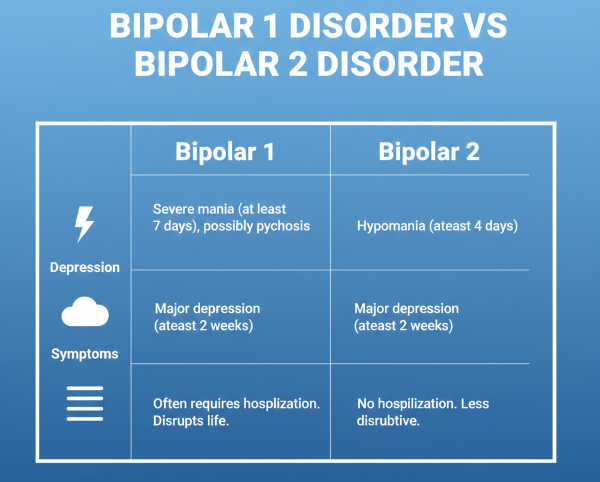
Bipolar 1 vs. Bipolar 2 Chart
Bipolar 1 and Bipolar 2 can be well explained in comparison:
Mania: Bipolar I – full mania, Bipolar II – hypomania.
Depression: Both have it, but Bipolar II commonly has a worse variety of depression.
Hospitalization: It is more prevalent in Bipolar I.
Psychosis: Bipolar I – possible, Bipolar II – rare.
Difficulties with diagnosis: Bipolar II is more frequently misdiagnosed.
Bipolar 1 vs. Bipolar 2 Symptoms
The symptoms are similar but the intensity is a point in Bipolar 1 as opposed to Bipolar 2.
Bipolar I symptoms may include:
- Extreme energy and euphoria
- Little or no need for sleep
- Narcissism or total confidence.
- Hazardous acts and lack of judgment.
- Bipolar II symptoms may include:
- High mood and fully in control.
- Efficacy or active capacity.
- Long entrapment of unhappiness.
- Infuriating and not rapturous rapturousness.
What Causes Bipolar 1 and 2?
In both diagnoses, the causes of bipolar disorders are similar. Positively acting has a great influence on the brain chemistry, and the changes in the genetic make-up affect the regulation of the mood. Episodes may be triggered by stress, trauma, substance use and non-tolerated changes in life.
The causes are ones alike in Bipolar 1 vs. Bipolar 2- Difference in expression and intensity of the symptoms is present.
Find stability and hope with expert bipolar disorder treatment at DeLand Treatment Solutions today
Bipolar 1 vs. Bipolar 2: Which is Worse?
It is a tedious and yet arduous question. There is no condition considered to be worse in Bipolar 1 vs. Bipolar 2, they are distinct. Bipolar I is more dangerous in the exacerbation of manic and Bipolar II usually deals with prolonged and more disabling depression.
The severity varies, and it is dependent on the person, accessibility of care, support mechanisms as well as the timing of treatment initiation.
Bipolar 1 and Bipolar 2 Treatment
The combination of mood stabilizers, psychotherapy, and lifestyle support is generally used as the form of treatment for Bipolar 1 vs. Bipolar 2. The conditions of Bipolar I tend to need more mood stabilization to avoid the manic episode, whereas the treatment of Bipolar II is more oriented at the prevention of the moods cycling and the full management of the depression.
The treatment approaches of DeLand Treatment Solutions are individual and they are shaped on the evidence and directed to long-term balance, not just to smother symptoms.

When to Seek Help
When you have been having mood swings that have been causing havoc in your work, relations as well as even sleep or even safety then it takes professional guidance. Critical events may be prevented due to the early support and have a great impact on the quality of life.
Call DeLand Treatment Solutions and talk to one of its mental health professionals to find out about the disorders that pertain to bipolar and how to get yourself a different cloud to change and provide you with steady legs, as well as demonstrate that you can breathe clean air and possess hope in life.
In case you or the people close to you are having troubles, then DeLand Treatment Solutions can offer your assistance. Call now and make the initial step to know, balance and recovery.
Disclaimer
This content is for educational purposes only and is not intended to replace professional medical advice, diagnosis, or treatment. Always seek the guidance of a qualified mental health professional regarding any mental health concerns.
Frequently Asked Questions
Which is more serious, bipolar 1 or 2?
Both conditions are serious in different ways. Bipolar I involves more severe mania that can be dangerous, while Bipolar II often includes longer, deeper depressive episodes. The impact depends on symptom severity, treatment access, and individual circumstances.
How to tell if you are bipolar 1 or 2?
Only a mental health professional can make an accurate diagnosis. The key factor is whether you’ve experienced full mania (Bipolar I) or hypomania with depression (Bipolar II). A detailed clinical assessment is essential.
What to avoid if you’re bipolar?
People with bipolar disorder should avoid sleep deprivation, substance use, and sudden medication changes. High stress and irregular routines can also trigger mood episodes. Consistency and professional guidance are crucial for stability.
Is bipolar 1 or 2 harder to live with?
It varies by person. Bipolar I can be harder during manic episodes, while Bipolar II can feel harder due to persistent depression. Both conditions require ongoing management and support.
How does mania differ in bipolar 1 & 2?
In Bipolar I, mania is intense, disruptive, and may require hospitalization. In Bipolar II, hypomania is milder, shorter, and doesn’t cause severe impairment, though it still affects mood and behavior.
How to remember the difference between bipolar 1 and 2?
Think of Bipolar I as having “one” extreme—full mania. Bipolar II has “two” major states: hypomania and depression, but no full manic episodes.
What does mania look like in bipolar 1?
Mania in Bipolar I often includes extreme energy, little need for sleep, racing thoughts, impulsive decisions, and sometimes psychosis. It significantly disrupts daily life and can be dangerous without treatment.
What is the distinguishing factor between bipolar 1 and bipolar 2 disorder?
The distinguishing factor is mania. Bipolar I includes full manic episodes, while Bipolar II includes hypomania and major depression without full mania.